• Home
  • Events Calendar
  • Blueprint Guidelines
  • Privacy Policy
  • Subscribe to Daily Newsletter
  • NextGenInfra.io
No Result
View All Result
Converge Digest
Thursday, April 16, 2026
  • Home
  • Events Calendar
  • Blueprint Guidelines
  • Privacy Policy
  • Subscribe to Daily Newsletter
  • NextGenInfra.io
No Result
View All Result
Converge Digest
No Result
View All Result

Home » Intel’s “Knight’s Landing” Xeon Phi Coproccesors to Use 14nm

Intel’s “Knight’s Landing” Xeon Phi Coproccesors to Use 14nm

June 17, 2013
in All
A A

Intel’s new Xeon Phi coprocessors are powering the world’s fastest computer — “Milky Way 2,” built for China’s National Supercomputing Center in Guangzhou.  At the International Supercomputing Conference in Leipzig, Germany, Intel revealed that 48,000 Intel Xeon Phi coprocessors and 32,000 Intel Xeon processors were used to create Milky Way 2, which delivers a peak performance of 54.9 PFlops (54.9 quadrillion floating point operations per second) — more than twice the performance of the top rated system from the last edition of the Top500 list in November 2012.

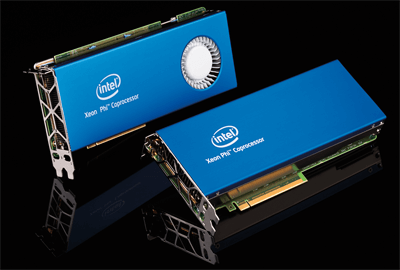
Intel also announced five new Xeon Phi coprocessors:  the Intel Xeon Phi coprocessor 7100 family is designed and optimized to provide the best performance and offer the highest level of features, including 61 cores clocked at 1.23GHz, 16 GB of memory capacity support (double the amount previously available in accelerators or coprocessors) and over 1.2 TFlops of double precision performance. The Intel Xeon Phi coprocessor 3100 family is designed for high performance per dollar value. The family features 57 cores clocked at 1.1 GHz and 1TFlops of double precision performance. The Intel Xeon Phi coprocessor 5100 family is optimized for high-density environments with the ability to allow sockets to attach directly to a mini-board for use in blade form factors.

Looking further ahead, the second generation Intel Xeon Phi coprocessors, codenamed “Knights Landing,” will be manufactured using Intel’s 14nm process technology featuring second generation 3-D tri-gate transistors.  It will be available either on a PCIe card or a host processor (CPU). As a PCIe card-based coprocessor, “Knights Landing” will handle offload workloads from the system’s Intel Xeon processors and provide an upgrade path for users of current generation of coprocessors.  As a host processor directly installed in the motherboard socket, it will function as a CPU and enable the next leap in compute density and performance per watt, handling all the duties of the primary processor and the specialized coprocessor at the same time.

http://www.intel.com

Tags: Blueprint columnsChinaIntelSilicon
ShareTweetShare
Previous Post

Infinera: One Billion Hours without Failure

Next Post

NTT to Acquire Solutionary for Managed Security Services

Staff

Staff

Related Posts

Intel Q3 2025: AI Partnerships, Foundry Momentum, and U.S. Backing 
All

Intel Q3 2025: AI Partnerships, Foundry Momentum, and U.S. Backing 

October 23, 2025
FCC issues 2.5 GHz licenses from Auction 108
Clouds and Carriers

FCC Moves to Expel Hong Kong Telecom from U.S.

October 20, 2025
Intel Ramps 18A Production at Fab 52
Semiconductors

Intel Ramps 18A Production at Fab 52

October 9, 2025
Intel Foundry Services forms USMAG Alliance
Semiconductors

NVIDIA and Intel Forge $5B Partnership to Build Data Center and PC Chips

September 18, 2025
Intel’s Q3 data center revenue dropped 27% yoy
Financials

Intel Names New Data Center, Client, and Foundry Leaders

September 8, 2025
Intel cites progress with U.S. fabs
Semiconductors

U.S. Takes 9.9% Stake in Intel with $8.9B Equity Investment

August 22, 2025
Next Post
NTT to Acquire Solutionary for Managed Security Services

NTT to Acquire Solutionary for Managed Security Services

Please login to join discussion

Categories

  • 5G / 6G / Wi-Fi
  • AI Infrastructure
  • All
  • Automotive Networking
  • Blueprints
  • Clouds and Carriers
  • Data Centers
  • Enterprise
  • Explainer
  • Feature
  • Financials
  • Last Mile / Middle Mile
  • Legal / Regulatory
  • Optical
  • Quantum
  • Research
  • Security
  • Semiconductors
  • Space
  • Start-ups
  • Subsea
  • Sustainability
  • Video
  • Webinars

Archives

Tags

5G All AT&T Australia AWS Blueprint columns BroadbandWireless Broadcom China Ciena Cisco Data Centers Dell'Oro Ericsson FCC Financial Financials Huawei Infinera Intel Japan Juniper Last Mile Last Mille LTE Mergers and Acquisitions Mobile NFV Nokia Optical Packet Systems PacketVoice People Regulatory Satellite SDN Service Providers Silicon Silicon Valley StandardsWatch Storage TTP UK Verizon Wi-Fi
Converge Digest

A private dossier for networking and telecoms

Follow Us

  • Home
  • Events Calendar
  • Blueprint Guidelines
  • Privacy Policy
  • Subscribe to Daily Newsletter
  • NextGenInfra.io

© 2025 Converge Digest - A private dossier for networking and telecoms.

No Result
View All Result
  • Home
  • Events Calendar
  • Blueprint Guidelines
  • Privacy Policy
  • Subscribe to Daily Newsletter
  • NextGenInfra.io

© 2025 Converge Digest - A private dossier for networking and telecoms.

This website uses cookies. By continuing to use this website you are giving consent to cookies being used. Visit our Privacy and Cookie Policy.
Go to mobile version