• Home
  • Events Calendar
  • Blueprint Guidelines
  • Privacy Policy
  • Subscribe to Daily Newsletter
  • NextGenInfra.io
No Result
View All Result
Converge Digest
Saturday, April 11, 2026
  • Home
  • Events Calendar
  • Blueprint Guidelines
  • Privacy Policy
  • Subscribe to Daily Newsletter
  • NextGenInfra.io
No Result
View All Result
Converge Digest
No Result
View All Result

Home » Internet2 completes migration to its 5th gen optical backbone

Internet2 completes migration to its 5th gen optical backbone

January 19, 2022
in All
A A

Internet2, which serves 323 U.S. universities, 59 government agencies, 46 regional and state education networks, has migrated its research and education (R&E) network traffic to its fifth-generation backbone.

The new network’s optical layer now supports up to 32 terabits per segment with a new generation of transponders in increments of 400-800 Gbps. NGI’s new packet layer provides 8-16 petabits per second of port capacity per location. NGI delivers new software-driven advanced capabilities while also creating a greener footprint, with an expected 70 percent reduction in power consumption achieved through the latest hardware advancements.

“The technological advancements being enabled on the Internet2 network – together with software, tools, and security resources that have been developed in collaboration with community members – are providing next-generation capabilities that propel academic and research collaborations,” said Howard Pfeffer, Internet2 president and CEO. “A comprehensive upgrade of this scale allows us to support our community’s R&E infrastructure needs now and into the future – from K-12 students with connected devices, to faculty teaching classes and lab components, to scientists collaborating with colleagues all over the country and the world.” 

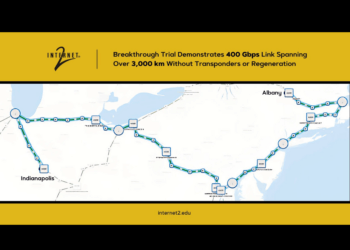
Internet2’s new infrastructure includes 12,000 miles of new single-mode ultra optical fiber across the U.S., along with power- and space-saving optical and routing equipment .

In 2021, Internet2 moved over two and three-quarters exabytes of data. 

Key vendors include Cisco, Ciena, Lumen, and General Datatech (GDT). 

“Ciena and Internet2 have a long history of success in building network architectures that fuel the next generation of scientific discovery,” said Steve Alexander, senior vice president and chief technology officer at Ciena. “Years ago, we teamed up with Internet2 to create America’s first 100G national research and education network and we look forward to supporting this next phase of their network evolution.”

“This initiative is a clear example of Cisco’s commitment to education and our focus on driving industry innovation,” added Renee Patton, Cisco’s global director of education and healthcare. “Our work with Internet2 is a model for the future of research and education globally. With innovative approaches such as this, we are working together to power inclusive exploration and learning for all.” 

“Lumen has been a key partner to Internet2 for years and provides the fiber backbone that powers their recent upgrade to Next Generation Infrastructure,” commented Sonia Ramsey, regional vice president of the Lumen state and local government and education market. “Internet2’s super high-speed network is built on the Lumen optical fiber and colocation infrastructure that quickly and securely connects important research and development groups and academic institutions in more than 40 cities. These ultra-fast connections are designed to increase scientific collaboration among diverse organizations across the U.S.”

https://internet2.edu/internet2-next-generation-infrastructure-operational-transition-to-fully-automated-400g-national-infrastructure-complete/

Tags: Blueprint columnsInternet2
ShareTweetShare
Previous Post

Juniper enhances its AI-driven SD-WAN capabilities

Next Post

Zain Kuwait picks Ericsson for 5G Standalone Charging

Staff

Staff

Related Posts

Internet2 Deploys 400G ZR+ for Long-Haul Optical Transport
Optical

Internet2 Deploys 400G ZR+ for Long-Haul Optical Transport

March 27, 2025
Blueprint: Brazil looks to municipal Wi-Fi 6E
Blueprints

Blueprint: Brazil looks to municipal Wi-Fi 6E

February 21, 2023
Blueprint: Building wholesale networks with OTN
All

Blueprint: Building wholesale networks with OTN

December 20, 2022
Oracle opens cloud region in Chicago
All

Oracle opens cloud region in Chicago

December 20, 2022
BT trials C-RAN in Leeds
All

BT trials C-RAN in Leeds

December 19, 2022
T-Mobile builds cloud native 5G converged core with Cisco
All

T-Mobile builds cloud native 5G converged core with Cisco

December 15, 2022
Next Post
Zain Kuwait picks Ericsson for 5G Standalone Charging

Zain Kuwait picks Ericsson for 5G Standalone Charging

Please login to join discussion

Categories

  • 5G / 6G / Wi-Fi
  • AI Infrastructure
  • All
  • Automotive Networking
  • Blueprints
  • Clouds and Carriers
  • Data Centers
  • Enterprise
  • Explainer
  • Feature
  • Financials
  • Last Mile / Middle Mile
  • Legal / Regulatory
  • Optical
  • Quantum
  • Research
  • Security
  • Semiconductors
  • Space
  • Start-ups
  • Subsea
  • Sustainability
  • Video
  • Webinars

Archives

Tags

5G All AT&T Australia AWS Blueprint columns BroadbandWireless Broadcom China Ciena Cisco Data Centers Dell'Oro Ericsson FCC Financial Financials Huawei Infinera Intel Japan Juniper Last Mile Last Mille LTE Mergers and Acquisitions Mobile NFV Nokia Optical Packet Systems PacketVoice People Regulatory Satellite SDN Service Providers Silicon Silicon Valley StandardsWatch Storage TTP UK Verizon Wi-Fi
Converge Digest

A private dossier for networking and telecoms

Follow Us

  • Home
  • Events Calendar
  • Blueprint Guidelines
  • Privacy Policy
  • Subscribe to Daily Newsletter
  • NextGenInfra.io

© 2025 Converge Digest - A private dossier for networking and telecoms.

No Result
View All Result
  • Home
  • Events Calendar
  • Blueprint Guidelines
  • Privacy Policy
  • Subscribe to Daily Newsletter
  • NextGenInfra.io

© 2025 Converge Digest - A private dossier for networking and telecoms.

This website uses cookies. By continuing to use this website you are giving consent to cookies being used. Visit our Privacy and Cookie Policy.
Go to mobile version