IonQ demonstrated a key milestone in quantum networking by successfully converting photons from visible wavelengths to telecom wavelengths, enabling compatibility between trapped-ion quantum systems and existing fiber optic infrastructure. The prototype demonstration, carried out with support from the U.S. Air Force Research Lab (AFRL), marks a step toward scalable quantum networks and the future Quantum Internet.
IonQ’s trapped barium ion systems operate using visible light, which is not well suited for long-haul transmission. The ability to convert those signals into telecom wavelengths unlocks efficient transmission over standard optical fiber, the backbone of today’s internet. IonQ said this breakthrough will soon allow it to connect two quantum computers over standard wavelengths, accelerating the possibility of distributed quantum computing and secure quantum communication.
The announcement comes shortly after IonQ delivered its first trapped-ion quantum computer with an integrated photonic interface to AFRL in Rome, New York. IonQ continues to expand its footprint with research and operations centers in Washington D.C., Seattle, Boston, Denver, San Francisco, Chattanooga, and Basel, Switzerland.
• Demonstrated frequency conversion from visible to telecom wavelengths for trapped-ion systems
• Enables compatibility with existing global fiber optic infrastructure
• Prototype developed with AFRL in Rome, New York
• Paves way for distributed quantum computing and secure quantum networks
• Follows IonQ’s delivery of photonic-enabled quantum computer to AFRL
“I am thrilled to announce that we have taken an important step towards enabling the Quantum Internet. Working closely with AFRL, we are the first quantum company to demonstrate the ability to convert visible signals to telecom wavelengths,” said Niccolo de Masi, Chairman and CEO of IonQ.
🌐 Analysis: IonQ’s work on wavelength conversion strengthens its position in the race toward scalable quantum networking, a field where companies like Quantinuum, PsiQuantum, and IBM are also pursuing different architectures. The AFRL partnership underscores U.S. government interest in securing quantum leadership while aligning with telecom providers’ long-term infrastructure strategies.
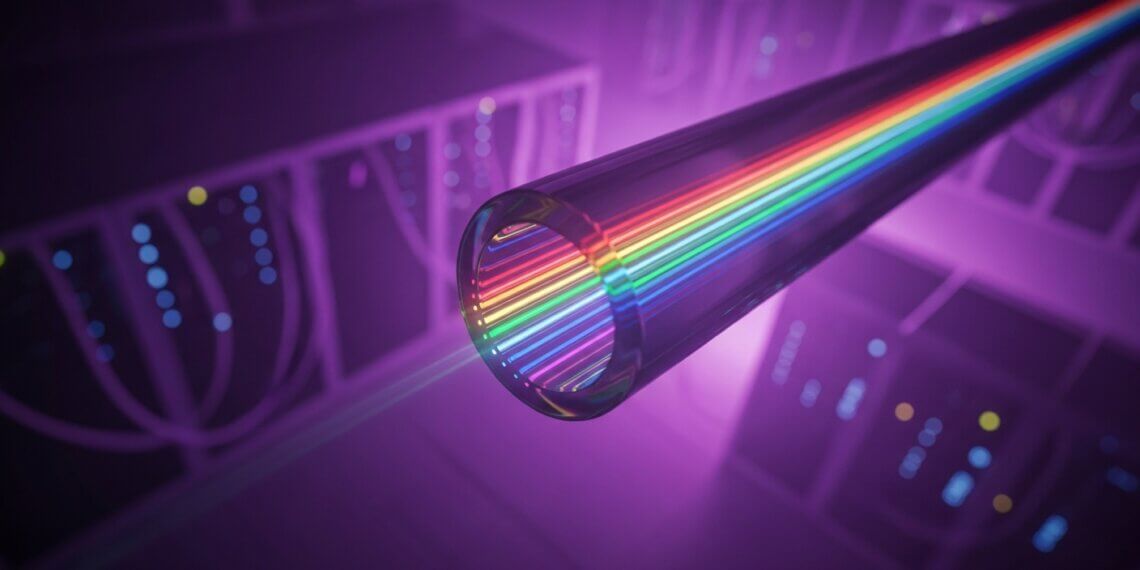
IonQ’s demonstration bridges the gap between quantum hardware that uses visible photons (around 493 nm and 650 nm in barium ion systems) and global telecom wavelengths (1260–1625 nm) optimized for fiber optic transmission. This breakthrough positions IonQ to move toward scalable, long-haul quantum links using existing infrastructure. Competitors such as Quantinuum, PsiQuantum, and IBM are exploring different interconnect strategies, but IonQ’s progress highlights the importance of wavelength conversion as a foundation for the Quantum Internet.
| Band | Wavelength Range (nm) | Use in Fiber Optics |
|---|---|---|
| O-band | 1260–1360 nm | Early systems, low dispersion |
| C-band | 1530–1565 nm | Most widely used; low loss, EDFAs |
| L-band | 1565–1625 nm | Extended reach; additional capacity |
🌐 We’re tracking the latest developments in quantum networking and computing. Follow our ongoing coverage at: https://convergedigest.com/category/quantum/