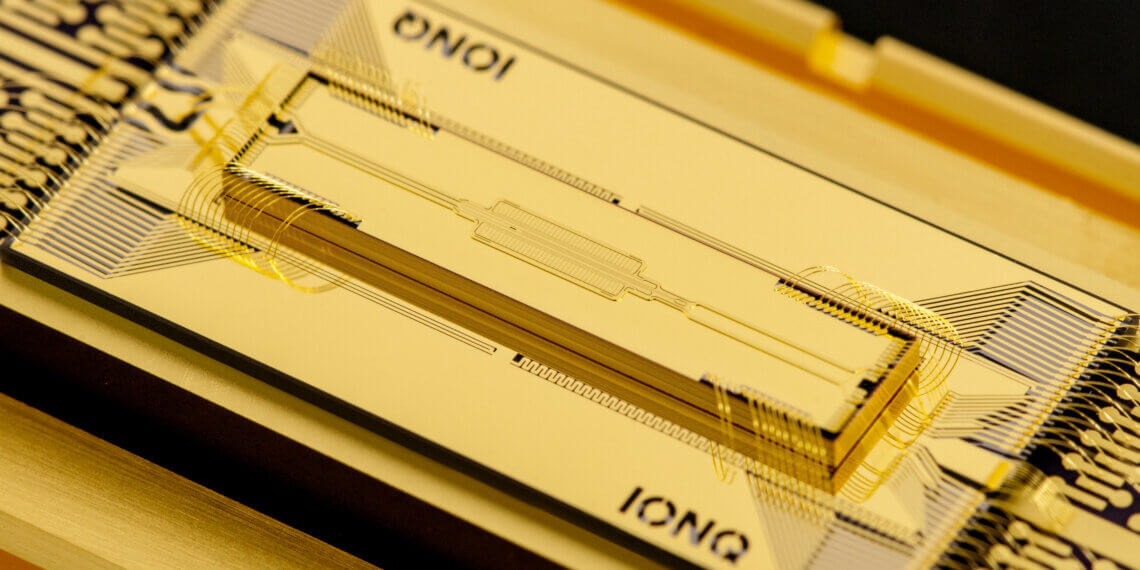
IonQ signed a memorandum of understanding (MOU) with the U.S. Department of Energy (DOE) to advance quantum technologies in space, including quantum-secure communications, networking, and sensing. The agreement supports the DOE’s Quantum in Space (QIS) initiative and establishes IonQ’s role in demonstrating ground-to-orbit-to-ground capabilities via its Capella Space platform. Initial efforts will focus on an orbital demonstration of quantum-secure networking.
The collaboration builds on IonQ’s recent acquisitions, including quantum networking firm Qubitekk (2024) and Capella Space (2025), and now expands to applications such as quantum position, navigation, and timing (PNT), time synchronization, sensing, and potentially quantum computing in orbit. “By working alongside the DOE, we aim to demonstrate the power of quantum computing and networking to enable new applications for secure communications,” said Niccolo de Masi, Chairman and CEO of IonQ. DOE executive Rima Kasia Oueid called the effort a step toward creating a “quantum sandbox in space” to accelerate commercialization.
Alongside the MOU, IonQ announced it will acquire Vector Atomic, a Pleasanton-based developer of advanced quantum sensing systems with over $200 million in U.S. government contracts. The all-stock deal brings Vector Atomic’s 76 employees and portfolio of optical atomic clocks, synchronization systems, and inertial sensors under IonQ, expanding its reach into PNT applications critical for defense and aerospace. IonQ also completed its acquisition of Oxford Ionics, a UK-based quantum computing company whose record-setting trapped-ion technology will accelerate IonQ’s roadmap toward fault-tolerant quantum systems.
• MOU with DOE supports the Quantum in Space (QIS) initiative, with IonQ demonstrating quantum-secure orbital networking
• Initial focus: quantum-secure communications via Capella Space platform; longer-term: PNT, sensing, time sync, and compute
• Acquisitions: Vector Atomic (quantum sensing, $200M+ contracts) and Oxford Ionics (trapped-ion architectures, UK expansion)
• IonQ now integrates quantum computing, networking, and sensing into a single full-stack platform
• Government and defense remain priority markets, alongside commercial cloud and pharma customers
“Integrating Vector Atomic’s sensing capabilities across our compute, networking, and space portfolios will advance our mission to provide scalable, commercial-grade quantum solutions for our customers today,” said de Masi.
🌐 Analysis: IonQ is positioning itself as the first company to unify quantum computing, networking, and sensing in a full-stack platform, giving it strategic weight in both commercial and defense markets. The DOE MOU underscores the U.S. government’s intent to accelerate space-based quantum infrastructure, while acquisitions of Vector Atomic and Oxford Ionics add critical sensing and high-fidelity compute assets. IonQ’s expansion mirrors moves by competitors like PsiQuantum, Quantinuum, and Atom Computing, but its aggressive M&A strategy differentiates it as the most diversified U.S.-based quantum provider.
IonQ acquired Capella Space in 2025 as part of its push into quantum networking and secure communications in space. apella Space is best known as a pioneer in synthetic aperture radar (SAR) satellites that provide high-resolution Earth observation images regardless of weather or daylight. Unlike optical imaging satellites, SAR can penetrate clouds, fog, smoke, and darkness, enabling 24/7 global monitoring. Capella’s satellites operate in the X-band and use advanced phased-array antennas and proprietary onboard processing for fast tasking and delivery. The acquisition:
- Provides IonQ with an operational satellite constellation capable of serving as testbeds for quantum-secure networking.
- Gives IonQ a platform to demonstrate ground-to-orbit-to-ground quantum communication, a key milestone in building the quantum internet.
- Extends IonQ’s portfolio beyond compute and terrestrial networking into space-based infrastructure, aligning with the DOE’s Quantum in Space (QIS) initiative.
- Enables integration of quantum key distribution (QKD) and quantum timing/synchronization experimentsonboard operational satellites.
🌐 We’re tracking the latest developments in quantum computing, networking, and sensing. Follow our ongoing coverage at: https://convergedigest.com/category/quantum/