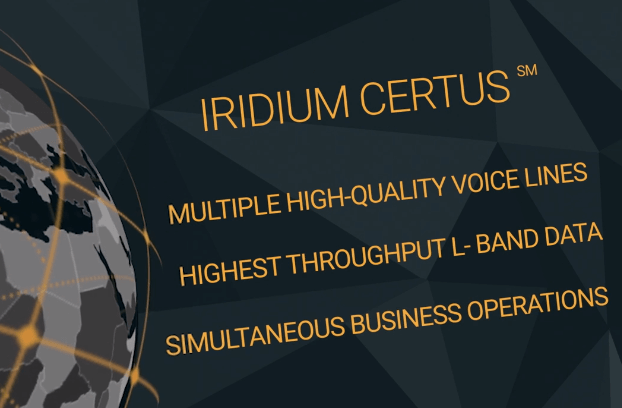
Iridium Communications inaugurated its “Certus” global broadband service, offering on-the-move internet and high-quality voice access for assets, autonomous vehicles, trains, aircraft and ships at sea. The initial service is targeted at maritime and terrestrial applications, with Iridium Certus aviation solutions expected later in 2019, once certified.
 Iridium Certus leverages the company’s $3 billion Iridium NEXT satellite replacement program. Iridium is debuting the service, which will feature a variety of speed classes, with the Iridium Certus 350 (352/352 Kbps) offering, which supports capabilities like internet and high-quality voice services to compact terminals built specifically for maritime, aviation and terrestrial/vehicle applications. Terminals will be upgradable to the next speed class, Iridium Certus 700 (352/704 Kbps), with a firmware update once available. Initial activations of the service occurred in December of 2018 with excellent system performance.
Terminals are being built by Cobham (maritime), Thales (maritime, aviation and land-mobile), Collins Aerospace (aviation), L3 (aviation), Gogo (aviation) and Satcom Direct (aviation).
So far, 35 service providers have been authorized by Iridium to provide the service around the world. The company estimates Iridium Certus will reach an approximately $100 million yearly run rate by year end 2021.
“The debut of Iridium Certus is the start of a new chapter in the Iridium story, one that is set to catapult us and our partners forward. At its core, Iridium Certus is an innovation engine for the future. It will enable us to provide broadband connections to teams, vehicles and the important IoT “things” that are in the 80-plus percent of the world that lacks cellular coverage,” said Iridium CEO Matt Desch. “Adoption of this new service by our partners has already begun, and it has been eagerly anticipated by every target industry. The launch of this service is a huge achievement, and it is already disrupting the status-quo through our smaller, faster, lighter and more cost-effective terminals and service.”
Iridium completes its LEO constellation, 75 satellites in orbit
The final 10 Iridium NEXT satellites were successfully launched into orbit aboard a SpaceX Falcon 9 rocket from Vandenberg Air Force Base in California.
This was the eighth and final launch for Iridium’s historic launch campaign with SpaceX, seeing a total of 75 new satellites deployed over less than two years.
The Iridium network is comprised of six polar orbiting planes, each containing 11 operational crosslinked satellites, for a total of 66 satellites in the active constellation. Once all the satellites from the Iridium-7 mission are operational, plane 5 will be the fourth orbital plane to be comprised entirely of Iridium NEXT satellites. In total, 81 Iridium NEXT satellites are being built, with 66 in the operational constellation, nine serving as on-orbit spares and six serving as ground spares.
Iridium NEXT is the company’s $3 billion, next-generation, mobile, global satellite network scheduled for completion in 2018. Iridium NEXT is replacing the company’s first generation global constellation in one of the largest technology upgrades ever completed in space. It represents the evolution of critical communications infrastructure that governments and organizations worldwide rely on to drive business, enable connectivity, empower disaster relief efforts and more.

Iridium has invested approximately $3 billion to replace its original satellite system with a new, state-of-the-art network, ushering in an era of financial and technological transformation for the company. At the core of this transformation is the dramatic change in cash flows as construction capital expenses end and a decade or longer “capex holiday” allows significant cash generation from existing and new services. These include Iridium CertusSM, which will provide the world’s fastest and only truly global specialty L-band broadband connectivity, enabling highly mobile internet access using smaller and more cost-effective terminals, and the AireonSM aircraft surveillance system, extending real-time visibility of aircraft for air traffic controllers and airlines to the entire planet for the first time.
To date, new satellites make up 60 of the 66 satellites in operation, with the final six scheduled for activation in the coming weeks. Iridium NEXT satellites were designed by Thales Alenia Space, which serves as system prime contractor, and are being integrated by Thales’ subcontractor, Northrop Grumman. The production process features an 18-station, state-of-the-art assembly line system for all 81 Iridium NEXT satellites being built.