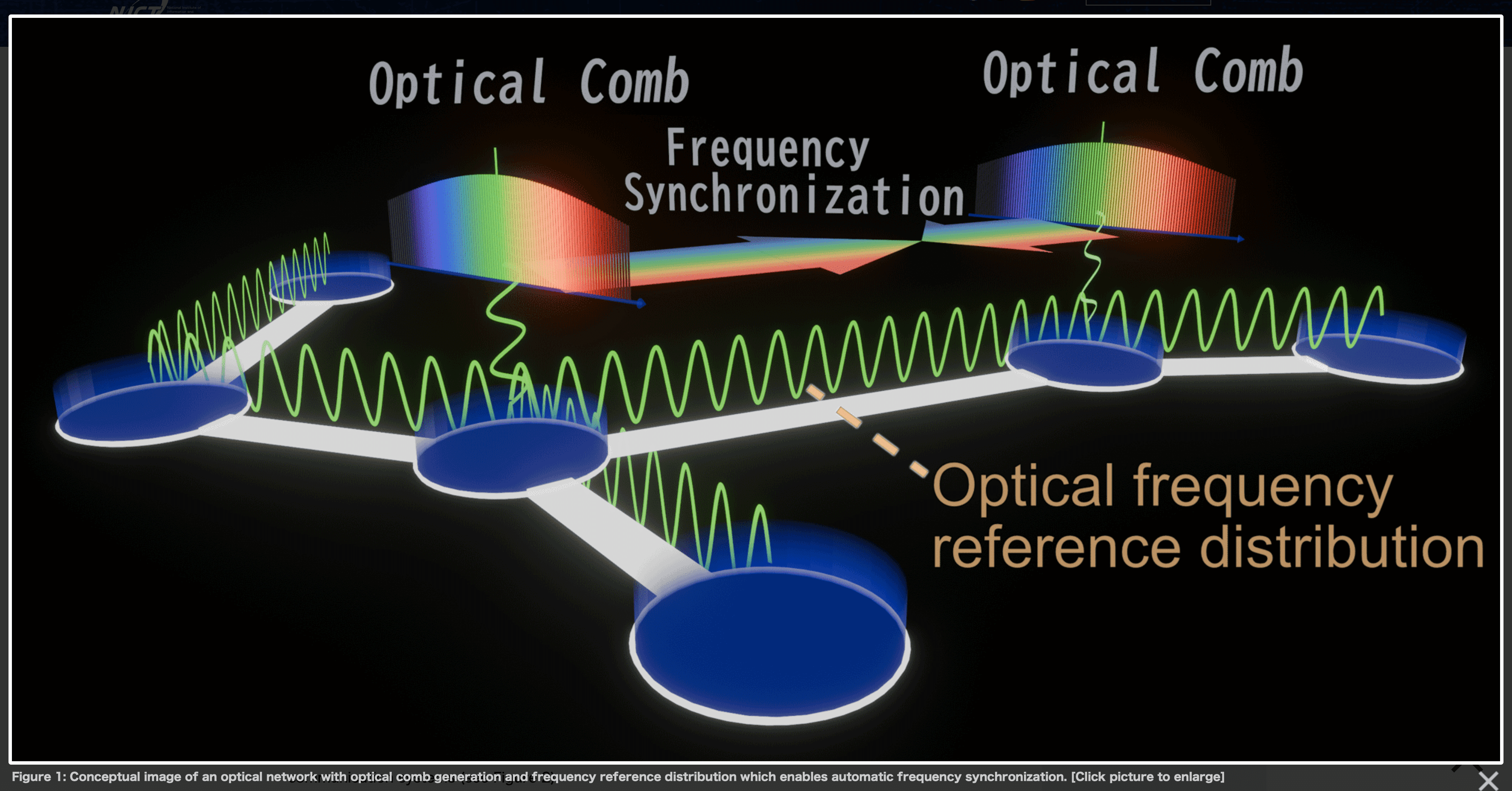
An international research team, led by Japan’s National Institute of Information and Communications Technology (NICT), demonstrated a new optical fiber communication system with a total transmission capacity of 336 Tbps. The system employs a single light source and utilizes advanced optical comb generation and frequency reference distribution technologies. This breakthrough replaces the need for hundreds of light sources typically found in transponder modules, drastically simplifying the architecture.
In the experiment, the team generated 650 sets of frequency-synchronized carrier and local oscillator pairs across the S, C, and L transmission bands, using a 39-core multicore fiber. The generated comb lines adhered to the 25 GHz frequency standard required for dual-polarization 16-QAM coherent optical communications. The system’s design facilitates automatic frequency synchronization between the comb units on both the transmitter and receiver sides, improving efficiency and reducing costs.
This development, presented at the 47th Optical Fiber Communication Conference (OFC 2024), is expected to accelerate the commercialization of multiband wavelength division multiplexing (WDM) systems and lower costs by eliminating the need for individual light sources in the S-band. The research highlights how the system can outperform current commercial optical transponders by nearly 200 times in transmission capacity.
- Achieved 336 Tbps transmission with a single light source
- Optical comb and frequency reference distribution generated 650 high-quality carrier/oscillator pairs
- Replaces hundreds of light sources in conventional systems, reducing costs
- Covers most of the S, C, and L transmission bands
- Expected to accelerate commercialization of S-band optical systems
“This technology will significantly simplify wide-band optical communication systems, cutting costs and accelerating development in the field,” said Ben Puttnam of NICT’s Photonic Network Laboratory.