• Home
  • Events Calendar
  • Blueprint Guidelines
  • Privacy Policy
  • Subscribe to Daily Newsletter
  • NextGenInfra.io
No Result
View All Result
Converge Digest
Saturday, April 11, 2026
  • Home
  • Events Calendar
  • Blueprint Guidelines
  • Privacy Policy
  • Subscribe to Daily Newsletter
  • NextGenInfra.io
No Result
View All Result
Converge Digest
No Result
View All Result

Home » JUPITER 3 brings 500G capacity and 300 spot beams

JUPITER 3 brings 500G capacity and 300 spot beams

July 30, 2023
in All
A A

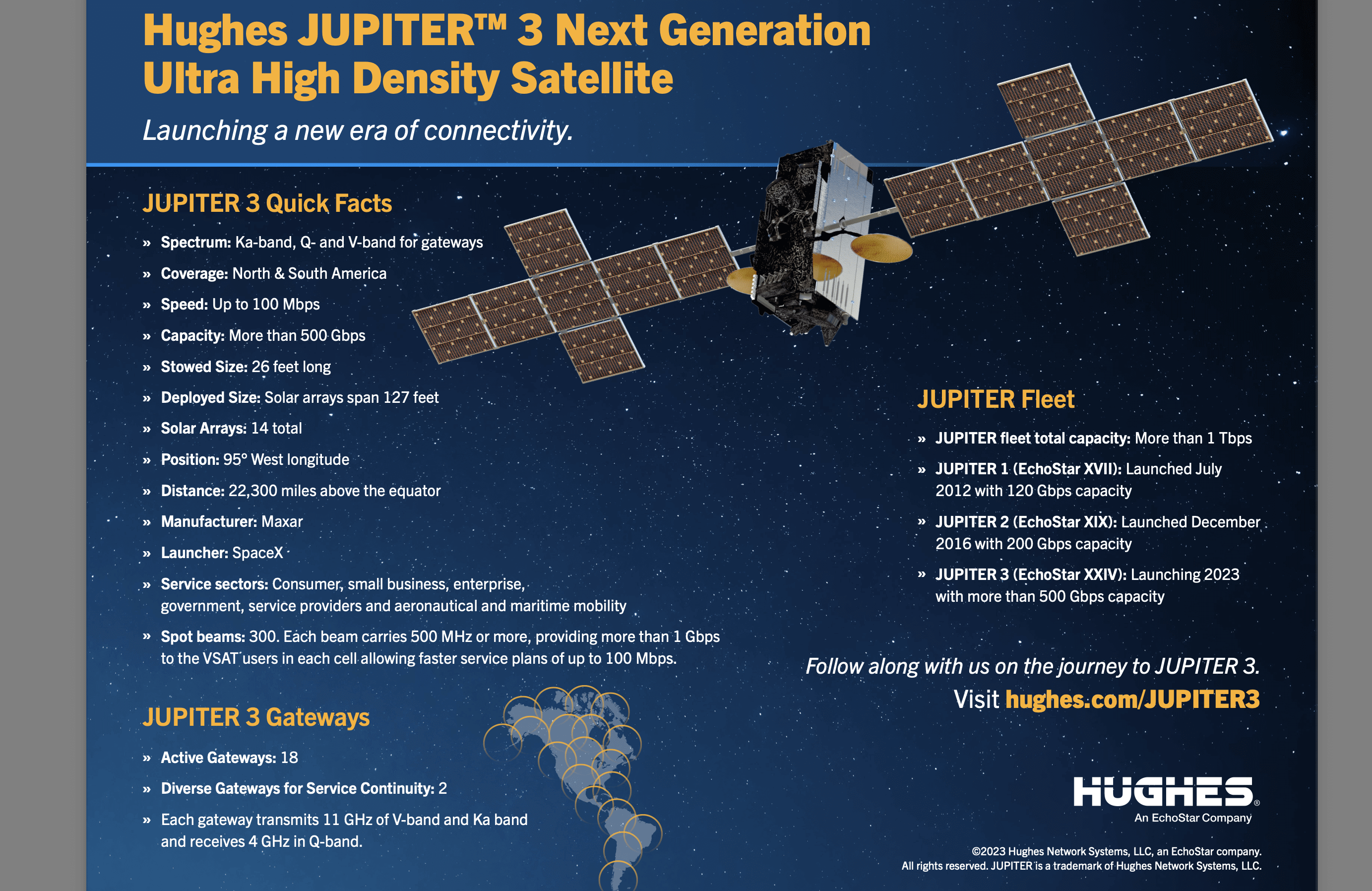
On Friday, July 28, SpaceX’s Falcon Heavy rocket launched the Hughes JUPITER 3 mission to a geosynchronous transfer orbit. Three hours and twenty-eight minutes after lift-off, JUPITER 3 successfully deployed from the launch vehicle and the solar arrays were unfolded in space to their full ten-story span. The satellite is now transmitting and receiving. It will undergo extensive bus and payload testing before entering service and augmenting the Hughes JUPITER fleet with more than 500 Gbps of additional capacity.  

JUPITER 3, also known as EchoStar XXIV, is the largest commercial satellite to date.  From geosynchronous orbit at 95° West longitude, it will provide connectivity across North and South America at speeds up to 100 Mbps. Hughes plans to offer a hybrid service that leverages multipath technology to seamlessly blend satellite and wireless technologies for a faster and more responsive service than traditional satellite internet. JUPITER 3 will also support applications such as in-flight Wi-Fi, enterprise networking and cellular backhaul for mobile network operators (MNOs).  

The new satellite features customized architecture based on a broad range of technology advances, including industry-first Q- and V-band gateway feeder links, the miniaturization of electronics, solid state amplifiers and highly efficient spot beam antenna designs. JUPITER 3 is equipped with 300 spot beams. Each beam carries 500 MHz or more, providing more than 1 Gbps to the VSAT users in each cell.  It uses Ka-band, Q- and V-band for gateways. Hughes has 18 active gateways, each of which transmits 11 GHz of V-band and Ka band and receives 4 GHz in Q-band. 

JUPITER 3 was built by Maxar Technologies in Palo Alto, California.

This was the third launch and landing of these Falcon Heavy side boosters, which previously supported USSF-44 and USSF-67.

“JUPITER 3 is the highest capacity, highest performing satellite we’ve ever launched. As the leading provider and inventor of satellite internet, we’re proud to herald the start of a new era of connectivity and serve more customers where cable and fiber cannot,” said Hamid Akhavan, CEO, EchoStar. “This purpose-built satellite is engineered uniquely to meet our customers’ needs and target capacity where it’s needed most, such as the most rural regions of the Americas, so they can stay connected to the applications and services they depend on every day.”  

Source: Hughes
ShareTweetShare
Previous Post

NTIA readies nearly $1 billion in 2nd round Tribal Broadband Connectivity 

Next Post

In Memoriam: Zohar Zisapel, 1949-2023

Jim Carroll

Jim Carroll

Editor and Publisher, Converge! Network Digest, Optical Networks Daily - Covering the full stack of network convergence from Silicon Valley

Related Posts

Cisco, G42, and AMD to Build AI Infrastructure in the UAE
AI Infrastructure

DigitalBridge Teams with KT for AI Data Centers in Korea

November 26, 2025
BerryComm Expands Central Indiana Fiber with Nokia
5G / 6G / Wi-Fi

Telefónica Germany Awards Nokia a 5-Year RAN Modernization Deal

November 26, 2025
AMD’s Compute + Pensando Network Architecture Powers Zyphra’s AI 
AI Infrastructure

AMD’s Compute + Pensando Network Architecture Powers Zyphra’s AI 

November 25, 2025
Bleu, the “Cloud de Confiance” from Capgemini and Orange
Clouds and Carriers

Orange Business Begins Migration of 70% of IT Infrastructure to Bleu Cloud

November 25, 2025
Dell’s server and networking sales rise 16% yoy
Financials

Dell Raises FY26 AI Infrastructure Outlook as AI Server Shipments Surge 150%

November 25, 2025
GlobalFoundries acquires Tagore Technology’s GaN IP
Optical

GlobalFoundries Acquires InfiniLink for Silicon-Photonics Expertise

November 25, 2025
Next Post
In Memoriam: Zohar Zisapel, 1949-2023

In Memoriam: Zohar Zisapel, 1949-2023

Categories

  • 5G / 6G / Wi-Fi
  • AI Infrastructure
  • All
  • Automotive Networking
  • Blueprints
  • Clouds and Carriers
  • Data Centers
  • Enterprise
  • Explainer
  • Feature
  • Financials
  • Last Mile / Middle Mile
  • Legal / Regulatory
  • Optical
  • Quantum
  • Research
  • Security
  • Semiconductors
  • Space
  • Start-ups
  • Subsea
  • Sustainability
  • Video
  • Webinars

Archives

Tags

5G All AT&T Australia AWS Blueprint columns BroadbandWireless Broadcom China Ciena Cisco Data Centers Dell'Oro Ericsson FCC Financial Financials Huawei Infinera Intel Japan Juniper Last Mile Last Mille LTE Mergers and Acquisitions Mobile NFV Nokia Optical Packet Systems PacketVoice People Regulatory Satellite SDN Service Providers Silicon Silicon Valley StandardsWatch Storage TTP UK Verizon Wi-Fi
Converge Digest

A private dossier for networking and telecoms

Follow Us

  • Home
  • Events Calendar
  • Blueprint Guidelines
  • Privacy Policy
  • Subscribe to Daily Newsletter
  • NextGenInfra.io

© 2025 Converge Digest - A private dossier for networking and telecoms.

No Result
View All Result
  • Home
  • Events Calendar
  • Blueprint Guidelines
  • Privacy Policy
  • Subscribe to Daily Newsletter
  • NextGenInfra.io

© 2025 Converge Digest - A private dossier for networking and telecoms.

This website uses cookies. By continuing to use this website you are giving consent to cookies being used. Visit our Privacy and Cookie Policy.
Go to mobile version