Alibaba’s Jack Ma made headlines across the world last week by laying out a plan for rapid global expansion of China’s e-commerce behemoth. In an Investor Conference held at the company’s Xixi headquarters in Hangzhou, China, Ma made the bold claim that Alibaba could reach $1 trillion in gross merchandise value by 2021 by becoming the primary online store for 2 billion people, as well as by expanding into new areas, one of which is the international public cloud services business. While Alibaba’s investor event was overshadowed somewhat by the news that Amazon will spend $13.7 billion in cash to acquire Whole Foods, the premium U.S. grocery store chain, Jack Ma unveiled a strategy with clear potential to disrupt the cloud market.
Meanwhile, business at Alibaba Group (NYSE: BABA) is ‘fantastic’ and is only going to get better this year, according to the company CFO. For the most recent fiscal quarter ended March 31, 2017, the company reported revenue of RMB 38,579 million ($5,605 million), an increase of 60% year-over-year, including:
• Revenue from core commerce of RMB31,570 million ($4,587 million), up 47% year-over-year.
• Revenue from cloud computing of RMB 2,163 million ($314 million), up 103% year-over-year.
• Revenue from digital media and entertainment of RMB 3,927 million ($571 million), up 234% year-over-year.
Growth at the parent company is primarily being driven by the steady increase in active buyers on its ecommerce platforms, both in numbers and in the value of goods and services being transacted. Annual active buyers reached 454 million, an increase of 31 million from the 12-month period ended on March 31, 2016. Mobile monthly active users (MAUs) on Alibaba Group’s China retail marketplaces reached 507 million in March, up 97 million over March 2016. Gross merchandise volume (GMV) transacted on Alibaba’s China retail marketplaces in fiscal year 2017 was RMB 3,767 billion ($547 billion), up 22% compared to RMB 3,092 billion in fiscal year 2016.

Alibaba Cloud, or Aliyun as it is known in Chinese, is firmly established as the leading infrastructure-as-a-service (IaaS) cloud in mainland China and is moving rapidly to become a Platform-as-a-Service (PaaS) provider and a Software-as-a-Service (SaaS) retailer. Some important Aliyun metrics emerged from the Investor presentation, including (with additional commentary):
· Public cloud is growing: based on Gartner’s figures from March 2017, Aliyun estimates the global public cloud market will amount to $245 billion in 2017, growing to $436 billion in 2021, a 15.9% CAGR.
· China’s public cloud market is growing even faster, with Gartner figures showing China’s public cloud market, valued at $14 billion this year, growing to $25 billion in 2021, a 17.2% CAGR; by 2021, China’s share of the global public cloud market would still be under 6%, which seems odd given the country’s share of global GDP is much higher and that ecommerce, social media and mobile technologies are booming in China – why so low versus the U.S. market?
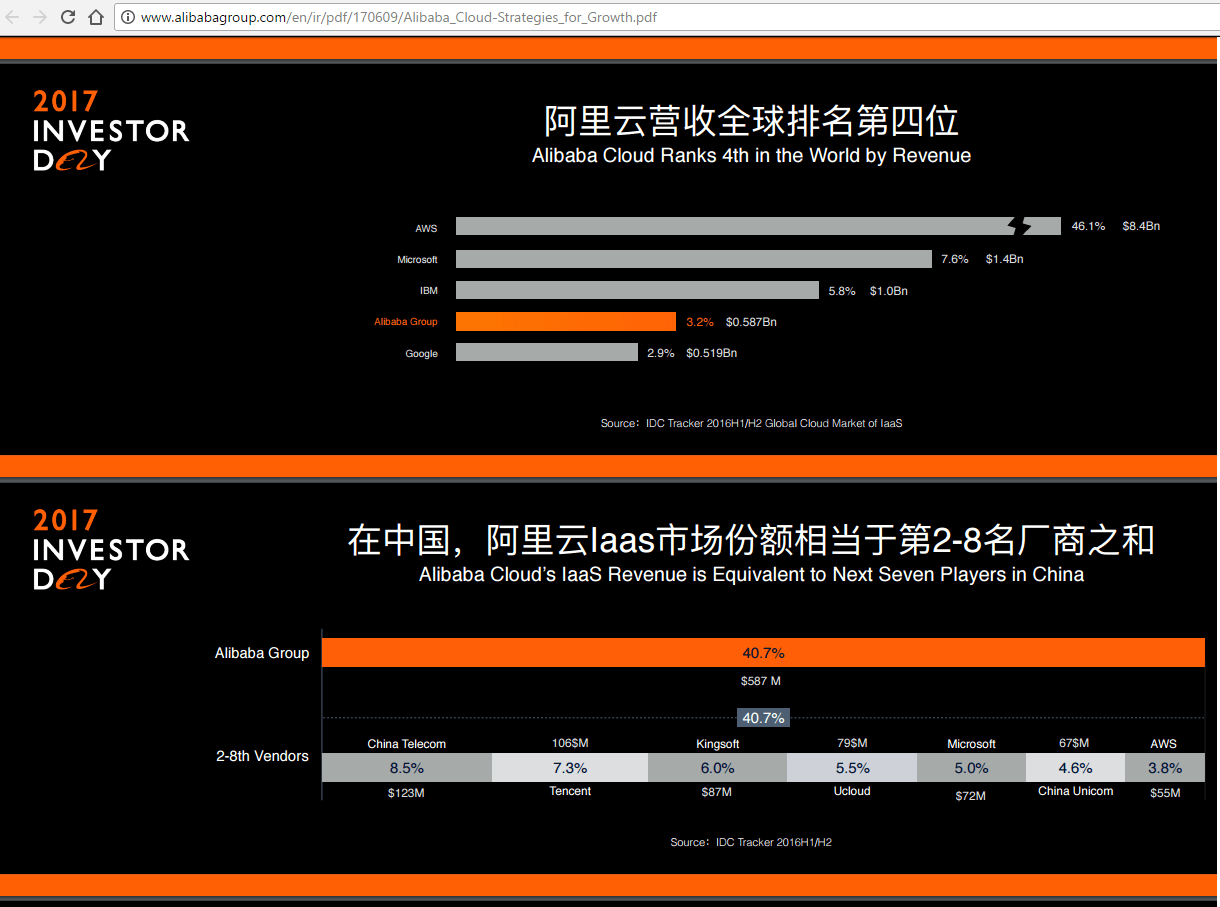
· Aliyun cited figures from IDC Tracker 2016 H1/H2 Global Cloud Market (IaaS), indicating it currently is the No.4 player in public cloud services worldwide, but with only a 3.2% share; No.1 was AWS, $8.4 billion, 46.1% share; No. 2 Microsoft, $1.4 billion, 7.6% share; No.3 IBM, $1.0 billion, 5.8% share; No.4 Alibaba, $0.57 billion, 3.2% share; No.5 Google, $0.519 billion, 2.9% share.
Clearly, AWS is dominating the public cloud market, especially in the U.S. The other U.S. public cloud players are investing aggressively to catch up and they too seem to have ambitions that reach to the sky. Alibaba’s Jack Ma has previously been quoted in the press as saying that Alibaba would catch and surpass Amazon. When it comes to cloud services at least, this will be extremely difficult given its current 3.2% share versus AWS’ 46.1% share, and a capex budget that appears decisively smaller.
In its home market of China, Aliyun’s IaaS revenue is equivalent to the next seven players combined. The numbers cited in IDC Tracker 2016 H1/H2 Global Cloud Market are as follows:
· No.1 – Alibaba Group, $587 million, 40.7% market share
· No.2 – China Telecom, $123 million, 8.5%
· No.3 – Tencent, $106 million, 7.3%
· No.4 – Kingsoft, $87 million, 6.0%
· No.5 – Ucloud, $79 million, 5.5%
· No.6 – Microsoft, $72 million, 5.0%
· No.7 – China Unicom, $67 million, 4.6%
· No.8 – AWS, $55 million, 3.8%
In addition, as of March 31, 2017 Aliyun had 874,000 paying customers, had 15 data centres worldwide and had 186 cloud service offers. It also claims a 96.7% retention rate amongst its top paying customers in Q1 2017 compared to a year earlier.
Over one-third of China’s Top 500 companies are on Alibaba Cloud, including China’s Public Safety Bureau (PSB), CCTV, Sinopec, Sina Weibo, Xinhua News Agency,Toutiao, Geely, Mango TV, CEA, Quanmin Live, Panda TV and DJI, while two-thirds of Chinese Unicorn companies are on Alibaba Cloud. Global Software-as-a-Service (SaaS) now available on Aliyun include Accenture, SAP, Docker, here, SUSE, Haivision, Wowza, AppScale, AppEX, Hillstone, Checkpoint Software Technologies, Hitachi Data Systems and Red Hat.
Aliyun’s Computing Conference 2016 was attended by over 40,000 developers in person, with more than 7 million viewers online. At its investor conference, Aliyun also disclosed a number of major international brands that are now using its services, including Schneider Electric, Shisheido, Philips, Nestle and Vodafone, which is a good start. Nevertheless, attracting international companies will be harder, first, because Alibaba has only just recently begun building data centres outside of China, and two, they will be much less known and trusted than established brands such as IBM.