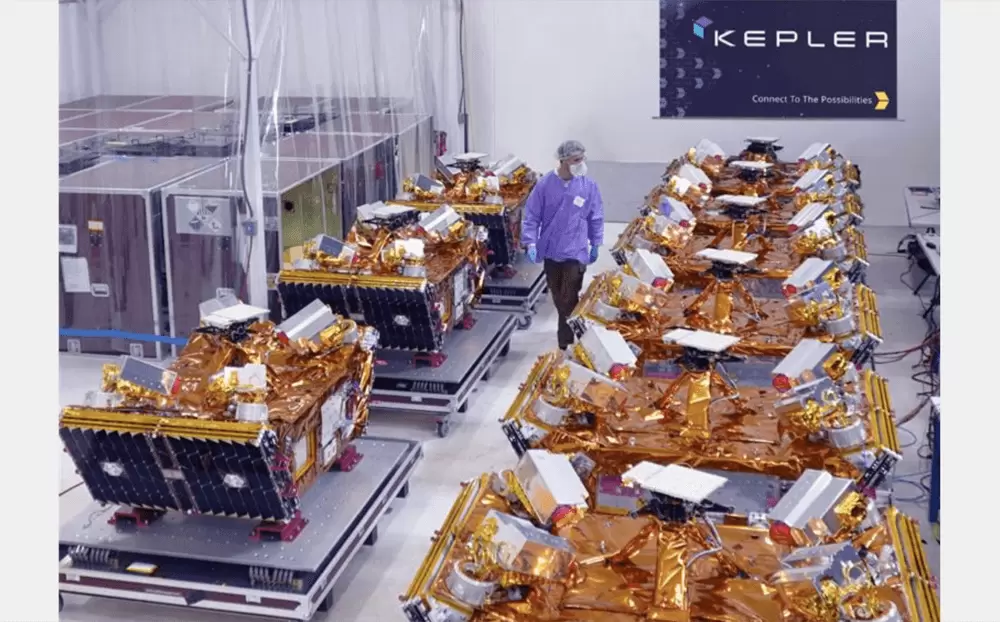
Kepler Communications will launch ten 300-kilogram-class satellites in January 2026 aboard a SpaceX Falcon 9 from Vandenberg Space Force Base, marking the first operational tranche of its optical data relay constellation. The satellites form the backbone of Kepler’s IP-routed, SDA-compatible optical network designed for real-time connectivity between space, air, and terrestrial users. Each spacecraft carries at least four laser terminals to support high-throughput, low-latency links across orbital and atmospheric layers.
The next-generation platform integrates distributed GPU/CPU resources to perform compute in orbit, reducing the need for downlinks and enabling real-time analytics. The architecture supports Earth-observation processing, autonomous mission operations, and hosted payloads that leverage Kepler’s optical backbone for continuous, secure data movement. Modular interfaces allow customers to attach sensors and software directly onto Kepler’s satellite bus and access managed connectivity through standardized APIs.
The launch follows successful Pathfinder demonstrations in space-to-space, space-to-ground, and space-to-air optical links—milestones that validated Kepler’s implementation of SDA optical standards and core technologies for a real-time relay network. Kepler plans additional tranches with backward-compatible 100-Gbps-class laser terminals. “Optical data relay is redefining how space systems communicate, operate, and deliver value,” said Mina Mitry, CEO and co-founder of Kepler Communications.
• Ten 300-kg optical satellites launching Jan. 2026
• SDA-compatible laser terminals; IP-mesh routing
• Distributed on-orbit compute: GPU + CPU + storage
• Hosted payload interfaces for sensors/software
• Real-time relay for EO, human spaceflight, and defense
• Roadmap includes 100-Gbps optical tech in next tranche
“Optical data relay is redefining how space systems communicate, operate, and deliver value,” said Mina Mitry, CEO and co-founder of Kepler Communications.
🌐 Analysis
Kepler, founded in 2015 by University of Toronto alumni Mina Mitry, Mark Michael, and Wen Cheng Chong, has raised over $120 million from IA Ventures, Canaan Partners, Costanoa Ventures, Tribe Capital, and other institutional investors. Its earliest technology centered on Ku-band IoT cubesats, but the company pivoted decisively toward SDA-aligned optical relays starting in 2021, culminating in several firsts: the first commercial demonstration of SDA-compatible optical inter-satellite links, successful air-to-space optical tests, and end-to-end IP routing in orbit. Kepler now positions itself alongside players building orbital data transport layers—such as SpaceX Starshield, Aalyria, Tesat/European constellations, and Amazon Project Kuiper’s future OISLs—while differentiating with on-orbit compute and hosted payload services. Its strategy mirrors the cloud model: standardized APIs, managed SLAs, and scalable infrastructure in orbit for government, commercial, and civil operators.
🌐 We’re tracking the latest developments in space infrastructure. Follow our ongoing coverage at: https://convergedigest.com/category/space