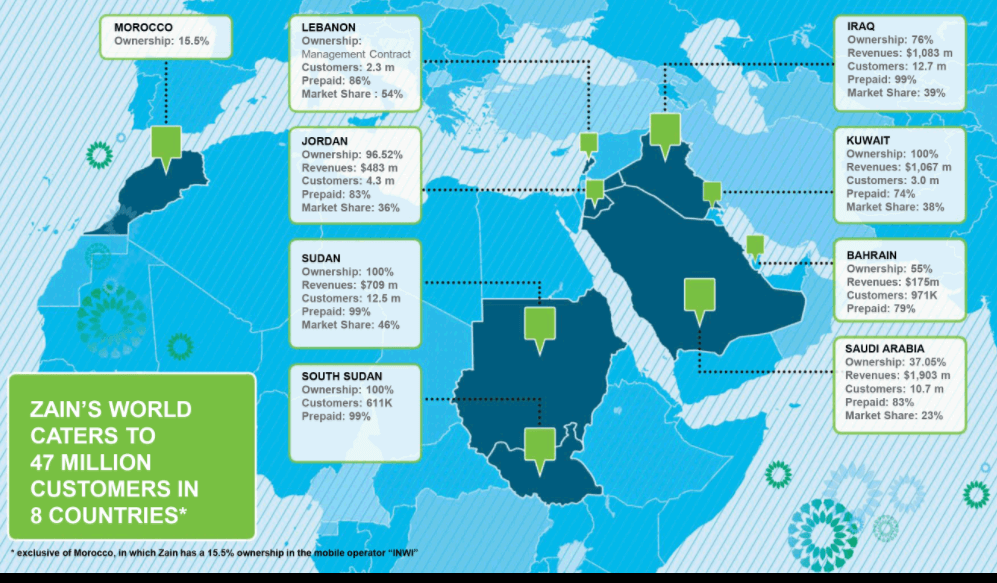
Kuwait-based Zain Group, which now has operations in eight markets across the Middle East and Africa, has just raised $846 million in cash by selling a 9.8% equity stake to neighboring Omantel. The all-cash deal adds a measure of liquidity to Zain Group, which is aiming to transform itself into a digital service provider as it prepares for 5G and other advanced infrastructure.
Zain Group, which was established in 1983 as Kuwait’s Mobile Telecommunications company, once pursued a very geographically expansionist strategy. In 2005, it acquired mobile operations in 13 African countries from Celtel International for a reported US$3.4 billion, including networks in Burkina Faso, Chad, Democratic Republic of the Congo, Gabon, Ghana, Kenya, Madagascar, Malawi, Niger, Nigeria, Sierra Leone, Tanzania, Uganda and Zambia.
Five years later, Zain decided to exit these ventures while making a nice profit on the investment. These African businesses were sold in 2010 to India’s Bharti Airtel for US$10.7 billion.
In 2008, the Zain Group raised US$4.49 billion (by issuing new shares) to support strategic expansion into the Kingdom of Saudi Arabia, and Nokia Siemens Networks was awarded a contract valued at US1 billion to rollout the network.
Even now, Nokia continues as a lead vendor to Zain Saudi Arabia, as well as other markets. In May 2017, the companies confirmed the deployment of Nokia’s multi-access edge computing (MEC) platform in Mecca. A similar installation also uses Nokia centralised RAN technology.to boost network upload speeds at Jeddah’s King Abdullah Sports stadium by up to 50%.
 Since selling its African operations in 2010, Zain has stayed to closer to home, focusing its external efforts on Bahrain, Iraq, Jordan, Lebanon, Morocco, Sudan, South Sudan, and the very important market of Saudi Arabia. Some of these countries, especially Iraq, Sudan, and South Sudan, are beset by social, political and economic issues – but everyone wants/needs mobile connectivity so demand remains strong.
In a management shake-up earlier this year, Zain’s board of directors appointed Mohannad Mohammed Al-Kharafi as the Chairman of Zain Group, Bader Nasser Al-Kharafi as Vice-Chairman and Chief Executive Officer of Zain Group, and appointed Scott Gegenheimer in a new role as Chief Executive Officer of Operations. Previously, Gegenheimer, a U.S. citizen, served simply as CEO for all of Zain Group since 2012. Before joining Zain, Gegenheimer held leadership positions at several regional operators, as well as with Cisco Systems and Motorola.
At the end of June 2017, Zain Group counted 45.2 million customers. The breakdown by country is roughly as follows:
•Iraq 27%
•Sudan 27%
•KSA 23%
•Jordan 9%
•Kuwait 6%
•Lebanon 5%
•Bahrain 2%
Declining revenue and EBITDA for the first half of 2017
Earlier this month, Zain Group consolidated first half 2017 revenues of KD 508 million (US$1.67 billion) down 8% year-on-year (Y-o-Y) in KD terms. The Group’s consolidated EBITDA for the period reached KD 212 million (US$695 million), down 17% Y-o-Y in KD terms, reflecting an EBITDA margin of 41.7%. Consolidated net income remained stable at KD 82 million (US$270 million). Earnings per share for the half-year stood at 21 Fils (US$0.07). Overall, the company described its financial performance as “in line with expectations” while acknowledging the impact of a significant 61% currency devaluation in Sudan and other factors. (the company says Zain Sudan continues to perform ‘exceptionally well’ in local currency terms),
Some key items and indicators
Data revenues for the group (excluding SMS and VAS) increased 4% Y-o-Y, representing 25% of the consolidated revenues.
 Zain launched an over-the-top, streaming video service called “iflix” across several markets. This follows the announcement earlier in the year that Zain and iflix had formed a joint venture entity named ‘iflix Arabia’ to be headquartered in Dubai. The JV will trade commercially as “iflix”, adding Zain’s territories of operation to iflix’s global footprint, including Kuwait, Bahrain, Iraq, Jordan, Lebanon, Saudi Arabia and Sudan, with the potential to further extend into additional regional markets. The content catalogue will include highly acclaimed Arabic shows and movies, exclusive Arabic content series, best titles from Hollywood and Bollywood, local programming and children’s shows.
In its home market of Kuwait, Zain’s customer base stands at 2.6 million. Kuwait remains the Group’s most profitable operation with revenues reaching KD 167 million (USD 549 million), EBITDA amounting to KD 66 million (USD 215 million) and net income came in at KD 39 million (USD 128 million). Zain Kuwait’s EBITDA margin stood at 39% at the end of the six-month period, with data revenues (excluding SMS & VAS) accounting for 32% of total revenues.
Zain Kuwait is currently implementing a smart meter project, in one of the sector’s largest ICT projects for the country’s Ministry of Electricity and Water. The Smart Meter project, which runs through 2024, is a key step in the company’s strategic plans to deploy smart city solutions in Kuwait and beyond. Ericsson has been selected as the sole technology partner in the Zain led consortium.
In June 2017, Zain launched Cloud Disaster Recovery (Cloud DR) service in Kuwait in collaboration with IBM. The new service provides Zain’s enterprise customers with cloud-based business continuity capabilities and faster disaster recovery of their critical IT systems.
In Saudi Arabia, Zain reports improved financial indicators thanks to a turnaround and cost optimisation program. In H1, 2017, the operator recorded its first-ever half yearly net profit of USD 14 million, compared to net losses USD 154 million in H1 2016. Revenues for the period were up by 9%, reaching USD 1.04 billion. The company recorded a significant 59% increase in EBITDA to reach USD 346 million in H1 2017.
Zain noted that the introduction of a biometric identification requirement for mobile services caused its total customer base to shrink by 15% to stand at 9 million customers at the end of June 2017. Impressively, the operator witnessed a 42% rise in data revenues (excluding SMS and VAS) Y-o-Y, representing 50% of total revenues.
During Q2, Zain KSA also successfully secured an additional 1800MHz spectrum for expansion of its4.5G LTE network’s coverage and capacity.
In January 2017, Zain Group appointed Peter Kaliaropoulos, an Australian national, as CEO of Zain Saudi Arabia. Previously, Kaliaropoulos was the GM of ‘touch’ Lebanon until June 2016, the country’s leading operator that Zain manages on behalf of the Lebanon Telecom Ministry
In Iraq, Zain managed to achieve US$523 million revenues due to the impressive growth in data usage and numerous customer acquisition initiatives in the northern regions of the country. The operation’s efficiency drive saw EBITDA reach USD 179 million, reflecting a 34% EBITDA margin. Net income amounted to USD 11 million for the period. Zain Iraq leads the market serving 12.9 million customers, which represented an impressive 15% Y-o-Y increase.
In Sudan, the 61% currency devaluation this year impacted financial results as measured in USD terms for the first six months of 2017. Nevertheless, in local currency (SDG) terms, revenues grew by 38% Y-o-Y to reach SDG 3.4 billion (USD 213 million, down 44% in USD terms) for the first six months of 2017. EBITDA increased by 22% to reach SDG 1.3 billion (USD 81 million, down 50% in USD terms), and net income increased by 14% to SDG 545 million (USD 34 million, down 54% in USD terms). Data revenues (excluding SMS and VAS) accounted for 15% of total revenues, with an impressive annual growth rate of 69%. The operation saw its customer base expand 3% to reach 12.9 million.
In Jordan, Zain grew its customer base by 3% Y-o-Y, serving 4.2 million customers at the end of June, and maintaining its market leading position despite intense price competition. Y-o-Y revenues increased 2% to reach US$241 million, with EBITDA up 1% to reach USD 116 million, reflecting an impressive 48% EBITDA margin. Net income decreased 5% to USD 48 million for the six-month period. With the continual expansion of 4G services across the country, data revenues (excluding SMS & VAS) represented 37% of total revenues, up by 15% Y-o-Y.
In Bahrain, Zain generated revenues of USD 100 million for the first six months of 2017, up 17% Y-o-Y. EBITDA for the period amounted to USD 30 million, down 8%, reflecting an EBITDA margin of 30%. Net income amounted to USD 4 million, reflecting a 21% decrease. Data revenues (excluding SMS & VAS) increased 36% Y-o-Y, representing 43% of overall revenues.