Kyocera is developing an AI-powered 5G virtualized base station, aiming for commercialization. Utilizing the NVIDIA GH200 Grace Hopper Superchip, the new base station enhances performance, reduces power consumption, and streamlines operations and maintenance, contributing to the global advancement of 5G infrastructure.
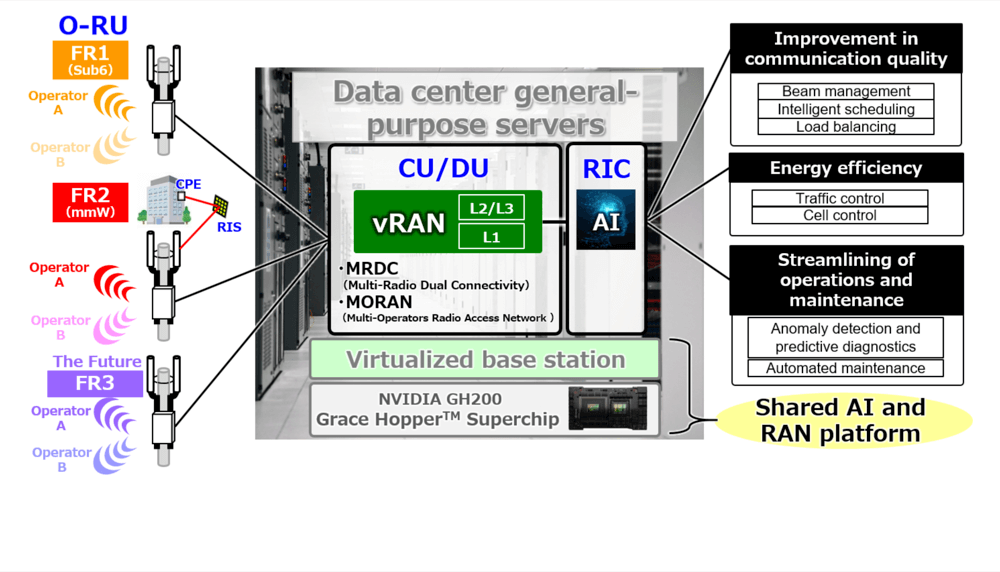
The AI-powered base station features dynamic traffic management, optimizing frequency allocation for improved upload and download speeds while enhancing energy efficiency. AI-driven automation further simplifies network management by optimizing settings in real-time. The system supports dual connectivity functionality, integrating O-RAN-compliant CU/DU/RU capable of handling Sub-6-GHz and millimeter-wave frequency bands. It can manage increased traffic loads efficiently and accommodate future frequency bands through software upgrades.
Kyocera’s innovation also enables base station sharing among multiple telecommunications operators, reducing capital expenditures and power consumption while improving 5G network coverage expansion. Additionally, optimized software implementation extends fronthaul distances beyond 40 kilometers, further increasing network reach and efficiency.
- Kyocera is developing an AI-powered 5G virtualized base station for commercialization.
- The system utilizes NVIDIA GH200 Grace Hopper Superchip for enhanced performance.
- AI dynamically manages network traffic, optimizing speed and energy efficiency.
- The base station supports Sub-6-GHz and millimeter-wave bands, with future expandability.
- Multi-operator base station sharing reduces costs and improves 5G network coverage.
- Extended fronthaul distances exceed 40 kilometers for broader connectivity.
“By leveraging AI and virtualization, our 5G virtualized base stations will revolutionize connectivity, optimize power efficiency, and streamline operations to meet the demands of a rapidly evolving digital world,” said Hideo Tanimoto, President of Kyocera.