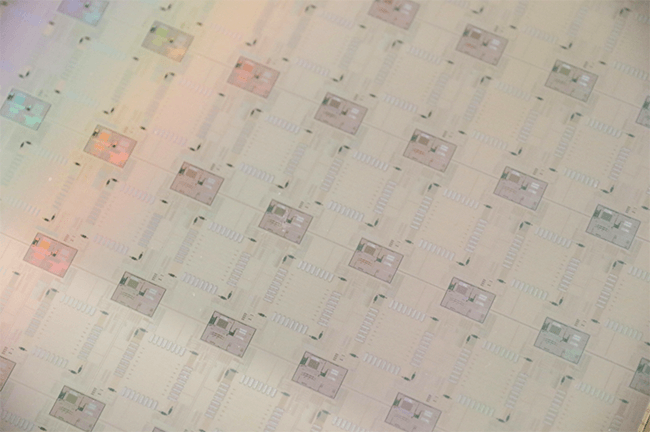
Lightmatter, a start-up based in Boston, unveiled a wafer-scale, programmable photonic interconnect that allows arrays of heterogeneous chips (CPUs, GPUs, memory, accelerators) to communicate with each other optically.
Lightmatter says its photonic interconnect offers a fully-reconfigurable connection topology between chips, reducing the cost and complexity of building heterogeneous computing systems.

The Lightmatter Passage packs forty switchable integrated photonic lanes into the same space that traditionally supports just one optical fiber. This could be used to enable a 1Tbps dynamically reconfigurable interconnect across an array of 48 chips spanning 8 inches by 8 inches, with a maximum communication latency of 5 nanoseconds. The company says it has a multi-year roadmap for its interconnects to deliver chip-to-chip communications with 100Tbps bandwidth.
“Lightmatter is leading a necessary paradigm shift in computer architecture needed to power the next giant leaps in compute technology, while also reducing the negative impact on our planet of rapidly-growing state of the art, yet inefficient, compute and communications solutions,” said Nick Harris, co-founder and CEO at Lightmatter. “Modern compute workloads call for system-level performance. With Passage, we’ve created a photonic rack-on-chip solution capable of supporting the future of computing by enabling ultra-high bandwidth interconnection between different kinds of chips, and simultaneously reducing cost, complexity, and energy consumption.”
Lightmatter is developing a photonic processor
Lightmatter, a start-up based in Boston, will unveil plans for an artificial intelligence (AI) photonic processor.
 Lightmatter said its general-purpose AI inference accelerator will use light to compute and transport data. The 3D-stacked chip package contains over a billion FinFET transistors, tens of thousands of photonic arithmetic units, and hundreds of record-setting data converters. Lightmatter’s photonic processor runs standard machine learning frameworks including PyTorch and TensorFlow, enabling state-of-the-art AI algorithms.
“The Department of Energy estimates that by 2030, computing and communications technology will consume more than 8 percent of the world’s power. Transistors, the workhorse of traditional processors, aren’t improving; they’re simply too hot. Building larger and larger datacenters is a dead end path along the road of computational progress,” said Nicholas Harris, PhD, founder and CEO at Lightmatter. “We need a new computing paradigm. Lightmatter’s optical processors are dramatically faster and more energy efficient than traditional processors. We’re simultaneously enabling the growth of computing and reducing its impact on our planet.”
On August 18th, Lightmatter’s VP of Engineering, Carl Ramey, will present their photonic processor architecture at HotChips32.