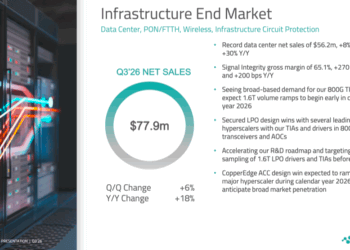

The Linear Pluggable Optics Multi-Source Agreement (LPO MSA) group has announced the release of its new 100Gbps-per-lane Linear Pluggable Optics (LPO) specification, designed to enable optical interconnects supporting up to 800 Gigabit Ethernet connectivity. This latest specification, 100G-DR-LPO, outlines comprehensive electrical and optical requirements to ensure interoperability across switches, network interface cards (NICs), and optical modules, aiming to significantly reduce power consumption, cost, and latency—key challenges in high-speed networks serving AI and machine learning workloads. Successfully validated through extensive interoperability testing among the consortium’s 50 industry-leading networking, semiconductor, and optics members, the specification builds upon existing industry standards such as IEEE 802.3 and OIF.
With the completion of the 100Gbps-per-lane specification, the LPO MSA is already looking forward, setting plans to develop a similar standard for 200Gbps-per-lane technology. The group intends to collaborate closely with standards bodies such as the OIF and IEEE to advance next-generation linear optical solutions, reinforcing its commitment to open standards and ecosystem interoperability. The MSA’s recent February 2025 interoperability testing demonstrated robust performance margins exceeding required specifications, verifying seamless compatibility across multiple vendors’ solutions.
Founded with the goal of reducing complexity and cost while improving reliability in high-speed optical networks, the LPO MSA continues to see strong participation from system, IC, and optical module providers. Its efforts are particularly significant as large-scale datacenter operators prepare to deploy 800G LPO modules in high volumes.
• LPO MSA announces 100Gbps-per-lane Linear Pluggable Optics specification, supporting up to 800Gbps Ethernet.
• Specification ensures interoperability, significantly reducing power, cost, and latency for optical interconnects.
• Successfully validated through extensive interoperability testing among leading vendors.
• Plans for 200Gbps-per-lane specification development underway, collaborating with OIF and IEEE.
• Specification addresses high-speed connectivity demands driven by AI and data-center growth.
“The hard work of the MSA member companies has resulted in a very solid specification,” said Andreas Bechtolsheim, LPO MSA Co-Chair. “This allows large datacenter operators to deploy 800G LPO modules in volume with confidence.”
- Linear Pluggable Optics (LPO) is an optical interconnect architecture that eliminates the need for digital signal processing (DSP) within optical modules, shifting DSP functionality instead to the host system. Unlike conventional optical transceivers, which include built-in DSP to compensate for optical impairments and dispersion, LPO modules provide a simpler, linear analog interface between optical and electrical domains. By removing the DSP from the module, LPO significantly reduces module complexity, cost, power consumption, and latency. This architecture is particularly beneficial for short-reach, high-density interconnect applications, such as intra-data center connectivity and AI/ML infrastructure, where minimal latency and reduced power are critical. Additionally, LPO solutions rely on host-based equalization and signal processing, leveraging advances in switch ASIC technology to further streamline optical networking designs.