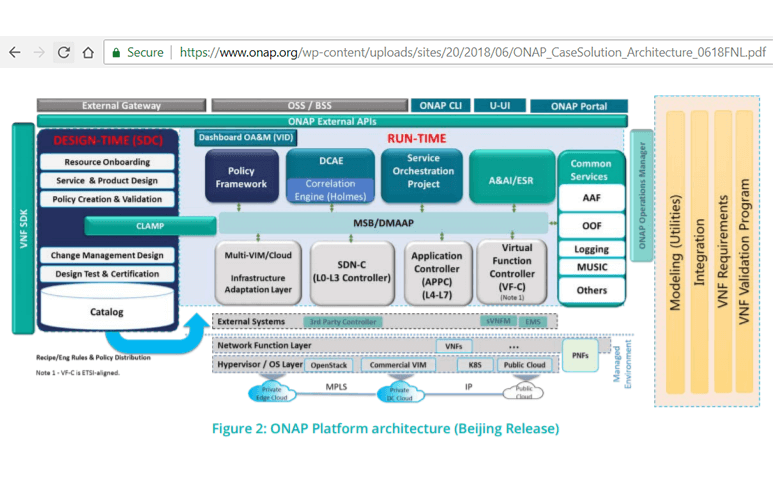
Linux Foundation Networking announced the second release of Open Network Automation Platform (ONAP), code named Beijing.
ONAP is positioned as a unified platform for end-to-end, closed-loop network automation. The Beijing release evolves the platform toward container-based implementations and provides robust documentation and training for Virtual Network Functions (VNF) developers, service designers, and operations managers.

“We are delighted to announce the availability of ONAP’s second release, Beijing, which advances the architecture, seven dimensions of deployability, and new automation functionality,” said Arpit Joshipura, General Manager of Networking, The Linux Foundation. “As a community, we celebrate the progress the Beijing release brings to the ecosystem and look forward to additional deployments of the platform.”
“The Beijing release ushers in the next phase of ONAP,” said Mazin Gilbert, ONAP Technical Steering Committee (TSC) Chair, and Vice President, Advanced Technology, AT&T Labs. “The technical enhancements in this release focus on enhancing the stability and deployability of the platform. In addition, the community has focused on supporting users in their adoption journey with the delivery of several new Getting Started guides as well as online and in-person introductory training options. Together with the community, we are further establishing ONAP as the defacto standard for automation.”
LF Networking cited the following feature enhancements in the Beijing release:
Architecture
- ONAP Operations Manager supports the migration to microservices-based deployments on Kubernetes
- ONAP has collaborated with MEF and TMForum on external APIs, ensuring those frameworks and APIs can communicate seamlessly with the ONAP platform.
Deployability
- Starting with the Beijing release, the ONAP development process measures improvements in seven key operational parameters (Usability, Security, Manageability, Stability, Scalability, Performance and Resiliency) for each platform module.
- The Beijing release brings advanced platform stability and resiliency based on deployment of of the ONAP Operations Manager (OOM) and the Multi-Site State Coordination Service (MUSIC) projects.
- ONAP OOM enables ONAP modules to be run on Kubernetes, contributing to availability, resilience, scalability and more for ONAP deployments and sets the stage for full implementation of a microservices architecture, expected with the third release, Casablanca.
- MUSIC is an optional new solution for state management of ONAP components across geographically distributed sites, ensuring federated active-active operation without degrading performance, reliability and availability.
- As security is a key element of the CI framework, the Project has adopted CII (Core Infrastructure Initiative) badging as part of its release requirements. CII is a project managed by The Linux Foundation that collaboratively works to improve the security and resilience of critical open source projects.
Functional Enhancements – Blueprint Enrichment
The residential vCPE blueprint has been enriched with change management and policy-driven workload placement features that include hardware platform awareness (HPA).
 Network service scaling to meet traffic needs is a fundamental NFV value proposition. VNF Manual Scaleout is also supported on vLB via APPC and Policy with LCM based Manual Scale Out.
Ecosystem Expansion
- The open source community is rapidly organizing to ensure the technology, tools and services are in place to support rapid adoption.
- VNF integration: With the Beijing release, the ONAP community worked closely with the OPNFV Verified Program (OVP), which simplifies adoption in commercial NFV products and establishes an industry threshold based on OPNFV capabilities and test cases, to coordinate integrations via the ONAP VNFSDK and ONAP VNF Validation Program (VVP) components.
- Documentation and training:
- New startup and operations guides for users
- Design guides and API and SDK documentation for service designers and VNF developers
- Online training: Free introductory courses on Open Source Networking Technologies and ONAP as well as more in-depth, paid ONAP Fundamentals training
- Community-led best-practices webinars
Real-World Use
Organizations spanning every aspect of the ecosystem (vendors, telecommunication providers, cable and cloud operators, NFV vendors and solution providers) continue to leverage ONAP for commercial products and services. The Beijing release code is being integrated into new and existing proofs of concept and production deployment plans for large global carriers like AT&T, Bell Canada, China Mobile, China Telecom, Orange, Reliance Jio, Verizon, Vodafone, Turk Telecom, among others. And major leading vendors are building products and solutions on the ONAP platform.