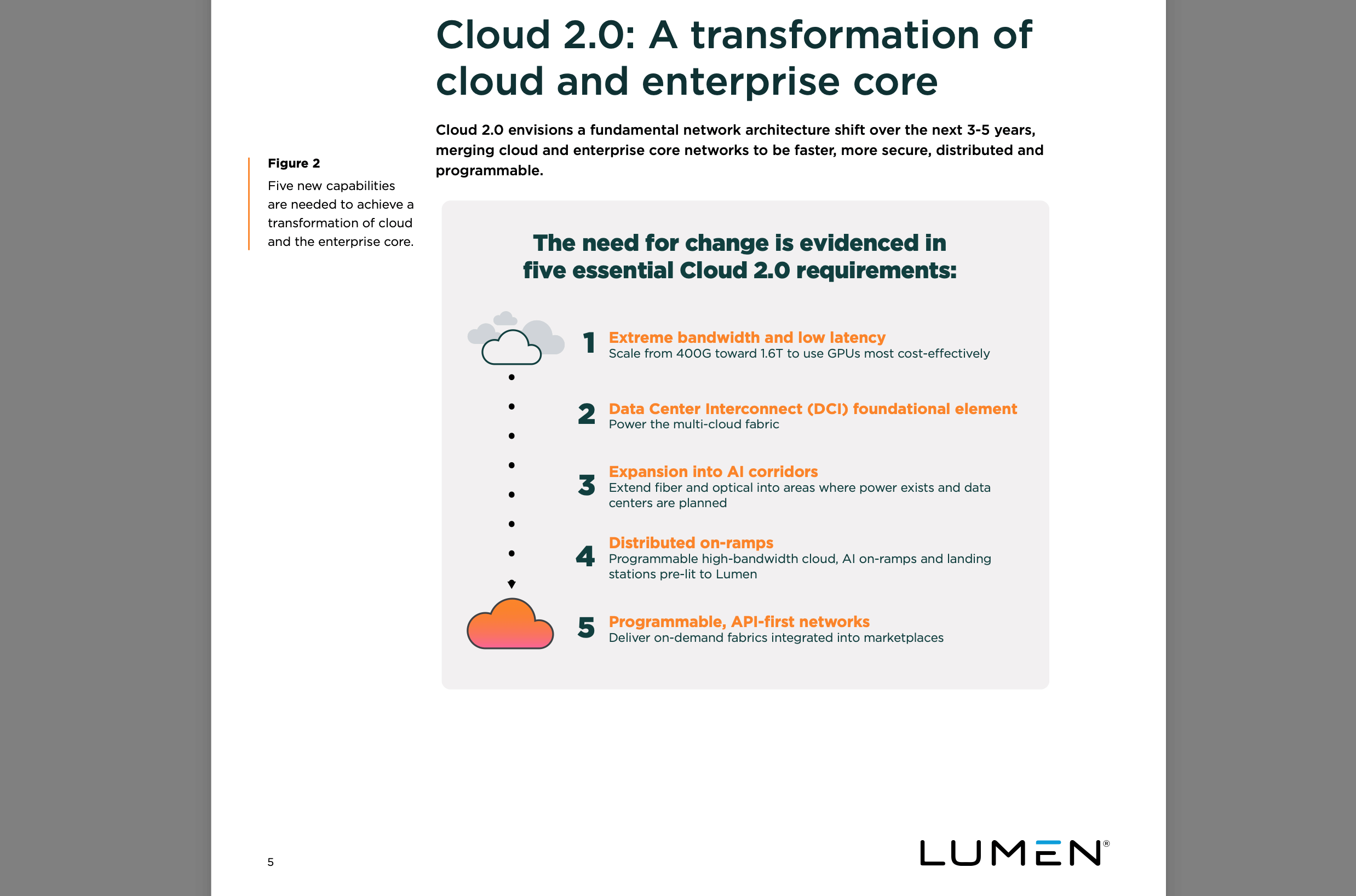
Lumen calls for a reset of the internet backbone to serve AI-scale traffic, unveiling its “Cloud 2.0” vision at an analyst forum. Chief Technology & Product Officer Dave Ward argues that Cloud 1.0’s centralized, static architecture cannot absorb a 100x surge in east-west traffic, real-time inference, and sub-5 ms latency targets. The company frames Cloud 2.0 as a fusion of cloud and enterprise networks with programmable control, fabric-based interconnects, and data-center-interconnect (DCI)-centric designs.
Ward’s white paper, Cloud 2.0: Because AI Won’t Run on Yesterday’s Internet, warns that patchwork upgrades won’t keep pace as U.S. data center footprints expand and AI pipelines demand 400G+ links and deterministic performance. He flags national-scale risks—innovation slowdowns, delayed AI deployments, rising costs—if backbone upgrades lag. Lumen positions its physical network, digital platforms, and ecosystem investments around these Cloud 2.0 principles.
The paper outlines a stratified network model spanning IP aggregation edges, Ethernet/wavelength-based DCI, and dark-fiber cores, with interconnect gravitating toward DCI fabrics rather than traditional carrier-neutral sites. Lumen forecasts most architectural change arriving by 2028, pushing operators and enterprises to accelerate plans for programmable, high-bandwidth, low-latency infrastructure at scale.
• Anticipated traffic shift: up to 100x growth in east-west flows driven by AI training/inference
• Latency target: sub-5 ms for real-time inference and distributed AI pipelines
• Throughput expectations: widespread 400G+ services for exabyte-scale data movement
• Network model: three performance layers—IP aggregation edge, Ethernet/waves DCI, dark-fiber core
• Interconnect trend: ~70% of interconnection traffic moving to DCI-centric fabrics by 2030
• Enterprise trend: 10x growth in inter-app connections across multi-cloud, edge-to-core footprints by 2028
• Operational stance: programmable networks, fabric-based connectivity, and distributed on-ramps as design defaults
• Timeline: majority of transformation completed by 2028, creating both opportunity and risk
“The public internet is not infinite, and it’s not programmable to meet the service demands of AI,” said Dave Ward. “Cloud 2.0 requires a complete reboot with programmable networks, massive bandwidth increases, and new distributed interconnect and on-ramp architectures.”
Ward’s whitepaper is posted here: https://assets.lumen.com/is/content/Lumen/preparing-cloud-two-enterprise-networks?Creativeid=92f38f2c-e426-41ed-b5dc-8989226b8c31
🌐 Analysis: Lumen’s Cloud 2.0 vision arrives as the company accelerates a deep transformation of both its network footprint and business model. Over the past year, Lumen has focused on modernizing its optical backbone with 400G and 800G capabilities, integrating software-defined control and edge compute infrastructure to support AI and cloud workloads. The company’s Quantum Fiber expansion and metro aggregation upgrades signal a pivot toward high-density, low-latency interconnects that align with the Cloud 2.0 model described by CTO Dave Ward.
At the same time, Lumen has rebalanced its portfolio through major asset transactions. In 2024, it sold its EMEA operations to Colt Technology Services for $1.8 billion and previously divested its Latin American business to Stonepeak for $2.7 billion. These moves freed capital for investment in North American network modernization and digital platform automation, reinforcing its strategy to become a programmable infrastructure provider rather than a legacy carrier. Lumen has also deepened partnerships with hyperscalers such as Microsoft Azure, Google Cloud, and AWS to deliver edge-based private connectivity and distributed compute zones closer to enterprise workloads—a critical step toward the “DCI-centric” architecture envisioned in Cloud 2.0.
In parallel, Lumen’s focus on AI-era networking echoes broader industry movements from AT&T, Verizon, and Zayo, which are pursuing similar fabric-based and optical-scale backbones optimized for GPU clusters and inter-cloud routing. As hyperscalers extend their own optical mesh fabrics and sovereign AI cloud regions, Lumen’s approach positions it as both an interconnection partner and an infrastructure enabler for the next decade of AI-driven traffic growth