• Home
  • Events Calendar
  • Blueprint Guidelines
  • Privacy Policy
  • Subscribe to Daily Newsletter
  • NextGenInfra.io
No Result
View All Result
Converge Digest
Friday, April 10, 2026
  • Home
  • Events Calendar
  • Blueprint Guidelines
  • Privacy Policy
  • Subscribe to Daily Newsletter
  • NextGenInfra.io
No Result
View All Result
Converge Digest
No Result
View All Result

Home » Marvell Debuts 64 Gbps Bi-Directional Die-to-Die Interface in 2nm

Marvell Debuts 64 Gbps Bi-Directional Die-to-Die Interface in 2nm

August 26, 2025
in All, Semiconductors
A A

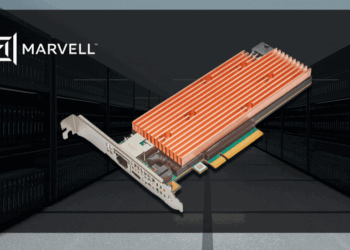
Marvell introduced the industry’s first 64 Gbps per wire bi-directional die-to-die (D2D) interconnect IP in 2nm, targeting next-generation XPUs for AI and cloud infrastructure. The technology, also available in 3nm, enables simultaneous two-way connectivity at 32 Gbps per direction on a single wire. With bandwidth density exceeding 30 Tbps/mm, the design delivers more than triple the density of equivalent UCIe implementations while using just 15% of the silicon area of conventional approaches.

The new D2D IP incorporates adaptive power management that dynamically responds to bursty data center traffic, reducing interface power consumption by up to 75% under normal conditions and 42% during peak usage. Reliability features include redundant lanes and automatic lane repair to improve yield and lower bit error rates. Marvell is delivering the interconnect as part of a complete stack—spanning PHY, application bridge, link layers, and physical interconnect—allowing chipmakers to accelerate time-to-market for custom XPUs.

The announcement builds on Marvell’s recent 2nm milestones, including its demonstration of working silicon in March 2025 and the introduction of 2nm SRAM earlier this year. The new D2D interconnect underscores Marvell’s broader custom silicon strategy, which spans advanced SerDes, silicon photonics, co-packaged optics, custom HBM, SoC fabrics, PCIe Gen 7 interfaces, and optical I/O.

  • 64 Gbps per wire bi-directional interface IP in 2nm and 3nm
  • 32 Gbps simultaneous two-way connectivity on a single wire
  • Bandwidth density >30 Tbps/mm, 3x that of UCIe at equivalent speeds
  • Adaptive power management cuts interface power up to 75%
  • Redundant lanes and automatic repair improve resiliency and yield
  • Delivered as a turnkey solution with PHY, bridge, link layers, and interconnect

“The 64 Gbps bi-directional D2D interface IP marks an industry first and reflects our commitment to pioneering technologies that enhance performance while reducing total cost of ownership for next-generation AI devices,” said Will Chu, senior vice president of Custom Cloud Solutions at Marvell.

🌐 Analysis: Marvell’s push into 2nm with D2D technology highlights the growing importance of intra-package interconnects as chipmakers shift toward disaggregated architectures. Competing standards such as UCIe aim to unify the ecosystem, but Marvell is carving out a differentiated position with higher bandwidth density and advanced power management. The move aligns with recent advances from rivals like Broadcom, which has emphasized PCIe Gen 7 and co-packaged optics, and underscores the race to optimize die-to-die links for AI accelerators and custom silicon platforms.

🌐 We’re tracking the latest developments in networking silicon. Follow our ongoing coverage at: https://convergedigest.com/category/semiconductors/

Tags: Marvell
ShareTweetShare
Previous Post

Crusoe Expands AI Cloud Capacity to 57MW at atNorth’s Iceland Data Center

Next Post

AT&T to Buy EchoStar Spectrum for $23B; Boost Mobile Shifts to Hybrid MNO

Jim Carroll

Jim Carroll

Editor and Publisher, Converge! Network Digest, Optical Networks Daily - Covering the full stack of network convergence from Silicon Valley

Related Posts

Marvell Adds Active Copper Cable Equalizers
All

Marvell Adds Active Copper Cable Equalizers

October 14, 2025
Matt Murphy appointed Chair of Marvell’s Board
Optical

ECOC25: Marvell Highlights CPO, 800G COLORZ, and 1.6T PAM4 DSP

September 25, 2025
Matt Murphy appointed Chair of Marvell’s Board
Semiconductors

Marvell Expands Share Repurchase by $5B, CEO Outlines AI and Data Center Pipeline

September 24, 2025
Marvell pushes ahead to 2nm with TSMC
Semiconductors

Marvell Expands CXL with CPU and DRAM Interoperability

September 2, 2025
Matt Murphy appointed Chair of Marvell’s Board
Financials

Marvell Doubles Down on AI With Record $2B Quarter and Optical Milestones

August 28, 2025
Marvell Secures Microsoft Azure Cloud HSM with LiquidSecurity
Semiconductors

Marvell Secures Microsoft Azure Cloud HSM with LiquidSecurity

August 18, 2025
Next Post
AT&T to Buy EchoStar Spectrum for $23B; Boost Mobile Shifts to Hybrid MNO

AT&T to Buy EchoStar Spectrum for $23B; Boost Mobile Shifts to Hybrid MNO

Categories

  • 5G / 6G / Wi-Fi
  • AI Infrastructure
  • All
  • Automotive Networking
  • Blueprints
  • Clouds and Carriers
  • Data Centers
  • Enterprise
  • Explainer
  • Feature
  • Financials
  • Last Mile / Middle Mile
  • Legal / Regulatory
  • Optical
  • Quantum
  • Research
  • Security
  • Semiconductors
  • Space
  • Start-ups
  • Subsea
  • Sustainability
  • Video
  • Webinars

Archives

Tags

5G All AT&T Australia AWS Blueprint columns BroadbandWireless Broadcom China Ciena Cisco Data Centers Dell'Oro Ericsson FCC Financial Financials Huawei Infinera Intel Japan Juniper Last Mile Last Mille LTE Mergers and Acquisitions Mobile NFV Nokia Optical Packet Systems PacketVoice People Regulatory Satellite SDN Service Providers Silicon Silicon Valley StandardsWatch Storage TTP UK Verizon Wi-Fi
Converge Digest

A private dossier for networking and telecoms

Follow Us

  • Home
  • Events Calendar
  • Blueprint Guidelines
  • Privacy Policy
  • Subscribe to Daily Newsletter
  • NextGenInfra.io

© 2025 Converge Digest - A private dossier for networking and telecoms.

No Result
View All Result
  • Home
  • Events Calendar
  • Blueprint Guidelines
  • Privacy Policy
  • Subscribe to Daily Newsletter
  • NextGenInfra.io

© 2025 Converge Digest - A private dossier for networking and telecoms.

This website uses cookies. By continuing to use this website you are giving consent to cookies being used. Visit our Privacy and Cookie Policy.
Go to mobile version