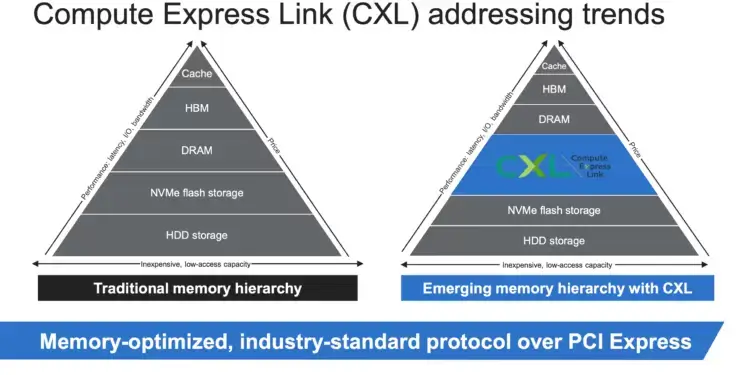
Marvell has confirmed the successful interoperability of its Structera™ portfolio of Compute Express Link (CXL) 2.0 devices with AMD EPYC™ processors and 5th Gen Intel® Xeon® Scalable platforms. The results, demonstrated across a range of configurations and workloads, provide cloud data center operators with the flexibility to deploy high-performance memory expansion solutions across diverse CPU architectures.
The Structera product line includes near-memory accelerators and memory expansion controllers designed to meet the growing bandwidth and capacity needs of modern cloud-scale infrastructure. By enabling seamless memory pooling and cache coherency, Structera devices help reduce server sprawl and improve data center efficiency. This cross-platform compatibility strengthens the case for CXL adoption, especially for memory-intensive workloads such as AI, machine learning, and in-memory databases.
Key Structera offerings include Structera A—featuring Arm® Neoverse® V2 cores with up to 1.6 Tbps of memory bandwidth—and Structera X, designed to expand DDR4/DDR5 memory pools cost-effectively. The collaboration between Marvell, AMD, and Intel further reinforces a commitment to an open, scalable CXL ecosystem optimized for next-generation data center architectures.
- Marvell Structera portfolio now validated with AMD EPYC and Intel Xeon platforms.
- CXL 2.0 interoperability enables memory expansion and pooling across CPUs.
- Structera A and X devices address AI, HPC, and in-memory computing use cases.
- Supports DDR4 and DDR5 memory, Arm Neoverse cores, and up to 1.6 Tbps bandwidth.
- Promotes efficient, flexible, and sustainable cloud-scale data center deployment.
“This successful interoperability showcases our ability to deliver innovative, high-performance solutions that redefine the efficiency, sustainability, and performance of cloud technology,” said Will Chu, SVP and GM, Custom Cloud Solutions at Marvell.
- In July 2024, Marvell introduced its new Structera product line of Compute Express Link (CXL)devices, aimed at resolving memory performance and scaling challenges in cloud data centers. These devices are designed to enable cloud operators to efficiently add memory to general-purpose servers, addressing the inefficiencies and high costs associated with memory-intensive applications. By leveraging the CXL industry standard, Marvell’s Structera line allows for the creation of new architectures that enhance memory bandwidth and capacity without the need for additional servers.
- The Structera product line includes two families of CXL devices tailored to specific use cases. The Structera A CXL near-memory accelerators integrate server-class processor cores and multiple memory channels to cater to high-bandwidth applications such as deep learning recommendation models (DLRM) and machine learning. The Structera X CXL memory-expansion controllers, on the other hand, are designed to add terabytes of memory to general-purpose servers, supporting high-capacity applications like in-memory databases. These products, which are the first in the industry to support four memory channels and utilize 5nm manufacturing processes, also incorporate inline compression for enhanced performance.
Marvell Structera A 2504
- PCIe 5.0/CXL2.0 x16
- Four channels of DRAM DDR5 6400 MT/sec
- Two memory DIMMs per channel (2DPC) support
- 16 Arm Neoverse V2 cores at 3.2 GHz
- Inline LZ4 compression and decompression
- Inline AES-XTS 256-bit encryption and decryption
- Embedded hardware security module and secure boot
Marvell Structera X 2404
- PCIe 5.0/CXL2.0 1 x16 or 2 x8
- Four channels of DRAM DDR4 3200 MT/sec
- Three memory DIMMs per channel (3DPC) support
- Inline LZ4 compression and decompression
- Inline AES-XTS 256-bit encryption and decryption
- Embedded hardware security module and secure boot
Marvell Structera X 2504
- Embedded hardware security module and secure boot
- PCIe 5.0/CXL2.0 1 x16 or 2 x8
- Four channels of DRAM DDR5 6400 MT/sec
- Two memory DIMMs per channel (2DPC) support
- Inline LZ4 compression and decompression
- Inline AES-XTS 256-bit encryption and decryption