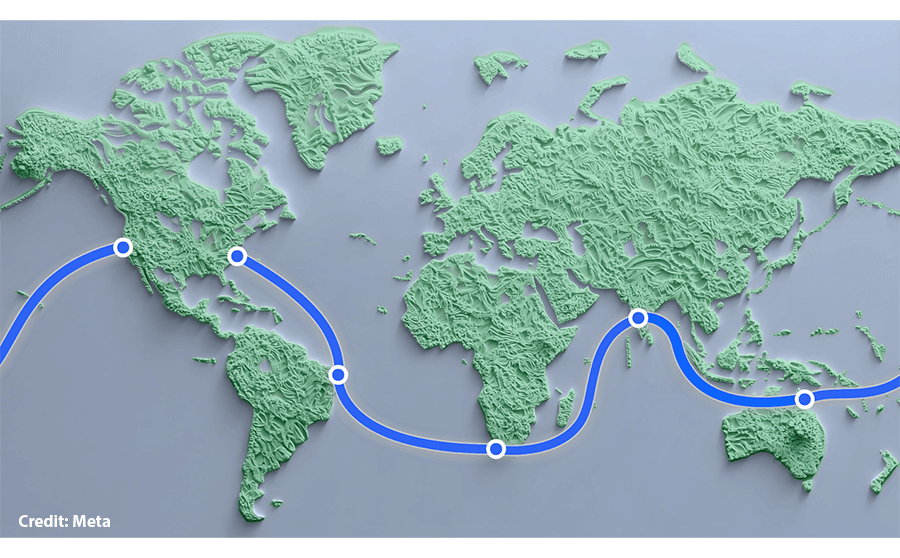
Meta has announced Project Waterworth, its most extensive subsea cable initiative to date. Spanning over 50,000 km (31,000 miles), the system will connect five continents, including the U.S., India, Brazil, and South Africa. Once completed, it will be the world’s longest subsea cable network, designed to enhance digital connectivity and support AI-driven applications.
The multi-billion dollar project will establish three new oceanic corridors, significantly expanding the global digital backbone that supports over 95% of intercontinental internet traffic. Project Waterworth will deploy 24-fiber-pair cables, exceeding the typical 8 to 16 fiber pairs of other systems. The investment aims to improve network capacity, resilience, and speed while integrating deep-water routing at depths of up to 7,000 meters (23,000 feet) and advanced burial techniques in high-risk areas.
Meta, which has been actively expanding subsea infrastructure for over a decade, with more than 20 cable systems deployed globally, says Project Waterworth will further reinforce AI-powered digital services, ensuring reliable, high-speed connectivity across major economic regions.
• 50,000 km (31,000 miles) subsea cable system spanning five continents
• Multi-billion dollar investment to strengthen intercontinental connectivity
• Three new oceanic corridors to enhance global network reliability
• 24-fiber-pair cables for high-capacity data transmission
• Deep-water routing up to 7,000 meters (23,000 feet) and improved coastal protection
Meta has been a significant participant in numerous subsea cable projects aimed at enhancing global connectivity. Notable projects include:
2Africa: A 45,000 km (28,000 miles) cable system connecting 33 countries across Africa, Europe, and Asia. This project, in partnership with companies like China Mobile, MTN Group, and Vodafone, is designed to deliver a capacity of up to 180 Tbps.
• MAREA: A 6,605 km (4,104 miles) cable connecting Virginia Beach, USA, to Sopelana, Spain. Completed in 2017, MAREA offers a design capacity of 200 Tbps. Meta and Microsoft co-own this cable, with Telxius operating it.
• Amitié: A 6,800 km (4,225 miles) cable linking Lynn, Massachusetts, USA, to Bude, UK, and Le Porge, France. Operational since October 2023, Amitié enhances connectivity between North America and Europe. Meta, through its subsidiary Edge Cable Holdings, is a major stakeholder, alongside partners like Aqua Comms, Vodafone, Microsoft, and Orange.
• Havfrue (also known as America Europe Connect-2 or AEC-2): A transatlantic cable linking the U.S. to Denmark, Ireland, and Norway. Spanning approximately 7,851 km (4,880 miles), it offers a design capacity of 108 Tbps. Meta co-owns this cable with partners such as Aqua Comms, Google, and Bulk Infrastructure.
• Pacific Light Cable Network (PLCN): Initially intended to connect the U.S. to Hong Kong, the project faced regulatory challenges, leading to a revised plan excluding the Hong Kong segment. Meta and Google are key stakeholders in this initiative.
• Anjana: A 7,121 km (4,425 miles) subsea cable connecting Myrtle Beach, South Carolina, USA, to Santander, Spain. This system aims to enhance connectivity between North America and Europe, with a capacity of nearly 500 Tbps.