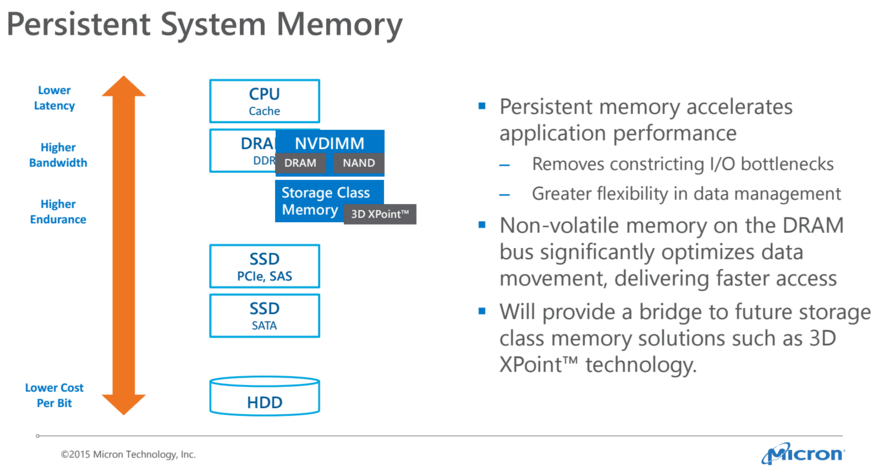
Micron Technology introduced a persistent memory technology that combines the low-latency benefits of DRAM with the lower cost of NAND Flash. The NVDIMM technology from Micron could play a key role in data center server design, allowing greater volumes of data to be stored closer to the CPU, boosting the performance of applications such as big data analytics, storage appliances, RAID cache, In-Memory Databases and On Line Transaction Processing.
 Micron is now producing 8GB DDR4 NVDIMM, the company’s first commercially available solution in the persistent memory category. In the event of a power failure or system crash, Micron’s NVDIMM solution provides an onboard controller that safely transfers data stored in DRAM to the onboard non-volatile memory, thereby preserving the data that would otherwise be lost.
“Micron is delivering on the promise of persistent memory with a solution that gives system architects a new approach for designing systems with better performance, reduced energy usage and improved total cost of ownership,” said Tom Eby, vice president for Micron’s compute and networking business unit. “With NVDIMM, we have a powerful solution that is available today. We’re also leading the way on future persistent memory development by spearheading R&D efforts on promising new technologies such as 3D XPoint™ memory, which will be available in 2016 and beyond.”
http://www.micron.com/persistentmemory
Intel and Micron Unveil 3D XPoint Memory 1000x Faster than NAND
 Intel and Micron Technology have developed a non-volatile memory that is up to 1,000 times faster and has up to 1,000 times greater endurance than NAND, and is 10 times denser than conventional memory.
The 3D XPoint technology, which is now entering production, is described as the first new memory category since the introduction of NAND flash in 1989.
“For decades, the industry has searched for ways to reduce the lag time between the processor and data to allow much faster analysis,” said Rob Crooke, senior vice president and general manager of Intel’s Non-Volatile Memory Solutions Group. “This new class of non-volatile memory achieves this goal and brings game-changing performance to memory and storage solutions.”
“One of the most significant hurdles in modern computing is the time it takes the processor to reach data on long-term storage,” said Mark Adams, president of Micron. “This new class of non-volatile memory is a revolutionary technology that allows for quick access to enormous data sets and enables entirely new applications.”
Intel said the 3D XPoint technology follows more than a decade of research and development. The innovative, transistor-less cross point architecture creates a three-dimensional checkerboard where memory cells sit at the intersection of word lines and bit lines, allowing the cells to be addressed individually. As a result, data can be written and read in small sizes, leading to faster and more efficient read/write processes.

In March 2015, Intel and Micron Technology announced availability of their 3D NAND technology, the world’s highest-density flash memory, for use in data center servers, laptops, tablets and mobile devices.