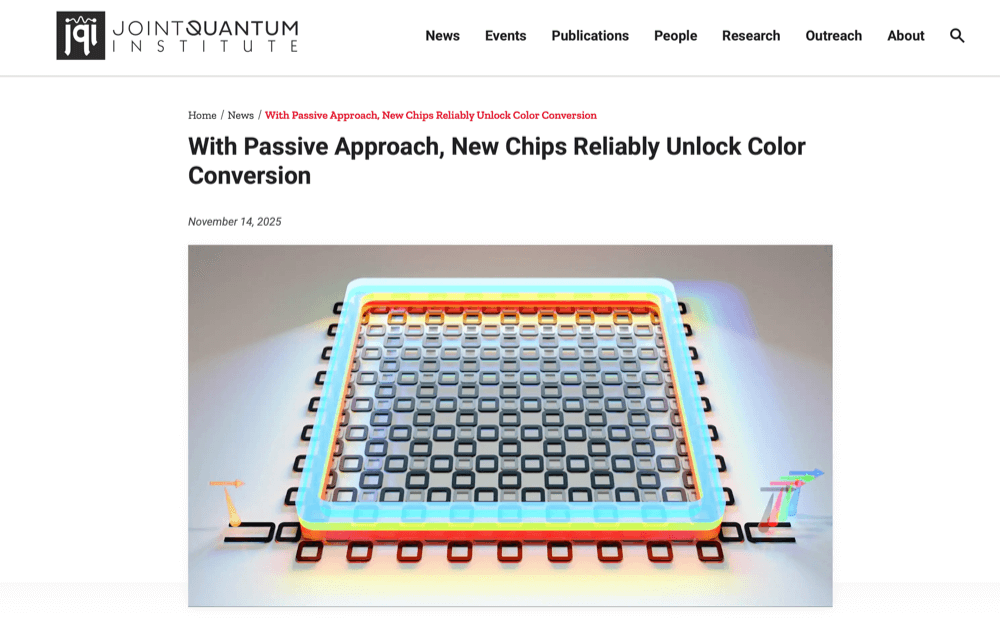
Researchers at the Joint Quantum Institute (JQI) have demonstrated a new class of photonic chips built from arrays of microring resonators that passively convert a telecom-band laser into red, green, and blue light—achieving second, third, and fourth harmonic generation without active tuning. The work, published in Science, shows that a “two-timescale” resonator architecture enables frequency-phase matching across chips without embedded heaters or iterative fabrication tweaks.
The device uses hundreds of tightly coupled microrings that support two distinct circulation paths: fast light cycling inside individual rings and slower propagation around a larger “super-ring” formed by the entire array. The interplay of these two resonant timescales greatly increases the odds of satisfying nonlinear frequency-phase matching conditions that normally require nanometer-level tolerances. When illuminated with ~190 THz (≈1600 nm) input light, all six chips tested from a single wafer produced stable second (red), third (green), and fourth (blue) harmonics.
Unlike single-ring devices—which require high-precision engineering and active compensation through embedded micro-heaters—the array-based architecture generated harmonic output across a broader input range and operated purely passively. The researchers also observed the emergence of additional sidebands around each harmonic at higher input powers, consistent with earlier work on nested frequency-comb generation using similar resonator arrays.
• Device: Arrays of microring resonators with dual timescales for passive frequency-phase matching
• Input: ~190 THz (~1600 nm) telecom laser
• Output: second (≈380 THz), third (≈570 THz), and fourth (≈760 THz) harmonics—red, green, blue
• Fabrication: Six chips on one wafer all produced multi-harmonic output
• Comparison: Single-ring devices required heaters and only yielded narrow-band SHG in one of three tested
• Applications: On-chip light sources, precision metrology, frequency conversion, nonlinear optical computing
“We have simultaneously relaxed these alignment issues to a huge degree, and also in a passive way,” said lead author Mahmoud Jalali Mehrabad. “We don’t need heaters; we don’t have heaters. They just work. It addresses a long-standing problem.”
🌐 Analysis:
This result strengthens the case for scalable, reproducible nonlinear photonics—a crucial requirement for integrated metrology systems, frequency-comb sources, and early quantum-network hardware. The passive robustness is notable when compared with earlier frequency-conversion platforms from industry and academia that depend on thermal tuning or complex feedback loops. JQI’s microring-array architecture provides a new pathway for manufacturable on-chip light sources at wavelengths where conventional lasers are unavailable.