• Home
  • Events Calendar
  • Blueprint Guidelines
  • Privacy Policy
  • Subscribe to Daily Newsletter
  • NextGenInfra.io
No Result
View All Result
Converge Digest
Friday, April 10, 2026
  • Home
  • Events Calendar
  • Blueprint Guidelines
  • Privacy Policy
  • Subscribe to Daily Newsletter
  • NextGenInfra.io
No Result
View All Result
Converge Digest
No Result
View All Result

Home » Microsoft Launches First NVIDIA GB300 NVL72 Supercluster for OpenAI

Microsoft Launches First NVIDIA GB300 NVL72 Supercluster for OpenAI

October 9, 2025
in AI Infrastructure
A A

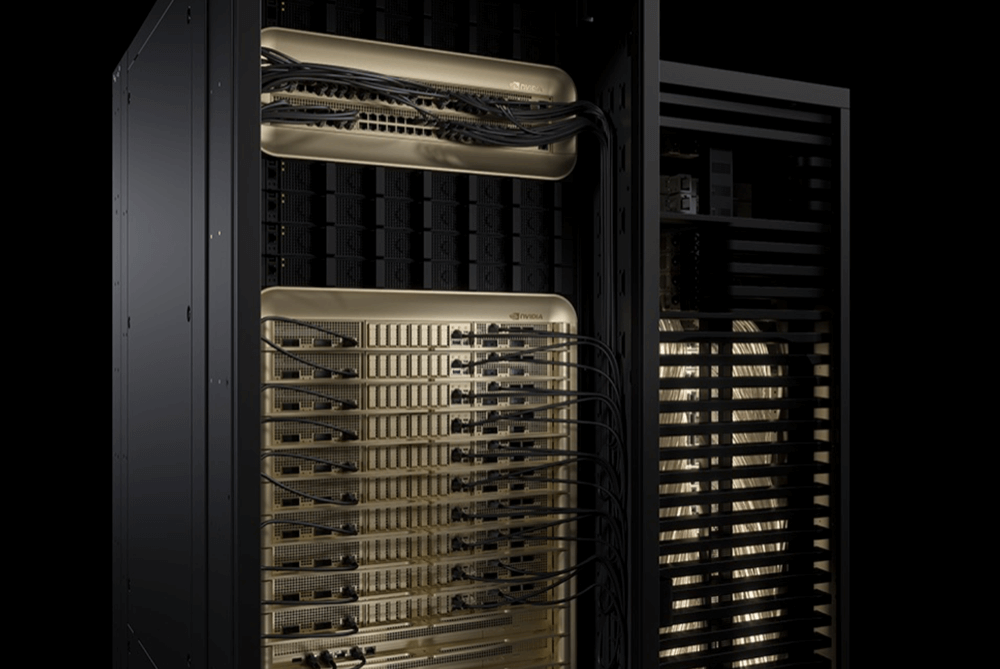
Microsoft Azure has deployed the world’s first production-scale NVIDIA GB300 NVL72 supercomputing cluster, marking a new era in AI infrastructure and U.S. technological leadership. The new NDv6 GB300 virtual machine (VM) series features more than 4,600 NVIDIA Blackwell Ultra GPUs connected via the Quantum-X800 InfiniBand platform. Purpose-built for OpenAI’s most demanding inference and training workloads, this cluster represents the most advanced co-engineered system yet between Microsoft and NVIDIA.

Each GB300 NVL72 rack combines 72 NVIDIA Blackwell Ultra GPUs and 36 Grace CPUs into a unified, liquid-cooled system delivering 37 TB of high-speed memory and 1.44 exaflops of FP4 Tensor Core performance per VM. NVLink Switch 5.0 technology enables 130 TB/s of intra-rack bandwidth, turning each rack into a single logical accelerator for reasoning, multimodal, and agentic AI models. At scale, NVIDIA Quantum-X800 InfiniBand interconnects more than 4,600 GPUs with 800 Gbps per-GPU bandwidth, advanced adaptive routing, congestion control, and SHARP v4 in-network computing to maximize throughput and minimize synchronization overhead.

Azure’s next-generation data center architecture integrates custom power distribution, high-density liquid cooling, and re-engineered orchestration stacks to sustain the compute intensity of trillion-parameter model development. The platform leverages NVIDIA’s full-stack AI software, including NVFP4 precision formats, compiler optimizations such as NVIDIA Dynamo, and communication libraries tuned for large-scale parallelism. In recent MLPerf Inference v5.1 benchmarks, the GB300 NVL72 achieved up to 5× higher throughput per GPU on the 671-billion-parameter DeepSeek-R1 reasoning model compared with the prior Hopper architecture, and led all new categories including the Llama 3.1 405B model.

“Delivering the industry’s first at-scale NVIDIA GB300 NVL72 production cluster for frontier AI is an achievement that goes beyond powerful silicon — it reflects Microsoft Azure and NVIDIA’s shared commitment to optimize all parts of the modern AI data center,” said Nidhi Chappell, Corporate Vice President of Microsoft Azure AI Infrastructure.

🌐 Analysis: This deployment places Microsoft as the first hyperscaler to operationalize NVIDIA’s Blackwell Ultra platform at production scale, ahead of AWS, Google, and Oracle. The Azure–NVIDIA collaboration positions the platform as the reference design for future frontier AI infrastructure, providing OpenAI with a faster path to multitrillion-parameter reasoning and multimodal systems. NVIDIA’s aggressive cadence from GB200 to GB300 underscores the accelerating AI hardware race, while Microsoft’s system-level integration signals how hyperscalers are reshaping data centers for exascale AI computing.


ShareTweetShare
Previous Post

Intel Ramps 18A Production at Fab 52

Next Post

OCP Calls for Collaboration on AI Data Center Infrastructure Standards

Jim Carroll

Jim Carroll

Editor and Publisher, Converge! Network Digest, Optical Networks Daily - Covering the full stack of network convergence from Silicon Valley

Related Posts

Cisco, G42, and AMD to Build AI Infrastructure in the UAE
AI Infrastructure

DigitalBridge Teams with KT for AI Data Centers in Korea

November 26, 2025
BerryComm Expands Central Indiana Fiber with Nokia
5G / 6G / Wi-Fi

Telefónica Germany Awards Nokia a 5-Year RAN Modernization Deal

November 26, 2025
AMD’s Compute + Pensando Network Architecture Powers Zyphra’s AI 
AI Infrastructure

AMD’s Compute + Pensando Network Architecture Powers Zyphra’s AI 

November 25, 2025
Bleu, the “Cloud de Confiance” from Capgemini and Orange
Clouds and Carriers

Orange Business Begins Migration of 70% of IT Infrastructure to Bleu Cloud

November 25, 2025
Dell’s server and networking sales rise 16% yoy
Financials

Dell Raises FY26 AI Infrastructure Outlook as AI Server Shipments Surge 150%

November 25, 2025
GlobalFoundries acquires Tagore Technology’s GaN IP
Optical

GlobalFoundries Acquires InfiniLink for Silicon-Photonics Expertise

November 25, 2025
Next Post
OCP releases Bunch of Wires (BoW) spec for chiplet interconnect

OCP Calls for Collaboration on AI Data Center Infrastructure Standards

Categories

  • 5G / 6G / Wi-Fi
  • AI Infrastructure
  • All
  • Automotive Networking
  • Blueprints
  • Clouds and Carriers
  • Data Centers
  • Enterprise
  • Explainer
  • Feature
  • Financials
  • Last Mile / Middle Mile
  • Legal / Regulatory
  • Optical
  • Quantum
  • Research
  • Security
  • Semiconductors
  • Space
  • Start-ups
  • Subsea
  • Sustainability
  • Video
  • Webinars

Archives

Tags

5G All AT&T Australia AWS Blueprint columns BroadbandWireless Broadcom China Ciena Cisco Data Centers Dell'Oro Ericsson FCC Financial Financials Huawei Infinera Intel Japan Juniper Last Mile Last Mille LTE Mergers and Acquisitions Mobile NFV Nokia Optical Packet Systems PacketVoice People Regulatory Satellite SDN Service Providers Silicon Silicon Valley StandardsWatch Storage TTP UK Verizon Wi-Fi
Converge Digest

A private dossier for networking and telecoms

Follow Us

  • Home
  • Events Calendar
  • Blueprint Guidelines
  • Privacy Policy
  • Subscribe to Daily Newsletter
  • NextGenInfra.io

© 2025 Converge Digest - A private dossier for networking and telecoms.

No Result
View All Result
  • Home
  • Events Calendar
  • Blueprint Guidelines
  • Privacy Policy
  • Subscribe to Daily Newsletter
  • NextGenInfra.io

© 2025 Converge Digest - A private dossier for networking and telecoms.

This website uses cookies. By continuing to use this website you are giving consent to cookies being used. Visit our Privacy and Cookie Policy.
Go to mobile version