Full article: Part 1, Part 2 , Part 3, Part 4
Preamble – note on RJIO coverage, update on BharatNet and the DTH market
It will be noted that while in Parts 2 and 3 a fair amount of detail was provided on the complex, wholesale restructuring of the Indian mobile communications market for three out of the four main groups – Bharti Airtel, Vodafone and RCOM – RJIO was covered somewhat peripherally in terms of its actual and potential relationship to RCOM, and there are several reasons for that. Firstly, RJIO is not being restructured, secondly its structure and situation and offer so far are all dramatic but not that complicated, thirdly, the company has been covered in detail from its first moves in 2010 and more specifically over the last 18 months, both in quasi-monthly updates on the market and in at least one dedicated series. In addition, it should be noted that however glorious its future may eventually turn out to be, the current situation is that RJIO is still very much a work in progress with as yet almost no revenue, no meaningful customer service history and no base of committed customers.
While India’s mobile market is by far the largest part of its communications systems and OND normally focuses on this currently turbulent sector, the country looks poised for real economic lift-off, and could manage to double its wealth each decade, so that many of its smaller markets will start to be of greater interest.
BharatNet – India’s National Optical Fibre Network
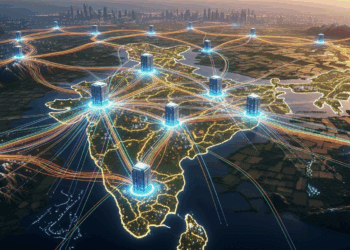
This project, launched by the Indian government in October 2011 at a proposed cost of INR 20,000 crore, as the National Optical Fibre Network, to link 250,000 small and medium-sized villages (gram panchayats) to a national fibre backbone and thus bring India’s still huge unconnected rural population into one national digital internet community via fixed broadband rates of under INR 150 per month, has constantly missed connectivity targets set for it. This is largely due to difficulties of obtaining rights of way to lay the fibre. As of late February 2015, only 5,000 villages had been connected. In early April 2015, when 20,000 villages were reported to have been connected, the project, expected to cost INR 72,000 crore, was re-launched under the name BharatNet, with a target of completing the 250,000 connections by the end of 2016.
At the end of May 2015 at a meeting in New Delhi of representatives of the majority of Indian states, chaired by Telecom Minister Ravi Shankar Prasad, it was revealed that several states, namely Andhra Pradesh, Haryana, Himachal Pradesh, Madhya Pradesh, Maharashtra, Odisha. Tamil Nadu and West Bengal, all said to be dissatisfied with the rate of progress of implementation of the network (nominally being carried out under the management of SPV Bharat Broadband Network Limited and executed by CPSUs BSNL, RailTel and Powergrid) were considering, had proposed or were already engaged in implementing independent state versions of the network.
Specifically, in mid-January 2015 India’s Economic Times had reported that the state government of Andhra Pradesh (with a population of over 53 million, or 4.0% of the national total) planned to provide broadband connections with speeds of up to 15 Mbit/s to 12 million households for a monthly fee of INR150 in the first stage of a local INR 50 billion optical fibre deployment project, and had requested India’s federal government hand over its share of funds from the NOFN. Also, in mid-October 2016 the first minister of the State of Maharashtra (population – 121 million, or 9.29% of the national total) Defendra Fadnavis, was quoted by numerous sources as saying that the Maharashtra government was investing around INR 5,000 crore in the Digital Maharashtra project, which in the first phase would digitally connect 29,000 gram panchayats across the state under a program called MahaNet, described as part of BharatNet and designed to ensure education, healthcare, better access to government services and markets.
Similarly, in mid September 2015 NDTV reported that the government of the state of Tamil Nadu (population 78 million, or about 6.0% of the national total) would, using an ISP license obtained from India’s Ministry of Communications and an investment of about $452 million, provide Internet services including IPTV via the state-owned CATV operator Tamil Nadu Arasu Cable TV Corporation and implement BharatNet linking over 12,500 local rural bodies in the state. TACTV has signed a pact with RailTel to provide high speed broadband services and 552 local cable operators have been selected for this operation so far. The broadband will be provided by a newly formed company, the Tamil Nadu Fibernet Corporation, which may later offer VoD services as well.

Meanwhile, on February 1, 2017 Finance Minister Arun Jaitley said that the government would allocate INR 10,000 crore ($1.6 billion) to expand the BharatNet project in fiscal 2018. Jaitley added that high-speed broadband over fibre would be available in over 1.5 lakh gram panchayats with hotspots and access to digital services at low tariffs by the end of 2017-18.
Commercial DTH market with 62.65m active subscribers
Since its introduction in 2003, Indian DTH service has displayed a phenomenal growth. DTH has attained a registered pay subscriber base of around 97.05 million (including 62.65 million active subscribers). As on December 2016 there were 6 pay DTH service providers, aside from viewership of the free DTH services of state-owned Doordarshan.
These six private DTH firms are Dish TV, Reliance BIG TV, Tata Sky, Videocon d2h, Sun Direct TV and Bharti Telemedia. State broadcaster Doordarshan also runs a DTH platform for free-to-air channels called DD Free Dish, which some sources claim has around 20-22 million users. Of the pay TV vendors, Dish TV is the market leader with a 25% share, followed by Tata Sky with a 23%, according to data for September 2016 from TRAI. Videocon d2h and Bharti Telemedia have 20% market share each.
In November 2016 Zee Entertainment Enterprises-owned DTH platform Dish TV and the DTH arm of Videocon Industries announced plans to merge into a new 55/45% entity to be renamed as Dish TV Videocon, which based on the most recent TRAI data above would have a 45% market share and serve 27.6 million customers within an overall market of 175 million TV households. Meanwhile, the Competition Commission of India (CCI) has asked TRAI to assess whether this merger will violate any anti-trust laws.
Although the DTH market in India continued to grow during 2026 there is evidence that it is coming under pressure at the top end from OTT services from companies such as Amazon and Netflix, and at the bottom end from Doordarshan, which is believed to have gained customers recently partly due to the impact of India’s demonetisation drive on rural populations.