AI is transforming every layer of the digital economy — and networks must evolve to think, act, and secure themselves in real time.
Speaking at the Mplify Global Network Executive (GNE) Conference in Dallas, Pascal Menezes, CTO of Mplify (formerly MEF), delivered a sweeping presentation on how automation, network-as-a-service (NaaS), and new interoperability standards will define the AI era. He outlined how Mplify and its partners are building the frameworks to make networks adaptive, programmable, and AI-ready — both in fixed and mobile domains.
“Connectivity is the foundational layer of AI,” Menezes said. “Without automation and programmable fabrics, networks can’t adapt fast enough to support the agents, models, and data movement that define this new world.”
Four Major Themes for the AI Era
Menezes framed Mplify’s mission and roadmap around four key areas where members can monetize and lead during the AI transformation:
- Connectivity for AI – High-capacity, deterministic transport connecting GPUs, data centers, and inference nodes.
- Automation for AI – Autonomous, adaptive networks driven by API and AI agent interactions.
- Cybersecurity for AI – Embedding zero trust, identity, and policy frameworks across automated fabrics.
- Sovereign AI – National and regional AI infrastructures built on local connectivity, compute, and policy control.
Connectivity: The Foundation of AI
Menezes emphasized that transport is the “toll bridge” of AI — the glue that synchronizes models, connects data pipelines, and enables inference at the edge. As AI workloads grow, networks must deliver deterministic, elastic, and secure connectivity across wavelengths, OTNs, and broadband.
Mplify’s new Carrier Ethernet for AI certification extends traditional performance standards to next-generation networks spanning terrestrial fiber, satellite, and 5G fixed wireless access. This ensures predictable performance across both wired and wireless domains — from data center interconnects to last-mile access.
Automation: From APIs to Agents
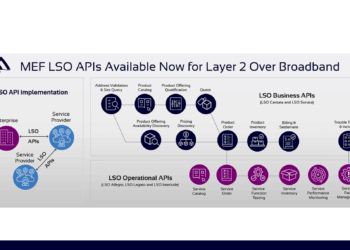
For the past decade, Mplify (formerly MEF) has standardized Lifecycle Service Orchestration (LSO) APIs — the transactional “containers” for ordering, monitoring, and managing network services. Menezes revealed the next evolution: wrapping these APIs in AI-friendly “payloads” and domain-specific languages (DSLs) that can be read, reasoned about, and executed by AI agents.
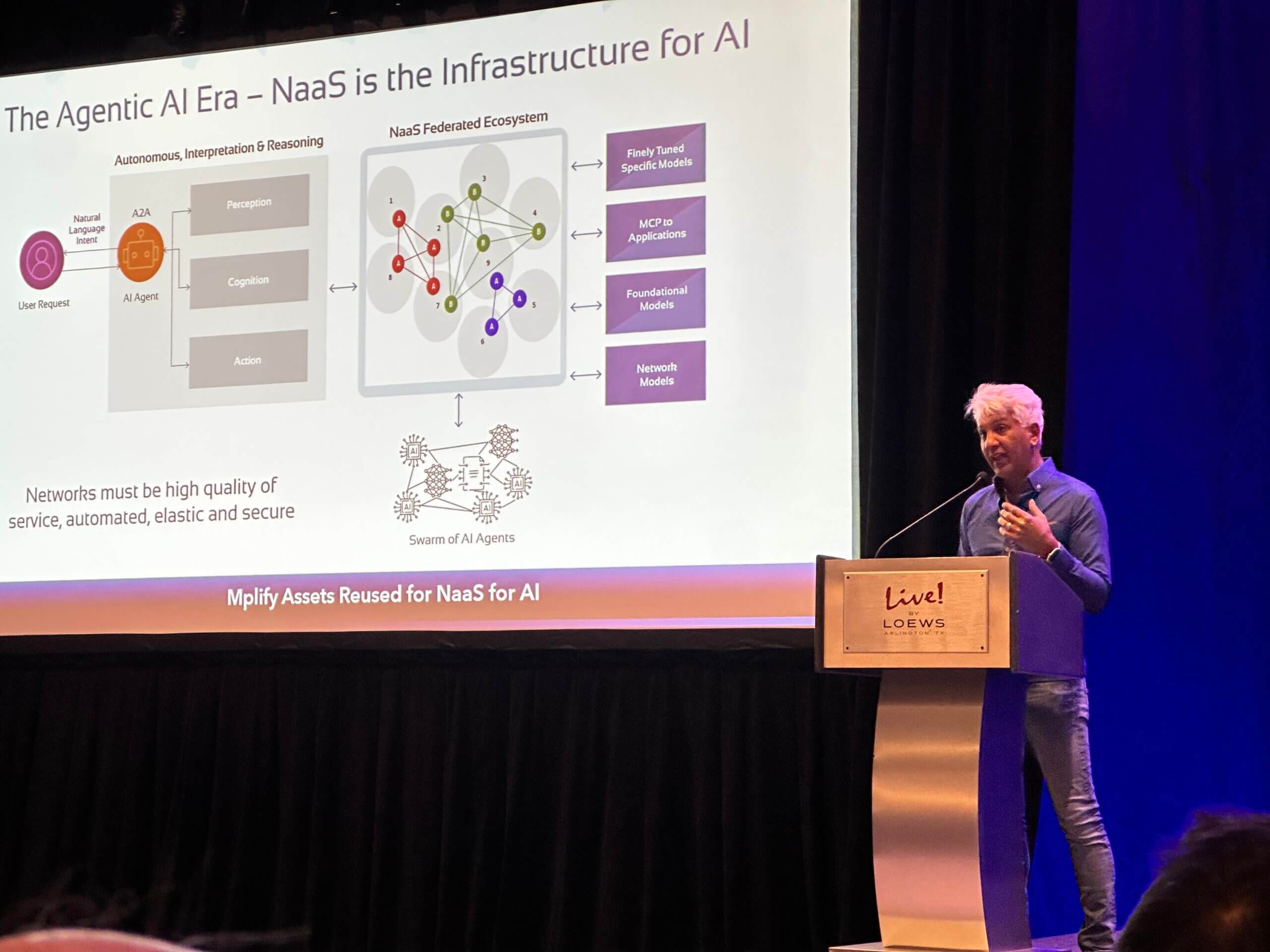
Mplify’s new MCP (Model Context Protocol) and A2A (Agent-to-Agent) frameworks will allow AI systems to communicate across organizational boundaries, automating provisioning, monitoring, and optimization.
“AI agents won’t code to APIs directly,” Menezes explained. “Instead, they’ll communicate through DSLs — shared languages that describe what each network service does, how it behaves, and how it’s secured. That’s what makes the network AI-native.”
Security and Trust in an Agentic World
As networks evolve to host thousands of interacting AI agents, Menezes stressed the need for trust, authentication, and policy control at every level. Mplify’s roadmap includes agent certification, threat assessment, and zero trust policy enforcement — ensuring that autonomous agents and models operate safely and predictably.
Sovereign AI: National Infrastructure as a Strategic Asset
In one of the keynote’s most forward-looking segments, Menezes discussed the rise of Sovereign AI, where nations fund domestic AI infrastructure using their own fiber, spectrum, and data policies.
Countries will build localized AI training and inference facilities, retaining control over their data, models, and intellectual property. Mplify’s evolving standards aim to define GPU-as-a-Service and Model-as-a-Service architectures, providing the same interoperability and assurance that Carrier Ethernet brought to IP connectivity.
“For the first time, governments are looking to their carriers not just as service providers but as sovereign AI infrastructure partners,” Menezes said.
GSMA–Mplify Collaboration: Bridging Fixed and Mobile NaaS
Menezes also previewed a new collaboration between GSMA’s CAMARA initiative and Mplify’s LSO APIs to enable a unified Network-as-a-Service (NaaS) experience for wired and wireless operators.
Through shared business and operational APIs, the initiative will allow developers to program network behavior across 5G, broadband, and edge fabrics — ensuring common service models, consistent security, and AI-driven orchestration across all domains.
Analysis
Mplify’s vision positions the network not as a passive transport layer but as a cognitive platform capable of interacting directly with AI models and agents. By merging its mature LSO API ecosystem with AI-native payloads and model context protocols, Mplify is defining the standards foundation for an autonomous, adaptive network economy.
The implications are vast: AI-driven NaaS, sovereign compute regions, and cross-domain interoperability will redefine how service providers, hyperscalers, and enterprises collaborate.