• Home
  • Events Calendar
  • Blueprint Guidelines
  • Privacy Policy
  • Subscribe to Daily Newsletter
  • NextGenInfra.io
No Result
View All Result
Converge Digest
Saturday, April 11, 2026
  • Home
  • Events Calendar
  • Blueprint Guidelines
  • Privacy Policy
  • Subscribe to Daily Newsletter
  • NextGenInfra.io
No Result
View All Result
Converge Digest
No Result
View All Result

Home » NASA’s Psyche mission to test Deep Space Optical Comms

NASA’s Psyche mission to test Deep Space Optical Comms

October 9, 2023
in Space
A A

This week NASA is slated to launch its Psyche asteroid mission on a SpaceX Falcon Heavy rocket from Kennedy Space Center in Florida.

The spacecraft will visit Psyche, which orbits the Sun between Mars and Jupiter, to learn how Earth and other rocky planets formed. It is the first mission to an asteroid with substantial amounts of metal, as previous missions have explored asteroids made mostly of rock or ice. 

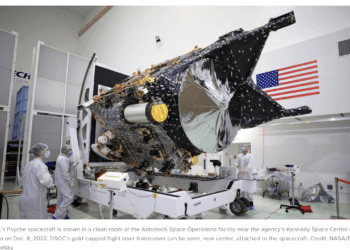
The mission will also host NASA’s Deep Space Optical Communications (DSOC) experiment, which will test the ability of lasers to transmit data at higher rates than traditional radio communications beyond the Moon. During the first two years of Psyche’s journey to its namesake asteroid, DSOC will test high-bandwidth optical communications to Earth. The experiment will not be relaying Psyche mission data.

The near-infrared transceiver’s 22-centimeter aperture telescope is mounted on an isolation-and-pointing assembly that stabilizes the optics and isolates it from spacecraft vibrations. 

The data sent back by the DSOC transceiver on Psyche will be collected by the 200-inch (5.1-meter) Hale Telescope at Caltech’s Palomar Observatory in San Diego County, California, using a sensitive superconducting nanowire photon-counting receiver to demonstrate high-rate data transfer.

Signals sent back to the spacecraft will be emitted by a high-power near-infrared laser transmitter at the Jet Propulsion Laboratory’s Table Mountain facility near Wrightwood, California.

The key objectives of the experiment are to demonstrate:

  • that flight laser transceiver and ground systems are able to lock onto each other’s laser signals during DSOC’s calibration and commissioning phase.
  • that optical transmissions are feasible at a distance of 1 astronomical unit (equal to the distance from the sun to the Earth ~ 150 million km)
  • that the system can operate for a duration of 2 years.

Source: NASA
Tags: NASA
ShareTweetShare
Previous Post

Zayo updates network rollouts including 400G milestones

Next Post

MEF’s Enterprise Leadership Council

Jim Carroll

Jim Carroll

Editor and Publisher, Converge! Network Digest, Optical Networks Daily - Covering the full stack of network convergence from Silicon Valley

Related Posts

NASA’s Deep Space optical communications achieves first light
Space

NASA’s Deep Space optical communications achieves first light

November 17, 2023
NASA awards contracts for space communications
All

NASA awards contracts for space communications

October 12, 2022
NASA awards $622.5M contract for Cybersecurity and Enterprise
All

NASA awards $622.5M contract for Cybersecurity and Enterprise

May 17, 2022
NASA picks Nokia to supply 4G network for the Moon
All

NASA picks Nokia to supply 4G network for the Moon

October 19, 2020
Next Post
Industry Pivot to NaaS

MEF's Enterprise Leadership Council

Categories

  • 5G / 6G / Wi-Fi
  • AI Infrastructure
  • All
  • Automotive Networking
  • Blueprints
  • Clouds and Carriers
  • Data Centers
  • Enterprise
  • Explainer
  • Feature
  • Financials
  • Last Mile / Middle Mile
  • Legal / Regulatory
  • Optical
  • Quantum
  • Research
  • Security
  • Semiconductors
  • Space
  • Start-ups
  • Subsea
  • Sustainability
  • Video
  • Webinars

Archives

Tags

5G All AT&T Australia AWS Blueprint columns BroadbandWireless Broadcom China Ciena Cisco Data Centers Dell'Oro Ericsson FCC Financial Financials Huawei Infinera Intel Japan Juniper Last Mile Last Mille LTE Mergers and Acquisitions Mobile NFV Nokia Optical Packet Systems PacketVoice People Regulatory Satellite SDN Service Providers Silicon Silicon Valley StandardsWatch Storage TTP UK Verizon Wi-Fi
Converge Digest

A private dossier for networking and telecoms

Follow Us

  • Home
  • Events Calendar
  • Blueprint Guidelines
  • Privacy Policy
  • Subscribe to Daily Newsletter
  • NextGenInfra.io

© 2025 Converge Digest - A private dossier for networking and telecoms.

No Result
View All Result
  • Home
  • Events Calendar
  • Blueprint Guidelines
  • Privacy Policy
  • Subscribe to Daily Newsletter
  • NextGenInfra.io

© 2025 Converge Digest - A private dossier for networking and telecoms.

This website uses cookies. By continuing to use this website you are giving consent to cookies being used. Visit our Privacy and Cookie Policy.
Go to mobile version