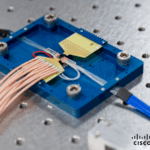
Quantum Computing Inc. (QCi) secured its first direct U.S. government contract for thin-film lithium niobate (TFLN) photonic integrated circuits (PICs) from the National Institute of Standards and Technology (NIST), part of the Department of Commerce. The contract, running from June 16, 2025, through April 15, 2026, covers design and fabrication of PICs optimized for low-loss waveguides, high-performance modulators, and narrow-band filters.
In addition to the NIST award, QCi also booked a TFLN chip order from a Fortune 500 science and technology company active in defense, intelligence, civil, and commercial sectors. Together, these wins strengthen QCi’s position as a U.S.-based supplier of advanced photonic technologies at a time when domestic capacity for secure, high-performance photonics is in demand. The company’s foundry model enables accelerated prototyping and fabrication for mission-critical systems.
QCi has previously participated in government projects through subcontracts, but this direct engagement with NIST signals broader adoption of its TFLN platform across national security and commercial markets. The company positions its photonics technology for applications spanning high-performance computing, artificial intelligence, cybersecurity, and sensing.
- NIST awarded QCi a TFLN photonic chip contract, June 2025–April 2026
- First direct government contract for QCi’s foundry services
- Project scope: low-loss waveguides, modulators, and narrow-band filters
- Additional order placed by a Fortune 500 defense and technology company
- Expands QCi’s role as a domestic supplier of mission-critical photonic technologies
“We are excited to support the NIST mission with our state-of-the-art TFLN capabilities. This contract highlights the potential of our foundry model and our commitment to providing secure, domestic access to cutting-edge photonic technologies,” said Dr. Pouya Dianat, Chief Revenue Officer of QCi.
🌐 Why it Matters: The NIST contract underscores growing U.S. emphasis on secure, domestic photonics manufacturing for advanced computing and defense applications. TFLN platforms are seen as critical enablers for next-generation AI, quantum, and secure communications systems, making QCi’s entry into direct government contracts strategically significant.
🌐 We’re tracking the latest developments in networking silicon. Follow our ongoing coverage at: https://convergedigest.com/category/semiconductors/