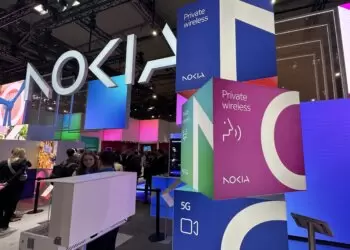
Nokia Bell Labs is celebrating its 100th anniversary in 2025, celebrating a century of groundbreaking research that has shaped modern communications, computing, and the internet.
Founded in 1925 as the Bell Telephone Laboratories, a joint venture between the Bell System companies and Western Electric (the manufacturing arm), Bell Labs has been responsible for pioneering technologies such as the transistor, the solar cell, the laser, and foundational advancements in radio astronomy, semiconductors, and cellular networks. Over the decades, its work has earned 10 Nobel Prizes, five Turing Awards, and numerous accolades across various fields. Bell Labs became known for pioneering numerous technological breakthroughs, including the transistor, radio astronomy, Information Theory, and fiber-optic communication.
Nokia acquired Bell Labs through a series of corporate transitions starting with AT&T’s 1996 spin-off of its equipment and research division into Lucent Technologies, which included Bell Labs. In 2006, Lucent merged with Alcatel, forming Alcatel-Lucent, with Bell Labs as its research arm. A decade later, in 2016, Nokia acquired Alcatel-Lucent to strengthen its position in network infrastructure, bringing Bell Labs under its ownership.
Continuing its legacy, Nokia Bell Labs is pushing the boundaries in space communications, quantum technologies, artificial intelligence, and advanced sensing. The lab is setting optical speed records, advancing 6G research, and developing communication networks designed to support sustained human presence on the Moon and beyond. Its innovations remain at the core of global telecommunications infrastructure, influencing the next generation of digital and physical integration.
With a century of transformative discoveries, Nokia Bell Labs remains committed to solving fundamental challenges that impact industries and societies worldwide. As the lab enters its next 100 years, it aims to further redefine human interaction with technology, drive sustainable innovation, and expand the possibilities of communication both on Earth and in space.
Peter Vetter, President of Bell Labs Core Research at Nokia, said: “At Nokia Bell Labs, we don’t just follow trends, we create them. Our researchers focus on solving hard problems that have a real human need in order to come up with the next big thing.”
Nokia Bell Labs to relocate its Murray Hill campus

In December 2023. Nokia Bell Labs announced plans to relocate its campus to a new state-of-the-art research and development facility in New Brunswick.
The move will establish New Brunswick as Nokia’s new R&D hub on the East Coast. The new facility, which will break ground in 2025 and is expected to be completed by 2028.
Nishant Batra, Chief Strategy and Technology Officer at Nokia, said: “Our Murray Hill campus has been home to iconic Nokia Bell Labs innovation for over 80 years. As we look toward the future of Nokia and Nokia Bell Labs in the region, we will take with us all that makes us exceptional – our vision, brainpower, culture of disruptive innovation, and technical prowess – and marry that legacy with a modern research and development facility that is built to our needs. Ultimately, we want a facility that feels right for the next 100 years of Nokia Bell Labs.”

- The Nokia Bell Labs’ campus in Murray Hill, New Jersey, originally established in the 1940s as part of Bell Telephone Laboratories, has been a center of technological innovation for decades. Renowned for developing the transistor in 1947, the facility has been associated with numerous Nobel Prizes, including advancements in lasers, the charge-coupled device, and the creation of the Unix operating system. Following the AT&T breakup in the 1980s, Bell Labs became part of Lucent Technologies, which later merged with Alcatel to form Alcatel-Lucent. In 2016, Nokia acquired Alcatel-Lucent, integrating Bell Labs into its structure.