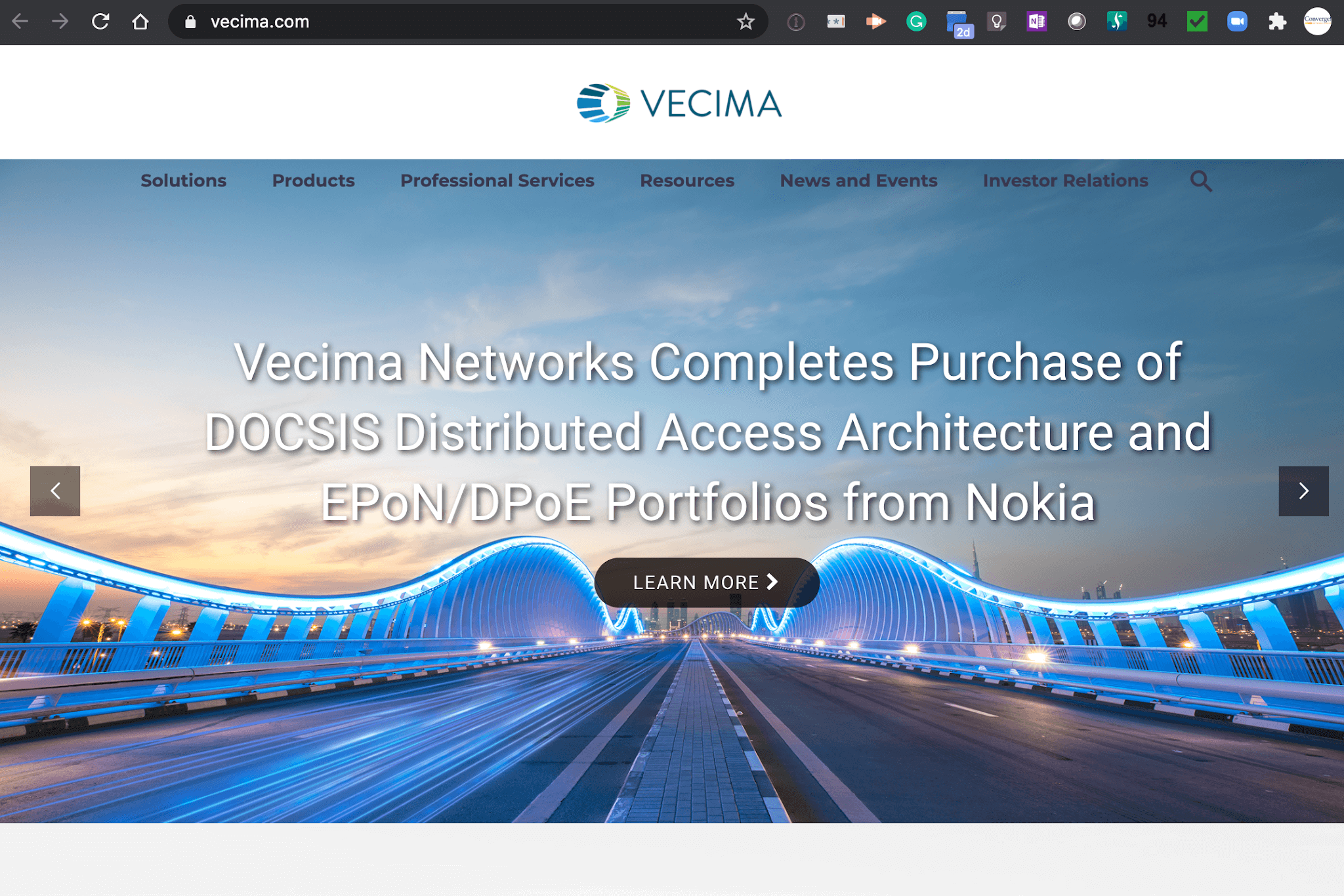
Nokia has sold its Gainspeed EPON/DPoE business to Vecima Networks. Financial terms were not disclosed.
Nokia said it plans to maintain an ongoing business relationship with Vecima that includes key, enabling technologies to address unified cable access opportunities.
 Nokia will retain its cable-related products and solutions including mobile, routing, transport, fiber, and fixed wireless access technology, along with network operations and customer experience-related solutions.
Vecima Networks, which is based in Victoria, BC, Canada, provides integrated hardware and scalable software solutions for broadband access, content delivery and telematics.
The companies said Nokia’s Gainspeed cable access portfolio is well-aligned with Vecima’s Entra family, both of which address the migration to cable’s 10G platform, including DAA (Distributed Access Architecture) and 10G-EPON.
The Nokia Unified Cable Access solution, featuring the Gainspeed portfolio of products, includes a centrally controlled Distributed Access Architecture solution with unified support for Flexible MAC DAA nodes for Hybrid Fiber-Coaxial (HFC) networks and DOCSIS Provisioning of EPON (DPoE) nodes for fiber-to-the-home and business. The portfolio also includes a DAA video engine and a chassis-based EPON/DPoE solution for non-HFC network implementations.
“Our cable access solutions have played a very important role in helping to redefine next generation cable solutions and our customers’ strategies for addressing evolving network demands using distributed architectures,” said Sandra Motley, President of Fixed Networks at Nokia. “However, the industry continues to go through significant shifts, and we believe the timing is right to transition our cable access business to Vecima Networks. Vecima has the focus, resources and complementary product portfolio needed to support these changes and help operators move toward a Distributed Access Architecture.”
Nokia intros virtualized Distributed Access Architecture
Nokia introduced the next generation of its Unified Cable Access solution based on a Distributed Access Architecture (DAA) that gives cable operators the flexibility to deploy both R-PHY and R-MACPHY devices within the same network and easily switch from one to the other based on their network requirements and strategic direction.
The basic idea with DAA is to move cable access layer functions that are traditionally placed in the headend and hub sites to the access nodes. To date, cable operators have had to choose between two DAA approaches: R-PHY, which moves only the DOCSIS signal generation (PHY) to the access node; and R-MACPHY, which moves both the PHY and DOCSIS processing (MAC) to the access node.
Features of Nokia’s new vDAA include:
- vCMTS Anywhere – Nokia has virtualized a cable modem termination system (CMTS), which includes the DOCSIS MAC, as a virtual network function (VNF). This provides the flexibility to run the vCMTS anywhere in the network: on the node, or on an off-the-shelf server in the outside plant, hub, headend or data center.
- Universal Node – Cable operators can convert a Gainspeed cable access node from R-PHY to R-MACHPHY, or vice versa, on the fly. This capability lets operators choose the best approach to a node for a given use case. It also enables an operator to seamlessly evolve from an R-PHY to R-MACPHY deployment.
- Unified Control – The Gainspeed access controller can simultaneously support both R-PHY and R-MACPHY nodes, expanding its current cable and fiber unified control capabilities. This helps operators reduce costs and simplify network design by using the same controller to manage all types of Nokia access nodes deployed across HFC and fiber networks
- Interoperability – Nokia is committed to full solution interoperability and will support any R-PHY or R-MACPHY node as part of its solution.

In 2016, Nokia acquired Gainspeed, a start-up specializing in DAA (Distributed Access Architecture) solutions for the cable industry via its Virtual CCAP (Converged Cable Access Platform) product line. Financial terms were not disclosed. Gainspeed’s Virtual CCAP enables cable operators to increase the capacity of their existing HFC (Hybrid Fiber Coax) infrastructure and rapidly deploy new services, while simultaneously reducing space and power requirements in the headend. The solution also enables cable operators to migrate their networks to a software-driven, all-IP architecture. Gainspeed’s design eliminates the physical CCAP by leveraging SDN and NFV to distribute the CCAP’s functions to other devices and locations in the network. This centralizes routing, control and management in the data center or cloud and pushes
the physical layer, DOCSIS processing and RF modulation into the node, deep within