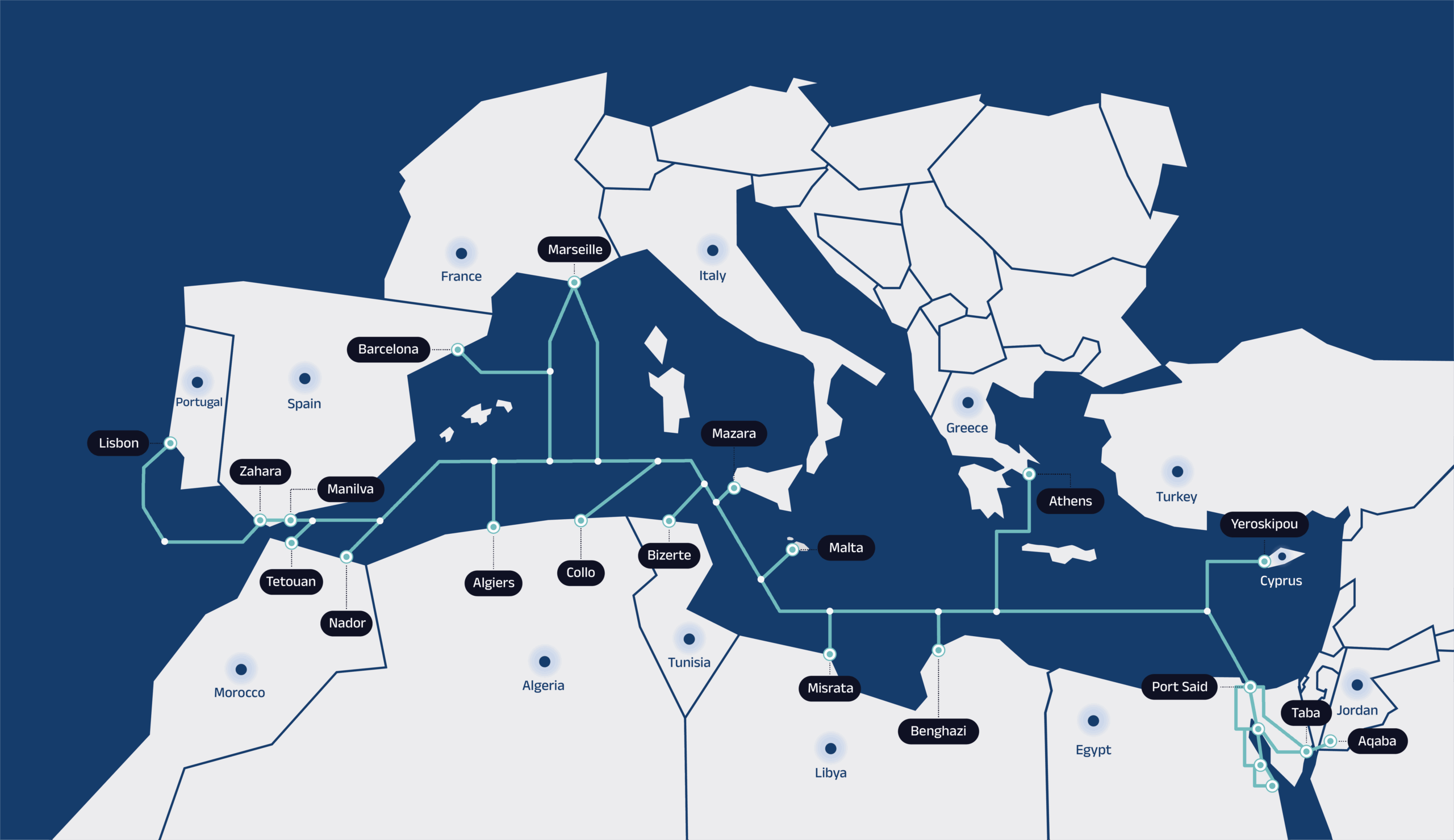
Nokia has been selected by AFR-IX Telecom to provide optical transport solutions for the Medusa subsea cable system, a new open-access fiber infrastructure that will link multiple landing points across Europe and North Africa. The cable system, currently under deployment, aims to create a high-capacity, low-latency digital corridor spanning the Atlantic coast, Mediterranean Sea, and Red Sea—serving as a critical enabler for 5G, AI, and cloud infrastructure growth in the region.
Medusa will connect key sites in North Africa—including Morocco, Algeria, Tunisia, Libya, and Egypt—with major European countries such as Portugal, Spain, France, Italy, and Greece. Designed as an open-access system, Medusa will allow regional telecom operators to access international capacity while supporting large-scale digital applications. Nokia’s 1830 Global Express (GX) platform and ICE7 coherent optics will deliver multi-terabit throughput per fiber pair, ensuring scalability and power efficiency across the system’s 8,700 km length.
With this contract, Nokia strengthens its position in the global subsea and long-haul optical transport market. The deal follows its acquisition of Infinera, which added high-performance photonic integration and coherent optics to its portfolio. The combined capabilities make Nokia a leading supplier of end-to-end optical transport solutions for both terrestrial and submarine networks, especially critical infrastructure spanning multiple countries and continents.
• AFR-IX Telecom owns and operates the Medusa subsea cable
• System includes landing points in Morocco, Algeria, Tunisia, Libya, Egypt, Portugal, Spain, France, Italy, and Greece
• Nokia will deploy its 1830 GX optical transport platform with ICE7 coherent optics
• Open-access design supports regional operators and hyperscale connectivity
• Supports high-bandwidth services for 5G, AI, and cloud deployments
• Medusa will span 8,700 km and deliver tens of Tbps per fiber pair
“Medusa is laying the groundwork for a more connected and inclusive digital future. With Nokia’s subsea optical solution, we will be able to deliver greater value to our customers by offering faster, more reliable connectivity at a lower cost, with the flexibility to scale as needs evolve,” said Miguel Angel Acero, CTO and Founder of Medusa.
🌐 Why it Matters: Nokia’s selection underscores its growing prominence in optical transport, reinforced by its recent acquisition of Infinera. This strategic move expanded Nokia’s capabilities across coherent optics and photonic integration, positioning the company to lead in high-capacity, long-haul, and subsea networks. The Medusa project reflects that momentum, enabling Nokia to help build a pan-regional fiber backbone linking Europe and Africa for the AI and cloud era.
🌐 We’re tracking the latest developments in subsea cable infrastructure, policy, and deployments. Follow our ongoing coverage at: https://convergedigest.com/category/subsea/