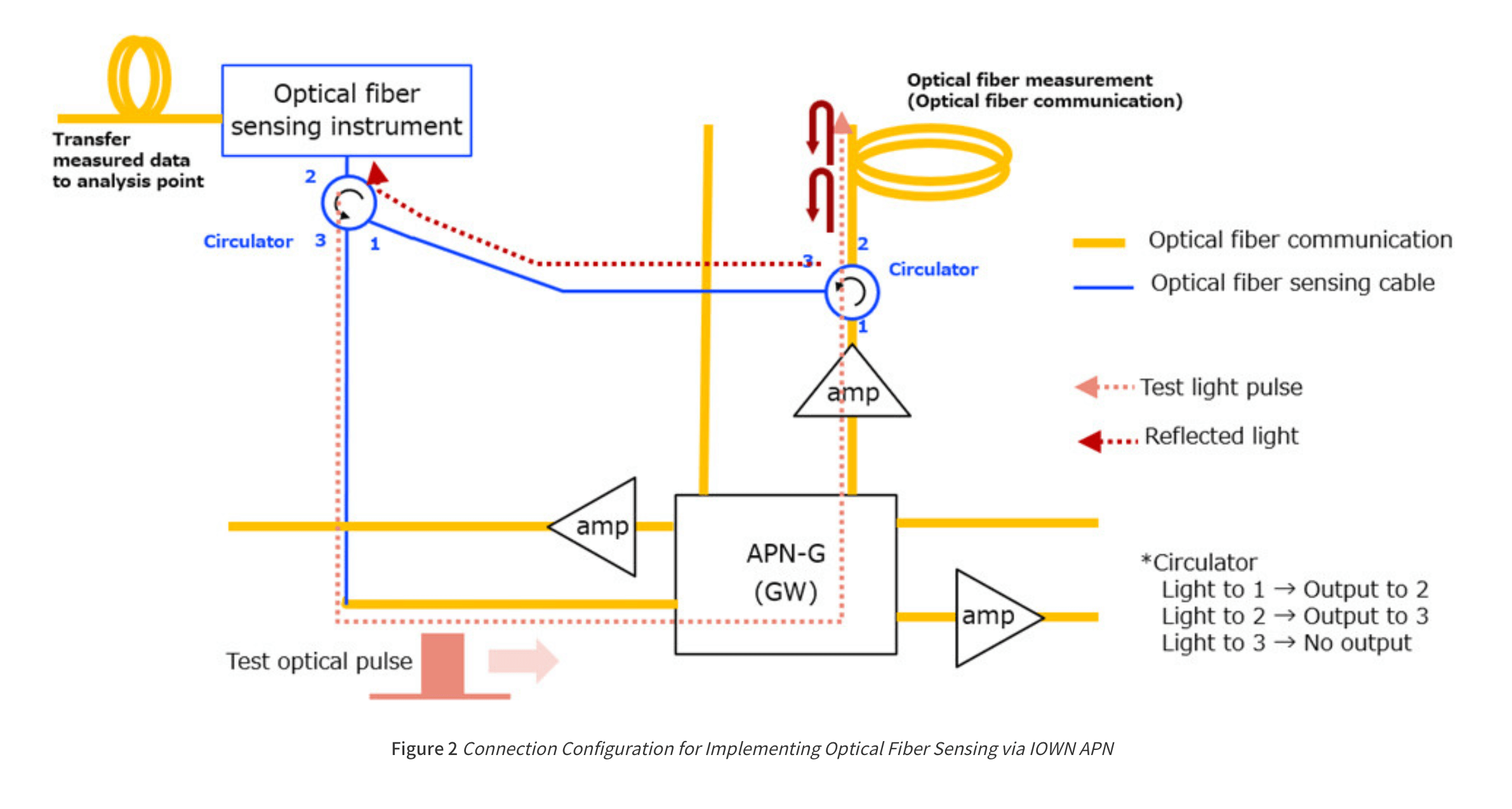
NTT Corporation, NTT EAST, NTT WEST, and NEC have jointly enhanced the IOWN All-Photonics Network (APN) by integrating optical fiber sensing technology to monitor real-time traffic conditions across multiple routes in Osaka City. By utilizing pre-existing underground optical fiber communication routes, the system captures and analyzes surface vibrations to assess vehicle speeds, traffic density, and flow patterns. The demonstration project spanned five routes, covering 37 km (23 miles) of optical fiber, and successfully visualized traffic trends over 8 km (5 miles) of roadways. The system also enables detailed analysis of vehicle speed and traffic volume in real time, providing valuable data for urban traffic management.
This optical fiber sensing configuration delivers a cost-effective and scalable solution for wide-area urban monitoring. Traditional traffic sensors require permanent installation at specific intervals, which can be costly and limited to certain locations. By contrast, NTT’s optical fiber sensing can flexibly monitor traffic conditions at any point along the fiber network, offering a broader and more adaptive system. The collaborative effort aims to expand this technology nationwide, enhancing urban infrastructure monitoring with potential applications in traffic management, disaster prevention, and urban planning.
The demonstration took place from December 2023 to January 2024, with analysis and validation conducted from February to July 2024. The project used five vibration sensing devices connected to the APN to track traffic over existing fiber optic cables. By applying a vehicle speed analysis algorithm, the system could visualize average vehicle speeds and traffic density with 200-meter (656-foot) granularity. The test confirmed that the results from the optical fiber sensing system closely aligned with data collected from other traditional traffic monitoring tools, showcasing the system’s accuracy and reliability.
Key Points:
• Optical fiber sensing deployed across 37 km of existing communication fiber in NTT WEST’s Osaka City service area.
• Test covered an 8 km stretch of open roads, monitoring vehicle speeds and traffic in real time.
• Analysis detected vehicle speeds and traffic density at intervals of 200 meters (656 feet).
• Data collection occurred between December 2023 and January 2024, with analysis extending until July 2024.
• The technology enables flexible traffic monitoring without the need for permanent roadside installations.
By leveraging optical fiber already in place for communication, the APN system offers a new approach to traffic monitoring, which could be expanded to monitor broader urban issues such as infrastructure health, disaster detection, and road safety. With the success of this demonstration in Osaka, the companies plan to continue research and development in collaboration with the IOWN Global Forum to further refine the system and explore additional use cases.
“With this demonstration, we’re moving towards smarter urban traffic management using existing infrastructure,” said a representative from NEC. “Our goal is to use this technology to help cities make data-driven decisions that improve traffic flow and reduce congestion.”