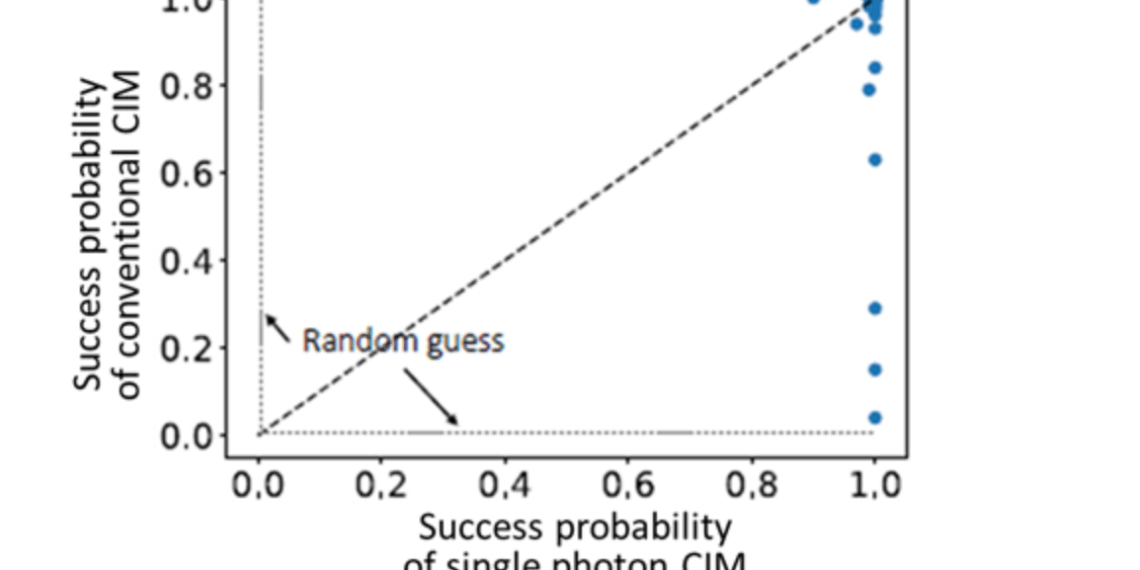
NTT Research and Tohoku University have published a joint study demonstrating that single-photon Coherent Ising Machines (CIMs) can outperform conventional models that rely on significantly higher photon counts. The findings, published in Quantum Science and Technology, challenge long-held assumptions that weaker light sources yield inferior computational performance. Instead, the research shows that CIMs operating with just one photon per pulse exhibit superior success probabilities in solving combinatorial optimization problems, thanks to the conversion of quantum entanglement into robust classical correlations.
The collaboration focuses on developing a scalable cyber CIM platform capable of simulating large-scale optimization problems using high-performance computing (HPC). As part of a Joint Research Agreement, Tohoku University is optimizing a third-generation cyber CIM that can scale to 100 million spins with sparse connectivity. The goal is to create energy-efficient accelerators for machine learning tasks by leveraging hybrid analog/digital computing based on quantum optical principles.
In contrast to conventional CIMs reported in Science in 2016, which operated with over 100 million photons per pulse, the new single-photon approach introduces a quantum advantage. Researchers found that the weak light regime enables a unique mechanism where quantum entanglement is rapidly converted into classical correlations through measurement and feedback—an effect absent in traditional systems. This insight could unlock faster, more efficient computation for NP-hard and combinatorial problems.
- NTT Research and Tohoku University demonstrated superior performance using single-photon CIMs
- The study shows quantum entanglement can be converted into classical correlations via feedback
- The collaboration targets scalable cyber CIMs using high-performance computing
- New models show success rates higher than CIMs using many photons per pulse
- Future efforts will move toward physical implementation of single-photon CIMs
“By combining quantum optical formalism and digital electronic platforms, our work with Tohoku University brings us one step closer to bringing to life a large-scale CIM simulator,” said Yoshihisa Yamamoto, PHI Lab Director at NTT Research.