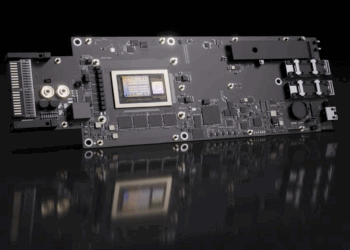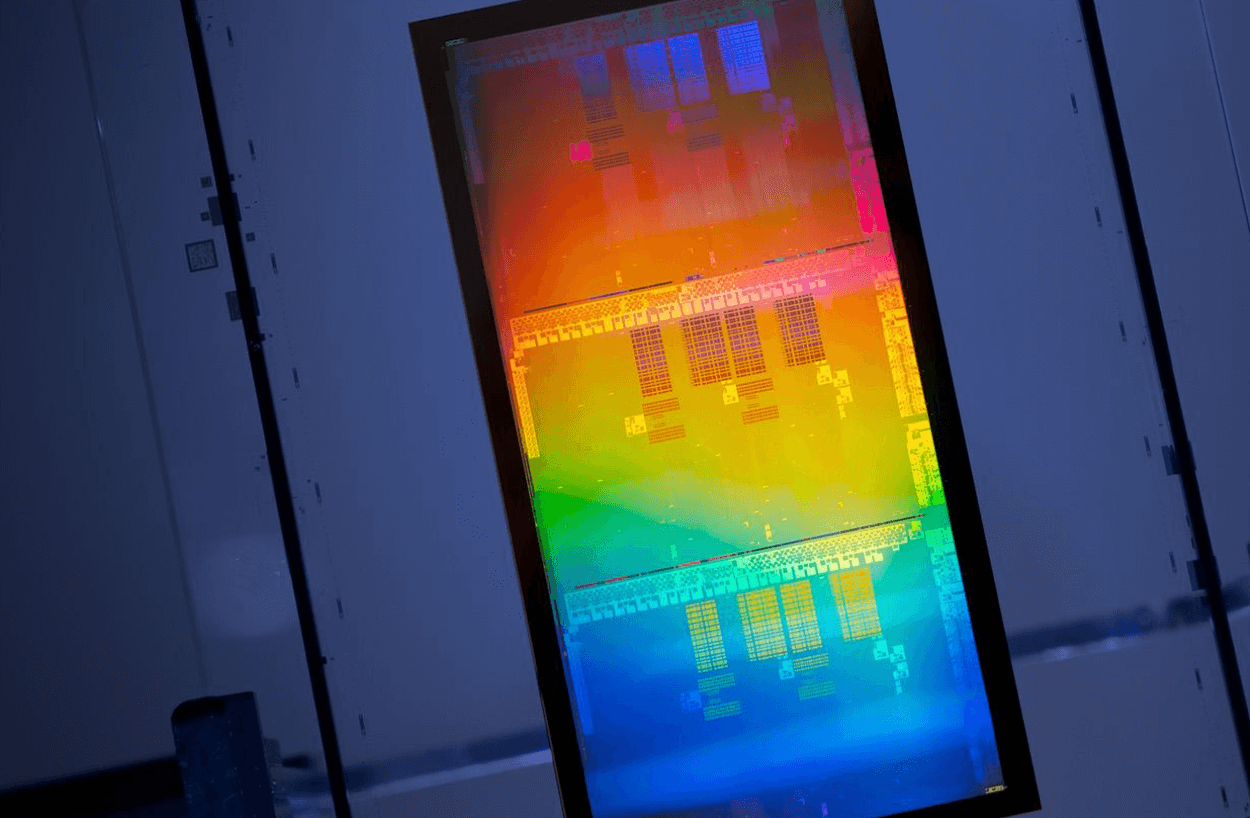
NVIDIA and Intel announced a sweeping collaboration to co-develop custom processors for AI infrastructure and personal computing, alongside a $5 billion NVIDIA investment in Intel common stock. The deal marks one of the most significant alliances between two longtime rivals in silicon, combining NVIDIA’s accelerated computing platform with Intel’s x86 CPU ecosystem.
Under the agreement, Intel will design and manufacture custom x86 CPUs for NVIDIA’s AI infrastructure platforms, with NVLink technology providing seamless integration between CPU and GPU architectures. For the PC market, Intel will deliver new system-on-chips (SoCs) that incorporate NVIDIA RTX GPU chiplets, targeting consumer and enterprise devices that demand high-performance graphics and compute capabilities. NVIDIA will take a $5 billion equity stake in Intel at $23.28 per share, subject to regulatory approvals.
The partnership positions both companies to accelerate AI adoption across hyperscale, enterprise, and consumer markets by tightly coupling NVIDIA’s CUDA software ecosystem and GPU expertise with Intel’s semiconductor manufacturing and packaging capabilities.
• Intel to design and manufacture custom NVIDIA x86 CPUs for AI infrastructure
• NVIDIA to integrate Intel CPUs with NVLink into its AI platforms
• Intel to build x86 SoCs with NVIDIA RTX GPU chiplets for PCs
• NVIDIA to invest $5 billion in Intel common stock at $23.28 per share
• Collaboration spans multiple generations of products for data center and client computing
“AI is powering a new industrial revolution and reinventing every layer of the computing stack,” said Jensen Huang, founder and CEO of NVIDIA. “This historic collaboration tightly couples NVIDIA’s AI and accelerated computing stack with Intel’s CPUs and the vast x86 ecosystem — a fusion of two world-class platforms.”
Some key points from a joint conference call hosted by the companies:
- NVIDIA will extend its rack-scale NVLink-72 architecture, previously tied to Arm CPUs, into the x86 ecosystem through Intel-built custom CPUs.
- Intel and NVIDIA see an untapped opportunity in the 150 million-unit annual laptop market, where integrated CPU-GPU SoCs could reach segments beyond gaming and workstation PCs.
- Lip-Bu Tan pointed to Intel’s packaging technologies — EMIB, Foveros, and multi-process assembly — as critical for merging NVIDIA GPU chiplets with Intel x86 dies.
- The collaboration will shift NVIDIA into a dual role: a major customer of Intel’s custom server CPUs and a supplierof GPU chiplets for Intel’s client SoCs.
- Engineering teams from both companies have worked quietly for nearly a year on joint architectures, covering CPUs, GPUs, and client SoCs.
- Huang stressed that NVIDIA’s Arm roadmap, including Grace, Vera, and Rubin CPUs, continues unaffected, with the Intel alliance expanding rather than replacing its CPU strategy.
- Executives pegged the combined data center CPU market at roughly $25 billion annually, with the broader partnership opportunity spanning up to $50 billion when PCs are included.
- NVIDIA’s $5 billion equity investment in Intel was positioned as both strategic and symbolic — designed to align long-term interests as the companies develop joint products.
- Both leaders highlighted advanced packaging and U.S.-based manufacturing as long-term enablers, while reaffirming TSMC’s ongoing role in leading-edge GPU production.
🌐 Analysis: This agreement represents a dramatic reset in the competitive landscape. For years, NVIDIA and Intel competed head-to-head in data center CPUs and GPUs, with Intel struggling to establish its own discrete GPU presence. By aligning, the companies combine NVIDIA’s dominance in accelerated computing with Intel’s deep x86 ecosystem and advanced packaging roadmaps. The deal also strengthens Intel’s foundry business at a time when AMD and Arm-based alternatives are gaining traction in data center and PC markets. It echoes NVIDIA’s past ambitions to acquire Arm, but instead leverages Intel’s existing position as a U.S.-based manufacturing powerhouse. Rival chipmakers, especially AMD, will face new competitive pressure as this alliance unfolds.
🌐 We’re tracking the latest developments in networking silicon. Follow our ongoing coverage at: https://convergedigest.com/category/semiconductors/