The Open Networking Foundation (ONF) announced a series of reference designs backed by ONF’s operator leadership, which includes AT&T, China Unicom, Comcast, Google, Deutsche Telekom, Telefonica, NTT Group, and Turk Telekom.
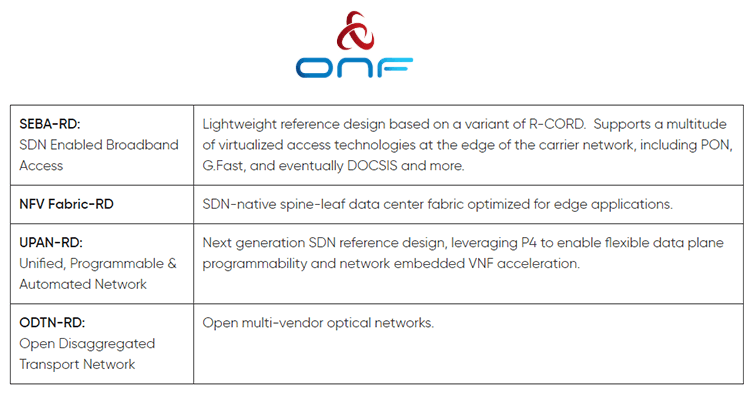
 The initial set of open source Reference Designs, which target edge and access clouds infrastructure, essentially are “blueprints” for how to put common modular components together to create platforms based on open source. They leverage the ONF’s prior work with CORD and M-CORD.
Another way to think of the reference designs is as “swim lanes” for assembling open source platforms for both the cloud data center infrastructure and the underlying optical transport network.
 It is also interesting to note Google’s presence in ONF’s operator leadership ranks. In April, Google announced plans to use P4Runtime as the foundation for its next generation of data centers and wide area network control-plane programming. P4 is a programming language was designed to be target-independent (i.e. a program written in P4 could be compiled, without modification, to run on a variety of targets, such as ASICs, FPGAs, CPUs, NPUs, and GPUs), and protocol-independent (i.e. a P4 program can describe existing standard protocols, or be used to specify innovative, new, customized forwarding behaviors). The ONF’s reference design for a Unified, Programmable & Automated Network (UPAN) will use P4 as its enabling technology. If other telcos adopt the UPAN reference design, Google will be well-positioned to offer them a wholesale service running in its cloud.
In addition, ADTRAN, Dell/EMC, Edgecore Networks and Juniper Networks have joined the ONF as supply chain partners in this reference design process.
“Over the last several years, ADTRAN has fully embraced open, disaggregated and software-defined attributes as the core principles in our Mosaic-branded access focused solutions. We are encouraged by ONF’s new strategic plan and strong operator commitment and believe ADTRAN is a perfect fit as a supply chain partner,” said ADTRAN Senior Vice President of Technology and Strategy Jay Wilson. “ADTRAN intends to contribute across multiple reference design initiatives by applying access domain expertise both in software and systems integration.”

Open Disaggregated Transport Network project gets underway
A new, operator-led Open Disaggregated Transport Network (ODTN) project is underway at the Open Networking Foundation (ONF).
The goal of ODTN is to build optical transport networks using disaggregated optical equipment, open and common standards, and open source software.
The project will deliver an open source platform for running multi-vendor optical transport networks. It will leverage the ONF’s ONOS SDN Controller, automatically and transparently discovers the disaggregated components and will control the entire transport network as a unified whole, thus enabling multi-vendor choice.

The organizers of the project say that just as the SDN movement has disaggregated the data center and operator edge networks, ODTN will bring similar benefits to the optical transport network including best-of-breed choice, elimination of vendor lock-in, cost containment and accelerated innovation.
Backers of the project include China Unicom, Comcast, NTT Communications, Telefonica and TIM.
Each of the five founding operators has committed to performing lab integration and evaluation of the platform for future transport applications. Additional support is coming from leading vendors in the optical equipment space, with NEC, NOKIA, Oplink, ZTE contributing to the software platform and building full solutions, CTTC contributing from academia, and ADVA, Ciena, Coriant, CoAdna, Infinera and Lumentum participating in lab and field trials.
Relationship to Other Projects
ODTN is the only open source solution in the optical transport space, but is leveraging other ongoing work which has focused on standardizing various interfaces and components.
ODTN will leverage and expose TAPI as its northbound interface, leveraging the work coming out of the ONF’s Open Transport Configuration and Control (OTCC) project. Likewise, OpenConfig is the base southbound model and API for communicating to optical equipment.
The OpenROADM MSA defines interoperability specifications and data models for optical devices, networks and services. ODTN benefits from this effort and, over time, it helps the industry achieve transponder compatibility. This will eliminate the need to deploy transponders in matched pairs, further disaggregating the solution and enabling even greater deployment flexibility.
TIP’s Open Optical & Packet Transport project is producing open DWDM architectures, models and APIs, covering transponders, open line systems, and routers. In time, the ODTN project hopes to benefit from the availability of open optical hardware coming from the TIP work. And visa versa, the TIP project can leverage the open source work coming out of ODTN on TIP white box hardware building blocks (such as Voyager).