The OpenFog Consortium, whose founding members include ARM, Cisco, Dell, Intel, Microsoft, and Princeton University, published its OpenFog Reference Architecture, a universal technical framework designed to enable the data-intensive requirements of the Internet of Things (IoT), 5G and artificial intelligence (AI) applications.

Fog computing is the system-level architecture that brings computing, storage, control, and networking functions closer to the data-producing sources along the cloud-to-thing continuum. The new reference architecture aims to enable high-performance, interoperability and security in complex digital transactions.
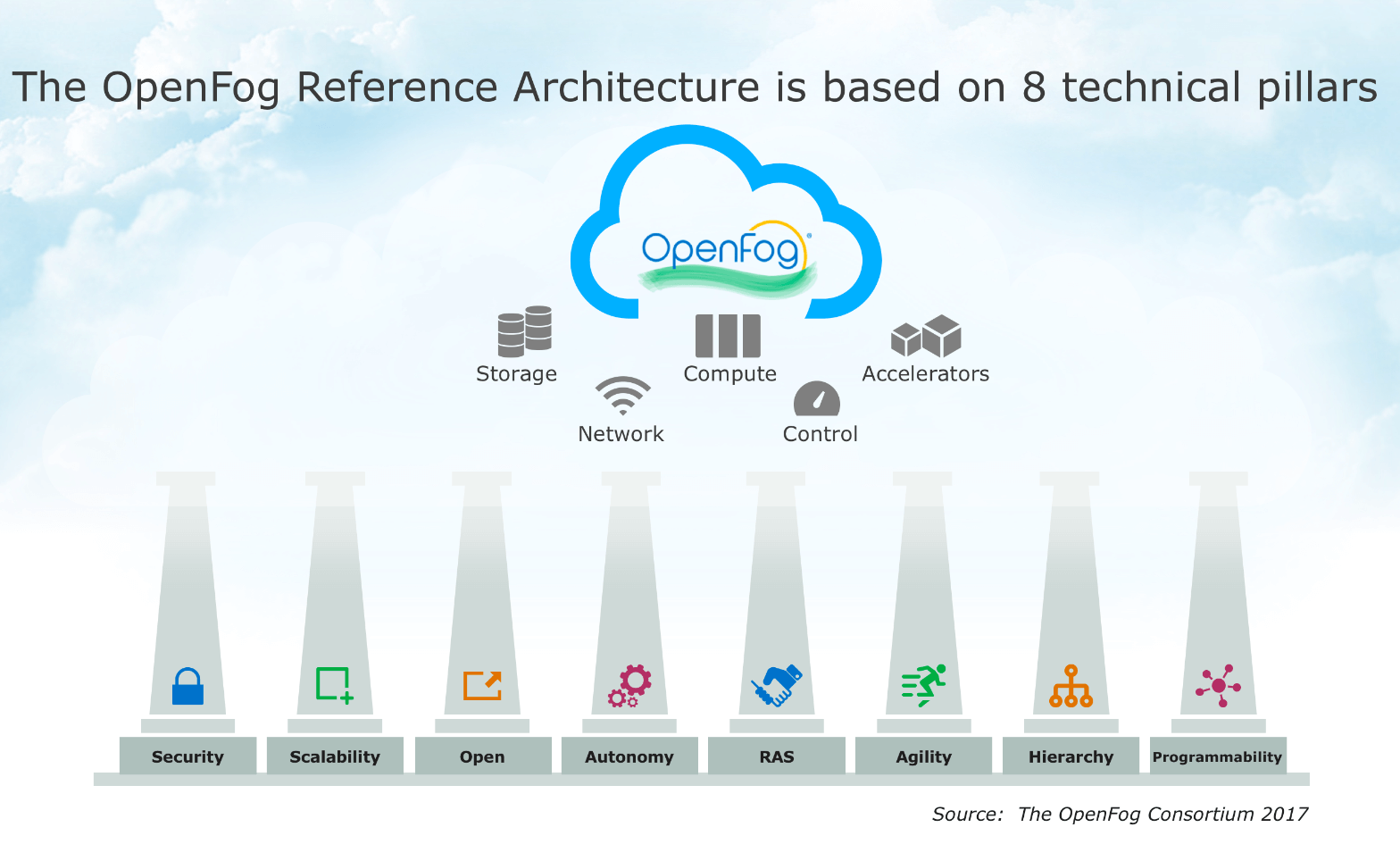
 In brief, the OpenFog Reference Architecture contains a medium- to high-level view of system architectures for fog nodes (smart, connected devices) and networks, deployment and hierarchy models, and use cases. It is based on eight core technical principles, termed pillars, which represent the key attributes that a system needs to encompass to be defined as “OpenFog.” These pillars include security, scalability, openness, autonomy, RAS (reliability, availability, and serviceability), agility, hierarchy and programmability.
“Just as TCP/IP became the standard and universal framework that enabled the Internet to take off, members of OpenFog have created a standard and universal framework to enable interoperability for 5G, IoT and AI applications,” said Helder Antunes, chairman of the OpenFog Consortium and senior director for the Corporate Strategic Innovation Group at Cisco. “While fog computing is starting to be rolled out in smart cities, connected cars, drones and more, it needs a common, interoperable platform to turbocharge the tremendous opportunity in digital transformation. The new OpenFog Reference Architecture is an important giant step in that direction.”
“The OpenFog Reference Architecture is the culmination of a year-long effort from industry and university research members to ensure we address all the appropriate communications, software, infrastructure and security components of fog computing,” said Jeff Fedders, president of the OpenFog Consortium. “Our goal is to help and support both the business leader and the technologist to create new applications and business models through fog computing. By developing this common framework, we’re addressing the hardware, software and system elements necessary for an OpenFog architecture and a vibrant, supplier ecosystem.”