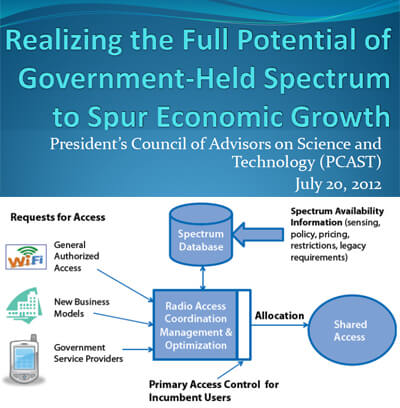

U.S. federal policy should shift in favor “Shared-Use Spectrum Superhighways” instead the current plan which is to first clear federal users from specific bands and then auction this spectrum for the exclusive use of the highest bidder, according to a new report issued by the President’s Council of Advisors on Science and Technology (PCAST). The report identifies 1,000 MHz of federal spectrum for sharing with the private sector.
The New Spectrum Superhighway plan (1) divides spectrum into substantial blocks with common characteristics (2) makes sharing by Federal users with commercial users the norm (3) measures spectrum effectiveness using a new metric (4) increases capacity by “1,000’s of times.”
A Presidential memorandum issued in June 2010 requires that 500 MHz of spectrum to be made available for commercial use within 10 years. However, a recent NTIA Study found that clearing just one 95 MHz band will take 10 years, cost $18 billion, and cause significant disruption. Moreover, the net revenue for the Treasury from the last successful auction of 45 MHz realized a net income of just a few hundred million a year ($5.3 billion total).
The PCAST report said its vision of shared spectrum is viable using existing technologies and is not dependent on cognitive or “smart” radios. Instead, a geo-location database could be used the share spectrum much like how the FCC is using managing TV bands. The TV Whitespaces system could be used as a model. Technical standards would need to be implemented for coexistence of transmitters and receivers to enable flexible sharing.
To get things rolling, the PCAST report recommends that an incentive mechanism be created to encourage Federal agencies to begin sharing (e.g., Spectrum Currency). The existing Spectrum Relocation Fund, which is supposed to fund the migration of federal users out of certain bands, could be redeveloped into a “Spectrum Efficiency Fund.” The system could be tested in a specific city before being extended nationwide.
Specifically, PCAST recommends beginning a pilot program involving spectrum sharing, supported by early release of funds from various sources, with three key elements: immediate sharing by new low-power devices in two existing Federal spectrum bands; formation of a Spectrum Sharing Partnership Steering Committee (SSP) of industry executives (e.g. CEOs) to advise on a policy framework to maximize commercial success; and creation of an urban Test City and a Mobile Test Service that can support rapid learning in spectrum management technology and practice.
The 192 page report is posted online.
http://www.whitehouse.gov/administration/eop/ostp/pcast
Reaction from AT&T: “While we are still reviewing the PCAST report, we are encouraged by the sustained interest in exploring ways to free up underutilized government spectrum for mobile Internet use. However, we are concerned with the report’s primary conclusion that ‘the norm for spectrum use should be sharing, not exclusivity.’ The report fails to recognize the benefits of exclusive use licenses, which are well known. Those licenses enabled the creation of the mobile Internet and all of the ensuing innovation, investment and job creation that followed.
“While we should be considering all options to meet the country’s spectrum goals, including the sharing of federal spectrum with government users, it is imperative that we clear and reallocate government spectrum where practical. We fully support the NTIA effort of determining which government bands can be cleared for commercial use, and we look forward to continuing to work with NTIA and other stakeholders to make more spectrum available for American consumers and businesses.”
Reaction from CTIA: “Cleared spectrum and an exclusive-use approach has enabled the U.S. wireless industry to invest hundreds of billions of dollars, deploying world-leading mobile broadband networks and resulting in tremendous economic benefits for U.S. consumers and businesses. Not surprisingly, that is the very same approach that has been used by the countries that we compete with in the global marketplace, who have brought hundreds of megahertz of cleared spectrum to market in recent years.”