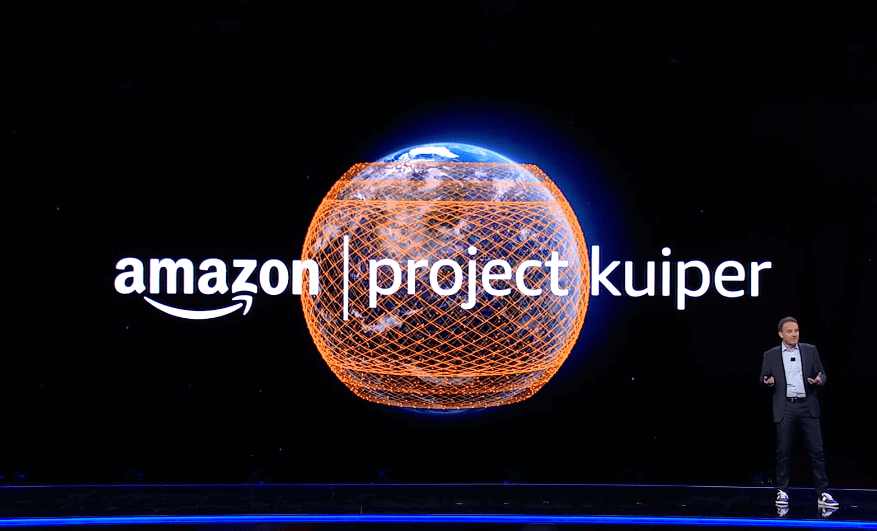
Amazon’s Project Kuiper has surpassed 100 satellites in orbit, marking a major milestone in its plan to deliver low Earth orbit (LEO) broadband service worldwide. On August 11, 2025, a SpaceX Falcon 9 rocket launched from Cape Canaveral Space Force Station carrying 24 Kuiper satellites as part of the KF-02 mission. The latest deployment brings the total number of operational satellites to 102, all placed in orbit since April.
The KF-02 mission placed the new satellites into a 465-kilometer (289-mile) parking orbit, where they will gradually maneuver to their operational altitude of 630 km (392 miles). Amazon’s $140 million Kuiper Processing Facility at Kennedy Space Center in Florida is designed to support up to three launch campaigns simultaneously, enabling a rapid build-out of the planned 3,200-plus-satellite constellation. The network aims to deliver high-speed, low-latency internet to underserved regions globally, competing with services such as SpaceX Starlink and OneWeb.
Since the first launch on April 28 aboard a ULA Atlas V, Project Kuiper has completed four missions—two with Atlas V and two with SpaceX Falcon 9—deploying satellites in batches of 24–27 units. The program is targeting more than 80 total launches for full deployment. Amazon says it is on track to begin beta service in select regions in 2026, once a critical mass of satellites is operational.
• Total satellites deployed: 102 of 3,200+ planned
• Launch partners: United Launch Alliance (ULA), SpaceX
• Launch cadence: 4 missions in under 4 months
• Operational altitude: 630 km (392 miles) LEO
• Beta service expected: 2026 in select regions
“We’re building a network that will bring fast, affordable internet to communities around the world, and every launch brings us closer to that goal,” said Rajeev Badyal, Project Kuiper’s Vice President of Technology.
🌐 Why it Matters
Project Kuiper’s rapid satellite deployment highlights the intensifying competition in LEO broadband, where constellation size, launch cadence, and manufacturing scale are critical to success. By combining SpaceX’s high-frequency Falcon 9 launches with ULA’s heavy-lift capability, Amazon is accelerating toward global coverage and positioning itself as a formidable challenger to Starlink’s market dominance.
🌐 We’re tracking the latest developments in satellite broadband and LEO constellations. Follow our ongoing coverage at: https://convergedigest.com/category/space/