PsiQuantum has raised $1 billion in Series E funding to accelerate development of the world’s first million-qubit, fault-tolerant quantum computer. The Palo Alto–based company said the new capital will fund utility-scale sites in Brisbane and Chicago, enable deployment of large-scale prototypes to validate systems integration, and expand production of its photonic quantum chips. The round, led by funds managed by BlackRock with Temasek and Baillie Gifford, values PsiQuantum at $7 billion and includes participation from NVIDIA’s venture arm NVentures, the Qatar Investment Authority, Macquarie Capital, Ribbit Capital, Adage Capital, Morgan Stanley’s Counterpoint Global, 1789 Capital, and S Ventures (SentinelOne), alongside existing backers Blackbird, Third Point Ventures, and T. Rowe Price.
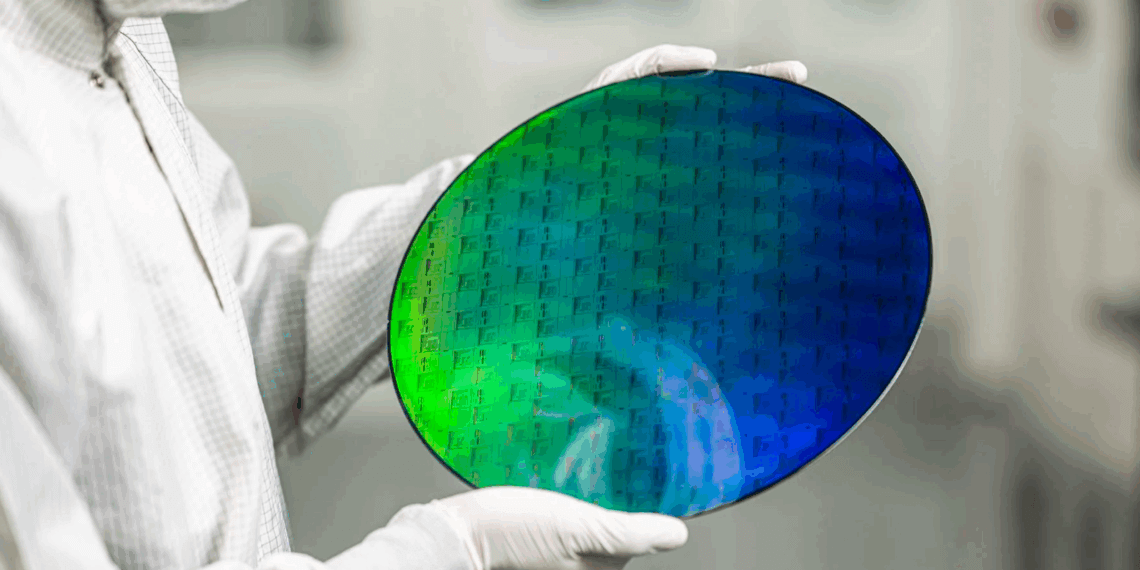
PsiQuantum said its approach—photonic qubits fabricated with standard semiconductor processes—provides a path to scale past barriers of manufacturability, cooling, and networking. Its chips are manufactured at GlobalFoundries’ Fab 8 in New York, with barium titanate (BTO) integrated as a high-performance electro-optic material for fast, low-power optical switching. The company fabricates 300 mm BTO wafers at its California facilities and integrates them with silicon-photonics wafers from GlobalFoundries. In addition to qubit generation and measurement, PsiQuantum designs cooling, networking, and control systems, including a modular rack-style cooling architecture that can support hundreds of quantum chips in a single cabinet. The company has also demonstrated high-fidelity quantum networking between cabinets using standard telecom fiber.
Alongside the investment, PsiQuantum announced a collaboration with NVIDIA to advance quantum algorithms, software, GPU–QPU integration, and further development of its silicon-photonics platform. Since its Series D in 2021, the company says it has reached “unprecedented maturity and performance,” mass-manufacturing photonic quantum chips and building the missing optical switch technology needed to scale. PsiQuantum highlighted the applicability of its BTO-based switches not only for quantum but also for next-generation AI supercomputers, where high-speed, low-power optical interconnects are in demand.
- Series E: $1B raise at $7B valuation, led by BlackRock with new and existing global investors
- Sites: Brisbane, Australia and Chicago, USA to host utility-scale quantum facilities
- Technology: Photonic qubits built on semiconductor processes, leveraging GF Fab 8 manufacturing
- Barium titanate: 300 mm wafers produced in California, enabling high-performance electro-optic switches
- Systems: Rack-style modular cooling and cabinet-to-cabinet networking demonstrated with telecom fiber
- Partnership: NVIDIA collaboration on algorithms, GPU–QPU integration, and photonics platform
“Only building the real thing—million-qubit-scale, fault-tolerant machines—will unlock the promise of quantum computing,” said Jeremy O’Brien, co-founder and CEO of PsiQuantum.
🌐 Analysis: PsiQuantum is positioning photonics as the route to fault-tolerant quantum computing, emphasizing manufacturability and full-stack engineering rather than small-scale demonstrations. The integration of BTO as a scalable, high-performance switching material is central to its roadmap, potentially giving PsiQuantum a differentiator that also extends into AI infrastructure. The collaboration with NVIDIA underscores an emerging convergence of quantum and classical acceleration platforms, signaling that utility-scale systems will need to integrate seamlessly with high-performance compute environments.
PsiQuantum, headquartered in Palo Alto, California, is building fault-tolerant quantum computers based on silicon photonics. Founded in 2016 by Jeremy O’Brien, Terry Rudolph, Pete Shadbolt, and Mark Thompson, the company draws on decades of academic work at the University of Bristol, Imperial College London, and Cambridge. The founding team positioned PsiQuantum around the principle that only a million-qubit, error-corrected machine can deliver commercially useful quantum computing.
PsiQuantum’s approach leverages photonic qubits fabricated on mature semiconductor processes to bypass scaling challenges faced by superconducting and trapped-ion modalities. Its quantum photonic chips are manufactured at GlobalFoundries’ Fab 8 in New York, where the company has developed a high-volume silicon photonics flow. PsiQuantum also integrates 300 mm barium titanate wafers, produced in California, to enable ultra-fast optical switches—a critical missing piece for large-scale optical quantum systems. The company designs cooling and networking systems in-house, including modular rack-style cryogenics capable of supporting hundreds of chips per cabinet, and has demonstrated quantum networking between cabinets over standard telecom fiber.
The company has secured more than $2 billion in funding across multiple rounds, including $450M in Series D (2021), A$940M (~US$620M) in Australian government support (2024), and a $1B Series E in 2025 at a $7B valuation. Strategic partners include GlobalFoundries, SLAC, DARPA, AFRL, STFC Daresbury, and NVIDIA, which is collaborating on algorithms, GPU–QPU integration, and PsiQuantum’s silicon photonics platform. Global operations span the U.S., U.K., and Australia, with utility-scale facilities planned in Brisbane and Chicago.
- Headquarters: Palo Alto, California; facilities in the U.S., U.K., and Australia
- Founded: 2016 by Jeremy O’Brien, Terry Rudolph, Pete Shadbolt, Mark Thompson
- Core technology: Silicon photonic quantum computing with photonic qubits and BTO-based optical switches
- Manufacturing: Quantum photonic chips produced at GlobalFoundries Fab 8 (New York)
- Partnerships: GlobalFoundries, SLAC, DARPA, AFRL, UK STFC Daresbury, NVIDIA
- Utility-scale sites: Brisbane (target 2027) and Chicago
🌐 We’re tracking the latest developments in semiconductors and photonics. Follow our ongoing coverage at: https://convergedigest.com/category/semiconductors/