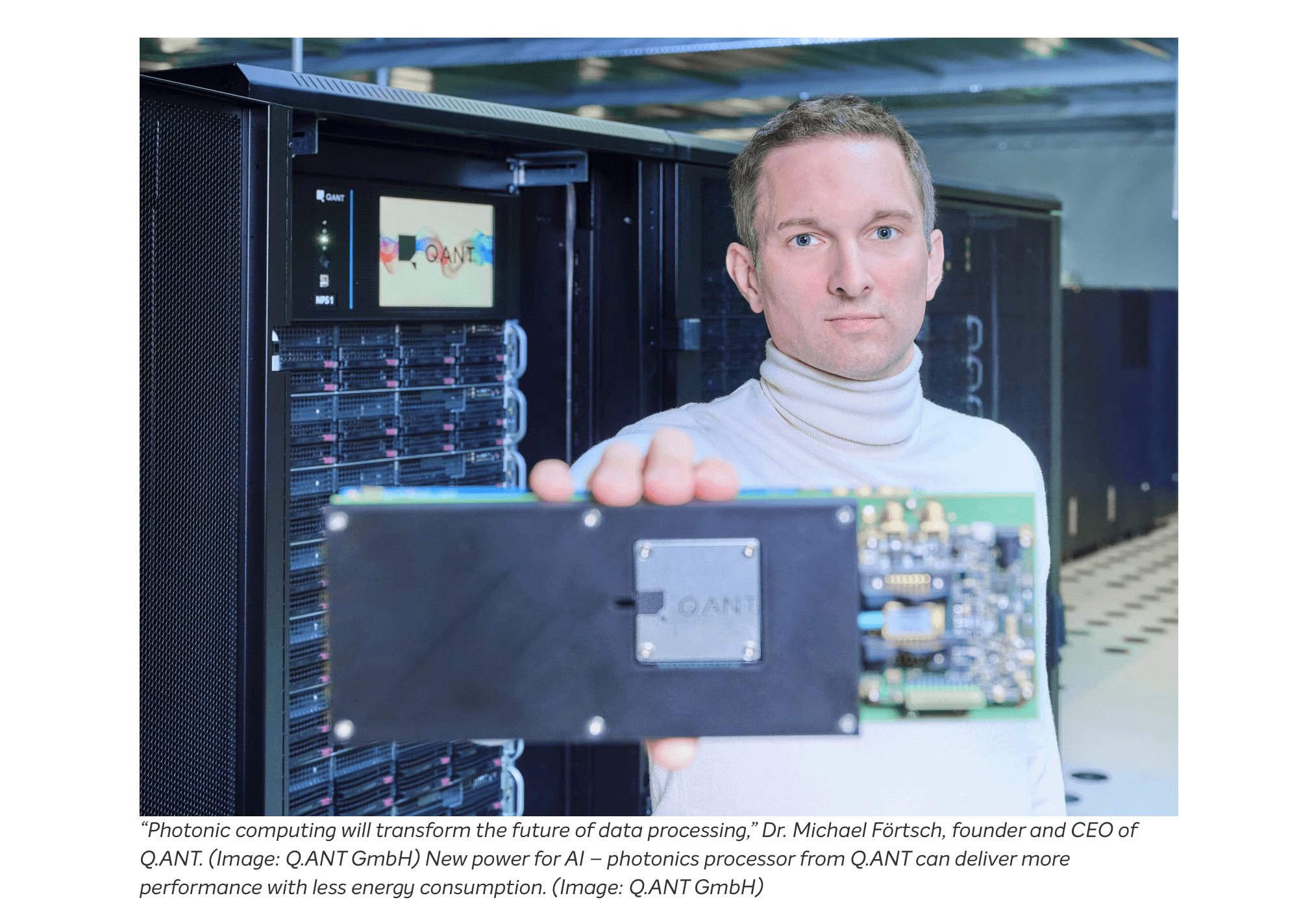
Germany’s Leibniz Supercomputing Centre (LRZ) has deployed the world’s first operational photonic AI processor, developed by Stuttgart-based Q.ANT, marking a breakthrough in energy-efficient computing. This processor uses light instead of electrons to perform AI tasks, significantly reducing power consumption while increasing performance. The integration supports LRZ’s Future Computing initiative, with initial applications focused on satellite and aerial image classification.
The deployment comes on the heels of a €62 million Series A funding round led by Cherry Ventures, UVC Partners, and imec.xpand. Additional investors include TRUMPF, L-Bank, and Grazia Equity. The funding, the largest ever in Europe for photonic computing, will accelerate Q.ANT’s commercial rollout and expansion into the U.S. market. Q.ANT’s Native Processing Server, based on Thin-Film Lithium Niobate (TFLN), enables seamless co-processing alongside traditional digital systems while promising up to 30 times energy efficiency and 50 times performance gains.
Q.ANT is positioning its photonic processor as a key enabler for next-generation AI and high-performance computing (HPC) infrastructure. The company is already shipping early systems to selected partners and expects to scale operations significantly over the next five years.
- LRZ becomes the first supercomputing center to deploy a photonic AI processor in production
- Q.ANT closes €62 million Series A to commercialize photonic computing
- System enables analog matrix-vector multiplications using light for deep learning workloads
- Initial use case: classification of satellite and aerial imagery
- Strategic backers include TRUMPF, imec.xpand, and Cherry Ventures
- Q.ANT aims to expand into the U.S. and scale its photonic co-processor platform globally
“Q.ANT was founded with a bold vision: to redefine the way the world computes by using light instead of electricity,” said Dr. Michael Förtsch, CEO of Q.ANT. “This investment proves that Europe has both the ambition and the capital to lead—and gives us the strong partners we need to pursue our mission.”
🌐 Background: Q.ANT GmbH, based in Stuttgart, Germany, was founded in 2018 as a spin-off from TRUMPF.
Q.ANT’s core technology centers around its Light Empowered Native Arithmetics (LENA) architecture, which performs native analog computation using light instead of electricity. This is enabled by its proprietary photonic processor platform, built on Thin-Film Lithium Niobate (TFLN) technology. Q.ANT’s Native Processing Server (NPS) integrates this chip technology into a plug-in format compatible with conventional data centers and software stacks, offering significant performance and energy efficiency gains—up to 30x lower energy use and 50x faster processing compared to traditional CMOS systems.
The company is led by physicist Dr. Michael Förtsch, who serves as founder and CEO. The leadership team includes Tim Stiegler as CFO and Andreas Abt as SVP of Native Computing. With the new funding, Q.ANT plans to scale manufacturing, expand operations into the U.S., and continue commercial rollout of its photonic processors for AI inference and HPC workloads.
Q.ANT collaborates closely with the Institute for Microelectronics Stuttgart (IMS CHIPS) on its in-house chip pilot line and has built strong advisory ties with industry veterans, including Hermann Hauser (ARM co-founder) and Hermann Eul (former Intel executive). The company is positioning its photonic processors as sustainable, high-performance alternatives to digital chips—particularly for nonlinear computation in AI, physics simulations, and image analysis.
- Headquarters: Stuttgart, Germany
- Founded: 2018 (spin-off from TRUMPF)
- CEO: Dr. Michael Förtsch
- Core Technology: Photonic processors based on LENA architecture and TFLN chips
- Flagship Product: Native Processing Server (NPS)
- Funding: €62M Series A in July 2025, backed by Cherry Ventures, UVC Partners, imec.xpand, and TRUMPF
- Key Applications: AI inference, HPC, analog co-processing, sustainable data center infrastructure
- Partners: IMS CHIPS, TRUMPF, EU Quantum Flagship ecosystem
🌐 Why it Matters: Q.ANT’s commercial deployment at LRZ and significant funding round highlight growing momentum for alternative computing architectures to address AI’s escalating energy demands. Photonic co-processors offer a path to radically scale AI infrastructure without proportionally increasing power consumption—a critical advantage as global compute needs surge.
🌐 We’re tracking the latest developments in networking silicon. Follow our ongoing coverage at: https://convergedigest.com/category/semiconductors/