Relativity Networks has signed Network Planning Solutions (NPS) as its first Trusted Installation Partner to accelerate commercial deployment of hollow-core fiber (HCF) systems. The agreement brings NPS’s international experience in fiber installation and support to Relativity’s rollout of HCF, a next-generation optical technology designed for AI, cloud, telecom, and financial trading networks.
Hollow-core fiber transmits light through an air-filled core rather than traditional glass, enabling significantly lower latency, higher throughput, and greater power handling. Relativity and NPS have already worked through hundreds of splices using advanced methods such as rotational alignment and interferometer inspection, demonstrating the viability of large-scale deployments. NPS, based in the UK, has been involved in early-stage HCF projects since 2019 and will provide end-to-end services including planning, pre-staging, installation, and ongoing support.
The partnership builds on Relativity’s existing cable-supply relationship with Prysmian, advancing the company’s strategy to scale HCF adoption globally. Hyperscalers and financial firms seeking ultra-low latency links are expected to be early adopters, while Relativity positions its ecosystem to ensure integration with conventional fiber systems.
• Relativity Networks selects NPS as inaugural Trusted Installation Partner for hollow-core fiber deployments
• NPS brings international experience, with HCF project work dating back to 2019
• Partnership covers end-to-end installation support, including advanced splice validation methods
• Builds on Relativity’s earlier supply agreement with Prysmian to scale HCF production
• Target markets: AI data centers, hyperscale cloud, telecommunications, and high-frequency trading
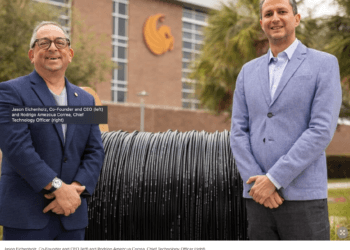
“Everyone in the industry is struggling to understand how to integrate something new into their ecosystem. There are many questions about HCF and how it connects to existing systems. We are addressing this by having a trusted installation partner like NPS,” said Jason Eichenholz, founder and CEO of Relativity Networks.
🌐 Analysis: Hollow-core fiber (HCF) guides light through an air-filled core rather than solid silica, reducing the effective refractive index closer to that of air. Peer-reviewed studies from the past five years (including work by Lumenisity and academic labs at Southampton University) show that this reduces optical latency by roughly 30% compared to conventional single-mode fiber, translating to measurable savings in microseconds per kilometer. For high-frequency trading and distributed AI training clusters where nanosecond-to-microsecond differences accumulate across many kilometers of links, this latency advantage can directly impact system performance.
Beyond latency, HCF supports a broader transmission window with lower non-linear effects than silica, enabling higher data throughput per channel and potentially simpler scaling to Tbps-class interconnects. Trials have also shown that HCF can handle higher optical power before nonlinearities such as self-phase modulation and four-wave mixing become limiting, which is important for coherent transmission in dense wavelength-division multiplexed (DWDM) systems.
The drawbacks remain cost and maturity. HCF is more expensive to produce due to the complexity of maintaining precise air-core structures over long lengths. Splicing and connectorization require specialized techniques, such as rotational alignment and interferometric cleave inspection, that add time and labor costs. Reliability under field conditions is also still under study, with questions about bend sensitivity, environmental robustness, and long-term stability compared to standard G.652.D fiber.
In this context, Relativity’s strategy of pairing cable supply (via Prysmian) with trusted installation partners like NPS is critical. Hyperscalers and financial networks may absorb higher upfront costs to achieve performance gains, but broader adoption will depend on demonstrating repeatable field deployments, seamless interoperability with existing infrastructure, and clear total cost of ownership advantages over advanced silica fibers. Rival efforts, including Microsoft’s Lumenisity (acquired in 2022) and emerging academic-commercial collaborations, indicate that HCF is moving from the lab toward commercialization, but widespread rollout will hinge on solving installation scalability and cost curve challenges.