• Home
  • Events Calendar
  • Blueprint Guidelines
  • Privacy Policy
  • Subscribe to Daily Newsletter
  • NextGenInfra.io
No Result
View All Result
Converge Digest
Friday, April 17, 2026
  • Home
  • Events Calendar
  • Blueprint Guidelines
  • Privacy Policy
  • Subscribe to Daily Newsletter
  • NextGenInfra.io
No Result
View All Result
Converge Digest
No Result
View All Result

Home » Samsung’s 512GB DDR5 module targets bandwidth-intensive apps

Samsung’s 512GB DDR5 module targets bandwidth-intensive apps

March 24, 2021
in Semiconductors
A A

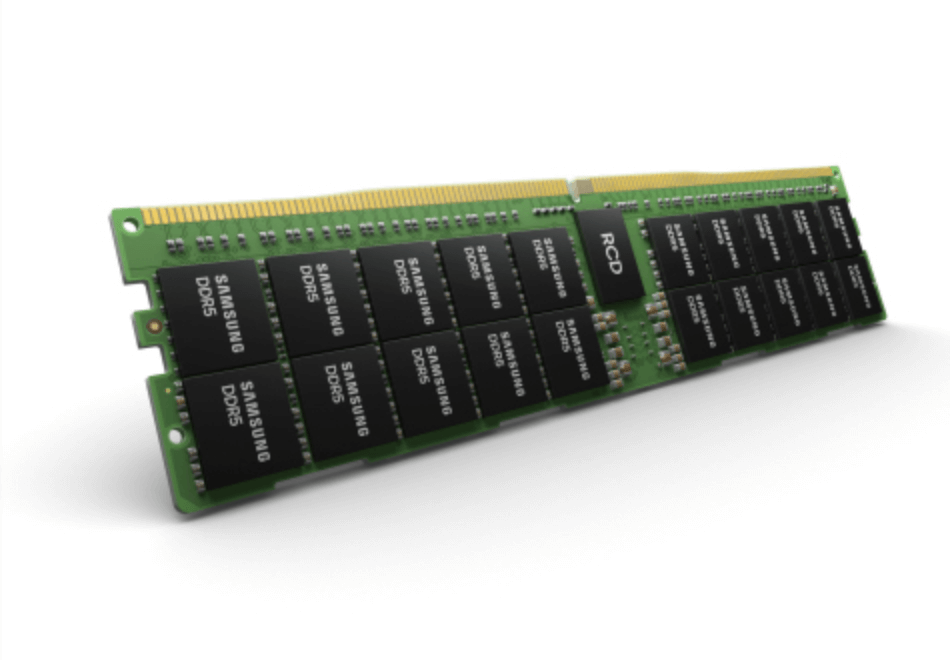
Samsung Electronics began sampling a 512GB DDR5 module based on High-K Metal Gate (HKMG) process technology. 

The memory module delivers more than twice the performance of DDR4 at up to 7,200 Mbps, making it suitable for the most high-bandwidth workloads in supercomputing, artificial intelligence (AI) and machine learning (ML), as well as data analytics applications.

Samsung said its DDR5 will utilize highly advanced HKMG technology that has been traditionally used in logic semiconductors. With continued scaling down of DRAM structures, the insulation layer has thinned, leading to a higher leakage current. By replacing the insulator with HKMG material, Samsung’s DDR5 will be able to reduce the leakage and reach new heights in performance. This new memory will also use approximately 13% less power, making it especially suitable for datacenters where energy efficiency is becoming increasingly critical. The HKMG process was adopted in Samsung’s GDDR6 memory in 2018 for the first time in the industry. By expanding its use in DDR5, Samsung is further solidifying its leadership in next-generation DRAM technology.

Leveraging through-silicon via (TSV) technology, Samsung’s DDR5 stacks eight layers of 16Gb DRAM chips to offer the largest capacity of 512GB. TSV was first utilized in DRAM in 2014 when Samsung introduced server modules with capacities up to 256GB.

“Samsung is the only semiconductor company with logic and memory capabilities and the expertise to incorporate HKMG cutting-edge logic technology into memory product development,” said Young-Soo Sohn, Vice President of the DRAM Memory Planning/Enabling Group at Samsung Electronics. “By bringing this type of process innovation to DRAM manufacturing, we are able to offer our customers high-performance, yet energy-efficient memory solutions to power the computers needed for medical research, financial markets, autonomous driving, smart cities and beyond.”

“As the amount of data to be moved, stored and processed increases exponentially, the transition to DDR5 comes at a critical inflection point for cloud datacenters, networks and edge deployments,” said Carolyn Duran, Vice President and GM of Memory and IO Technology at Intel. “Intel’s engineering teams closely partner with memory leaders like Samsung to deliver fast, power-efficient DDR5 memory that is performance-optimized and compatible with our upcoming Intel Xeon Scalable processors, code-named Sapphire Rapids.”


Tags: KoreaMemorySamsungSiliconStorage
ShareTweetShare
Previous Post

Virgin Media Business deploys Infinera’s XTM in Dublin metro network

Next Post

Red Hat OpenShift Service now available on AWS

Staff

Staff

Related Posts

Cisco, G42, and AMD to Build AI Infrastructure in the UAE
AI Infrastructure

DigitalBridge Teams with KT for AI Data Centers in Korea

November 26, 2025
SK Telecom Maps 1 GW AI Data Center Buildout
AI Infrastructure

SK Telecom Maps 1 GW AI Data Center Buildout

November 14, 2025
SaskTel Deploys Samsung’s Cloud-Native 4G and 5G Core 
5G / 6G / Wi-Fi

SaskTel Deploys Samsung’s Cloud-Native 4G and 5G Core 

November 14, 2025
NVIDIA Fuels Korea’s AI Factory Boom
AI Infrastructure

NVIDIA Fuels Korea’s AI Factory Boom

November 1, 2025
OpenAI Plans South Korea Infrastructure
AI Infrastructure

OpenAI Plans South Korea Infrastructure

October 1, 2025
Blueprint: Reimagining Data Center Networks for AI
Data Centers

VAST Data and SK Telecom Deploy Sovereign AI Cloud

August 17, 2025
Next Post
Red Hat OpenShift Service now available on AWS

Red Hat OpenShift Service now available on AWS

Please login to join discussion

Categories

  • 5G / 6G / Wi-Fi
  • AI Infrastructure
  • All
  • Automotive Networking
  • Blueprints
  • Clouds and Carriers
  • Data Centers
  • Enterprise
  • Explainer
  • Feature
  • Financials
  • Last Mile / Middle Mile
  • Legal / Regulatory
  • Optical
  • Quantum
  • Research
  • Security
  • Semiconductors
  • Space
  • Start-ups
  • Subsea
  • Sustainability
  • Video
  • Webinars

Archives

Tags

5G All AT&T Australia AWS Blueprint columns BroadbandWireless Broadcom China Ciena Cisco Data Centers Dell'Oro Ericsson FCC Financial Financials Huawei Infinera Intel Japan Juniper Last Mile Last Mille LTE Mergers and Acquisitions Mobile NFV Nokia Optical Packet Systems PacketVoice People Regulatory Satellite SDN Service Providers Silicon Silicon Valley StandardsWatch Storage TTP UK Verizon Wi-Fi
Converge Digest

A private dossier for networking and telecoms

Follow Us

  • Home
  • Events Calendar
  • Blueprint Guidelines
  • Privacy Policy
  • Subscribe to Daily Newsletter
  • NextGenInfra.io

© 2025 Converge Digest - A private dossier for networking and telecoms.

No Result
View All Result
  • Home
  • Events Calendar
  • Blueprint Guidelines
  • Privacy Policy
  • Subscribe to Daily Newsletter
  • NextGenInfra.io

© 2025 Converge Digest - A private dossier for networking and telecoms.

This website uses cookies. By continuing to use this website you are giving consent to cookies being used. Visit our Privacy and Cookie Policy.
Go to mobile version