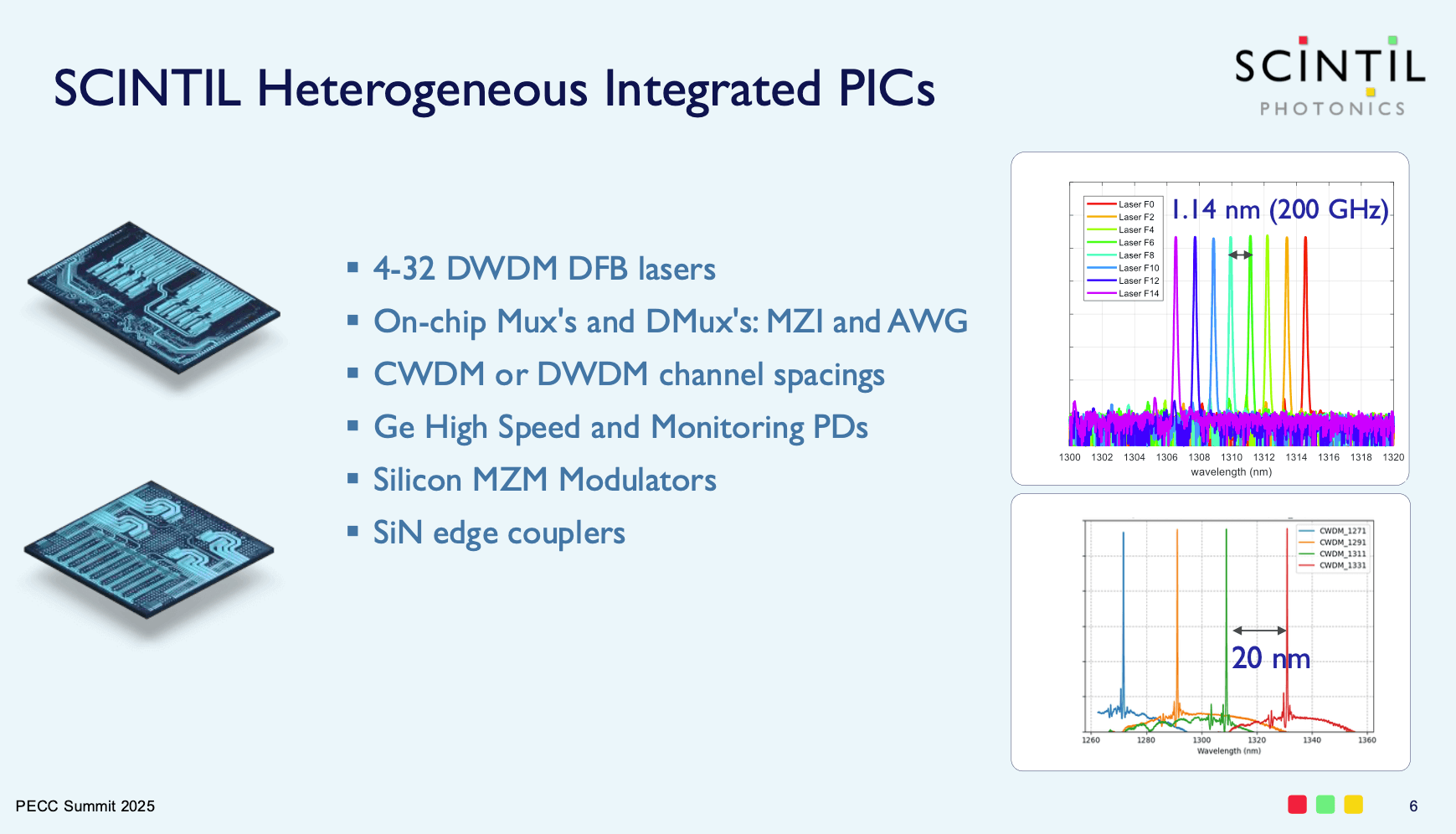
At the Optica + APC Photonic-Enabled Cloud Computing (PECC) Summit, Jim Theodoras, Vice President of Product Development at Scintil Photonics, outlined how heterogeneous integration and dense WDM co-packaged optics (CPO) could unlock a new era of scalable, power-efficient AI interconnects. Theodoras argued that as AI clusters scale, bandwidth density—not just raw speed—has become the defining constraint, and that the next leap forward will come from fully integrated, wavelength-division-multiplexed photonics.

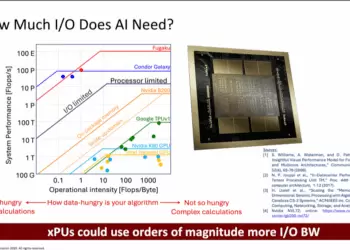
“AI networks don’t have one network — they have three,” Theodoras said. “Every GPU connects through multiple fabrics for scale-up, scale-out, and memory coherence. Where you once sold two transceivers per node, you now sell six.” He noted that this exponential growth in optical I/O, coupled with the shift to coherent high-bandwidth memory (HBM) architectures, is transforming data-center optics into an AI factory supply chain, where performance and profitability depend on the speed × density product.
Key technical points from the presentation:
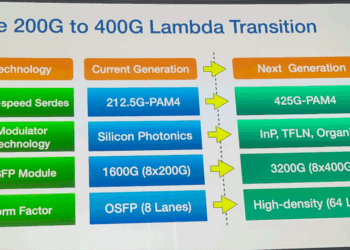
• The speed-density plateau: Ethernet generations that once scaled by 10× now only double, but each step requires higher parallelism—more lanes, more colors, higher modulation depth, and now spatial division multiplexing with multi-core fiber. “We’re getting twice the speed, but every generation doubles the complexity,” he said.
• Heterogeneous integration (Scintil SHIP): Scintil’s Silicon Heterogeneous Integrated Photonics (SHIP) process bonds III–V gain material onto standard silicon photonic wafers using a handle-exchange technique similar to backside-illuminated CMOS sensors. The process enables 4–32 DFB lasers on-die, integrated AWG mux/demux, Ge photodiodes, and SiN edge couplers — delivering a true monolithic DWDM photonic platform.
• LEAF-Light DWDM external laser source (ELS): Scintil’s first product targets CPO ecosystems with 100 GHz-spaced DWDM lasers offering >150 mW per channel at 50°C, 20% wall-plug efficiency, and <1 GHz wavelength stability. Theodoras highlighted its superior reliability—no AR coatings and no current through the grating—eliminating common EML failure modes.
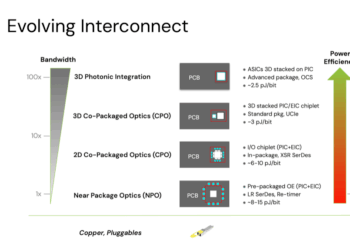
• CPO generations: He differentiated “gray CPO” (simple, air-cooled FR4 architectures) from true DWDM CPO, which uses color-multiplexed ring modulators and water cooling for maximum bandwidth density. “If you’re going to do CPO,” he said, “do it right—go for the WDM version that delivers sub-1 pJ/bit efficiency.”
• Energy efficiency roadmap: Scintil’s data shows LPO pluggables at ~5 pJ/bit, gray CPO near 3.8 pJ/bit, and DWDM CPO approaching 0.9 pJ/bit—a fourfold improvement over today’s best modules.
• Laser roadmap: Scintil’s WDM laser power roadmap tracks from 150 mW today to over 350 mW in 2026 and 500 mW in 2027 with integrated amplification, on par with the highest industry benchmarks.
Theodoras positioned Scintil’s heterogeneously integrated platform as a manufacturing-ready answer to AI bandwidth bottlenecks: scalable, foundry-compatible, and adaptable to multiple optical architectures. “Discrete EML-based optics have taken us far, but the world’s at capacity,” he said. “Heterogeneous integration lets us build at wafer scale, improve power and density, and make the billion-dollar generational leap AI demands.”
Founded in Grenoble, France, Scintil Photonics develops fully integrated photonic ICs that combine III–V lasers and silicon photonics for datacom, AI infrastructure, and optical computing. Its LEAF-Light external laser source and SHIP platform are enabling dense, reliable DWDM connectivity for the next wave of co-packaged and near-package optics.


www.scintil-photonics.com