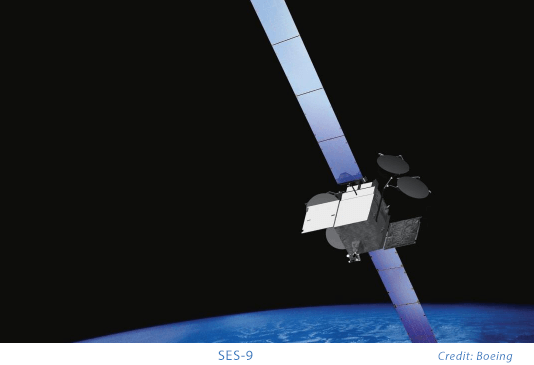
SES completed its acquisition of Intelsat, forming a global leader in multi-orbit satellite connectivity with a combined fleet of 120 satellites and strengthened access to low Earth orbit (LEO) assets. The merged entity now operates approximately 90 geostationary (GEO) and 30 medium Earth orbit (MEO) satellites and will leverage its expanded ground infrastructure and spectrum holdings across C-, Ku-, Ka-, military Ka-, X-, and UHF bands to deliver end-to-end services to enterprise and government markets.
The transaction boosts SES’s projected annual revenue to €3.7 billion, with a targeted adjusted EBITDA of €1.8 billion by 2028, and adjusted free cash flow surpassing €1 billion by 2027–2028, excluding the European IRIS2 program. SES aims to invest €600–€650 million annually in CapEx over the next four years to support its expansion into growth segments such as IoT, direct-to-device mobile services, inter-satellite links, space situational awareness, and quantum key distribution.
The company estimates total synergies from the merger will generate €2.4 billion in net present value, with 70% of integration benefits to be realized within three years. SES remains headquartered in Luxembourg and continues to be listed on the Paris and Luxembourg stock exchanges. It will also retain a strong operational presence in the United States through its McLean, Virginia office.
- Combined satellite fleet: ~90 GEO + ~30 MEO + LEO access
- Pro forma 2024–2028E revenue: €3.7 billion; EBITDA: €1.8 billion
- Synergy NPV: €2.4 billion; run-rate savings: €370 million annually
- CapEx forecast (2025–2028E): €600–€650 million annually
- Projected Free Cash Flow: >€1 billion by 2027–2028
- Headquarters: Luxembourg; U.S. hub: McLean, Virginia
“In this new chapter, we are bringing together a powerful mix of talented people, network infrastructure, spectrum, innovation, and global relationships that will allow us to deliver next-generation connectivity and space-enabled services in smarter and quicker ways,” said Adel Al-Saleh, CEO of SES.
History of SES
Founded in 1985 and headquartered in Betzdorf, Luxembourg, SES (Société Européenne des Satellites) launched its first satellite, Astra 1A, in 1988, pioneering direct-to-home television broadcasting in Europe. Over the decades, the company grew through a series of satellite launches, spectrum acquisitions, and strategic mergers, including its 2011 merger with New Skies Satellites and the full acquisition of SES Americom. SES became a dual-listed company in Paris and Luxembourg and emerged as one of the world’s largest satellite operators with a diversified customer base across video broadcasting, government, mobility, and enterprise connectivity segments.
SES was also a pioneer in the deployment of high-throughput satellites and digital video broadcasting. With its GEO fleet primarily positioned over Europe, the Americas, Africa, and Asia-Pacific, SES played a central role in delivering satellite TV, VSAT, and data services for decades.
The 03b Networks MEO Constellation
In 2016, SES became the first major operator to integrate medium Earth orbit (MEO) capabilities into its service portfolio by acquiring a controlling stake in O3b Networks. O3b—short for “Other 3 billion,” referencing the underserved global population without internet access—was founded in 2007 to provide fiber-equivalent connectivity from space. Positioned in a unique MEO orbit at approximately 8,000 km altitude, O3b satellites offer lower latency than GEO systems and high throughput for broadband applications.
SES expanded the constellation with the O3b mPOWER system, a second-generation MEO network featuring fully digital payloads and software-defined routing capabilities. With scalable bandwidth and adaptive beamforming, O3b mPOWER is designed to support demanding applications such as cloud connectivity, edge computing, government communications, and maritime broadband. The integration of Intelsat’s assets further strengthens SES’s vision of a fully integrated, multi-orbit network that spans GEO, MEO, and LEO layers.
🌐 We’re tracking the latest developments in subsea cable infrastructure, policy, and deployments. Follow our ongoing coverage at: https://convergedigest.com/category/subsea/