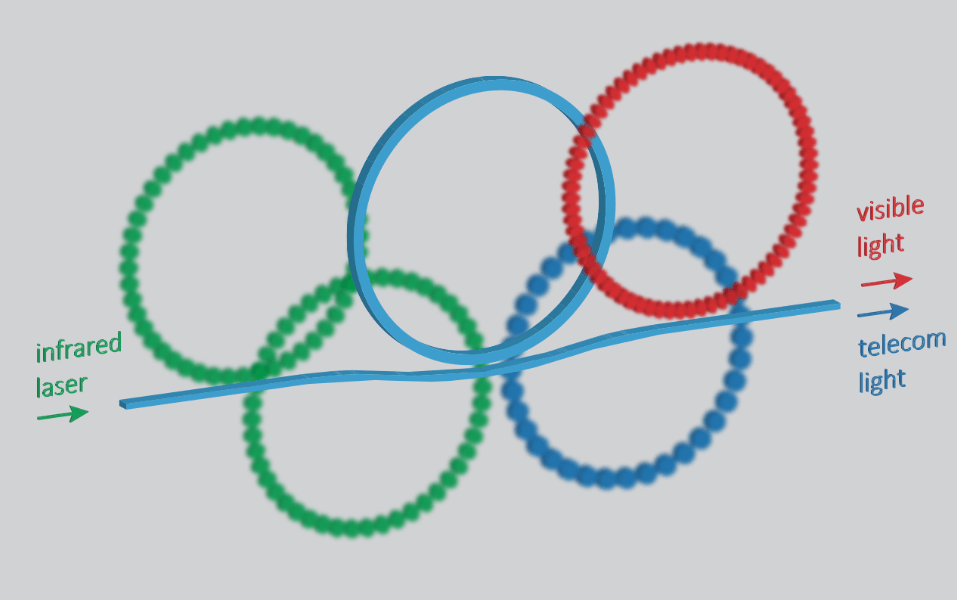
Researchers from the National Institute of Standards and Technology (NIST), University of Maryland, and University of Colorado are developing a new optical parametric oscillator (OPO) light source that can produce output light at different wavelength than the input light. In addition to creating light at visible wavelengths, the OPO simultaneously generates near-infrared wavelengths that can be used for telecom applications.
The research is published in Optica, The Optical Society’s (OSA) journal.
 “Our power-efficient and flexible approach generates coherent laser light across a range of wavelengths wider than what is accessible from direct chip-integrated lasers,” said research team leader Kartik Srinivasan. “The on-chip creation of visible light can be used as part of highly functional compact devices such as chip-based atomic clocks or devices for portable biochemical analyses. Developing the OPO in a silicon photonics platform creates the potential for scalable manufacturing of these devices in commercial fabrication foundries, which could make this approach very cost-effective.”
“Nonlinear optical technologies are already used as integral components of lasers in the world’s best atomic clocks and many laboratory spectroscopy systems,” said Xiyuan Lu, first author of the paper and a NIST-University of Maryland postdoctoral scholar. “Being able to access different types of nonlinear optical functionality, including OPOs, within integrated photonics is important for transitioning technologies currently based in laboratories into platforms that are portable and can be deployed in the field.”
The Optical Society said the silicon-based device may enable variety of photonic applications across a range of wavelengths.
Some highlights:
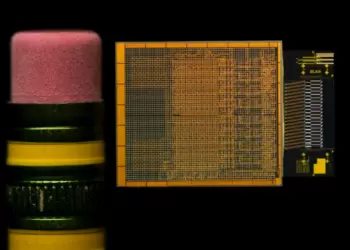
The OPO based on a microring made from silicon nitride.
It is fed by approximately 1 milliwatt of infrared laser power — about the same amount of power found in a laser pointer.
As the light travels around the microring it increases in optical intensity until powerful enough to create a non-linear optical response in silicon nitride.
This enables frequency conversion, a nonlinear process that can be used to produce an output wavelength, or frequency, that is different from that of the light going into the system.
The device was used to convert 900-nanometer input light to 700-nanometer-wavelength (visible) and 1300-nanometer-wavelength (telecommunications) bands.
The OPO accomplished this using less than 2 percent of the pump laser power required by previously reported microresonator OPOs developed for generating widely separated output colors.
number of compact chip lasers combined with flexible and versatile nonlinear nanophotonics.”
Paper: X. Lu, G. Moille, A. Singh, Q. Li, D. A. Westly, A. Rao, S.-P. Yu, T. C. Briles, S. B. Papp, K. Srinivasan, “Milliwatt-threshold visible-telecom optical parametric oscillation using silicon nanophotonics,” Optica, 6, 12, 1535-1541 (2019).
DOI: https://doi.org/10.1364/OPTICA.6.001535
https://www.osapublishing.org/optica/home.cfm