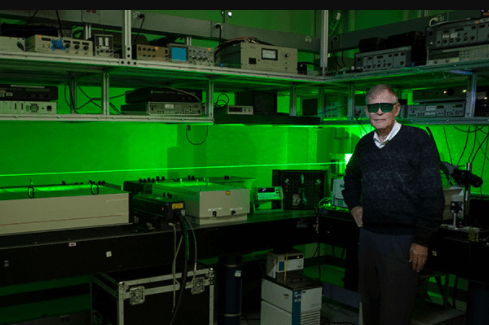
Robert L. Byer, a professor of applied physics and photon science at Stanford University’s School of Humanities and Sciences and a professor of photon science at SLAC National Accelerator Laboratory, is the first recipient of a newly created SPIE Maiman Laser Award.
SPIE said this award, which was created to mark the 60th anniversary of the laser’s invention, will be given annually to individuals who have made sustained contributions to laser source science and technology at the highest level.
Byer has received the 2020 SPIE Maiman Laser Award in recognition of sustained contributions and high impact in diode-pumped solid-state lasers and nonlinear optical sources.
 Byer’s illustrious career in laser technology includes developing the first visible, tunable red laser and the Q-switched unstable resonator Nd:YAG laser as well as demonstrating remote sensing using tunable infrared sources and utilizing precision spectroscopy using Coherent Anti-Stokes Raman Scattering (CARS). Out of more than 50 patents, Byer’s favorite remains his green laser pointer patent because it grew directly out of a student’s question during class. That invention has had prolific and mainstream use including as a lecture pointer, a pointer for astronomy, a rescue flare for sailors at sea, and, using a frequency-doubled light to generate green wavelengths, as a laser for color television. Byer has pursued his research and taught classes in lasers and nonlinear optics at Stanford since 1969. Earlier this year, he delivered a LASE plenary during SPIE Photonics West entitled “Accelerators on a Chip: A Path to Attosecond Science.”
“I grew up in Southern California surfing ocean waves from San Diego to Malibu Beach,” notes Byer. “My career has been in lasers and nonlinear optics where I have had the good fortune of surfing light waves with colleagues and friends from around the world. The demonstration of the first laser by Ted Maiman 60 years ago in the Hughes Research Laboratory, located above Malibu Beach, opened the door to the laser and all of its applications from communications to the detection of gravitational waves. I am thrilled to be selected as the inaugural recipient of the SPIE Maiman Laser Award.”
“Bob has been a tireless pioneer and promoter of solid-state laser technology for decades,” says Maiman Laser Award Subcommittee Chair and physics professor at ETH Zurich Ursula Keller. “He has worked on and developed new laser physics and technology, novel materials, and large, high-impact science projects based on key laser technology such as gravity waves, laser fusion, and particle acceleration. His work has had critical commercial impact, he has international collaborators all over the world, and is a leader in terms of the education of laser scientists. And, for me personally, as a former graduate student, he is simply one of the most inspiring professors at Stanford.”
Theodore Harold Maiman demonstrated the world’s first working laser, a ruby laser, on 16 May 1960.