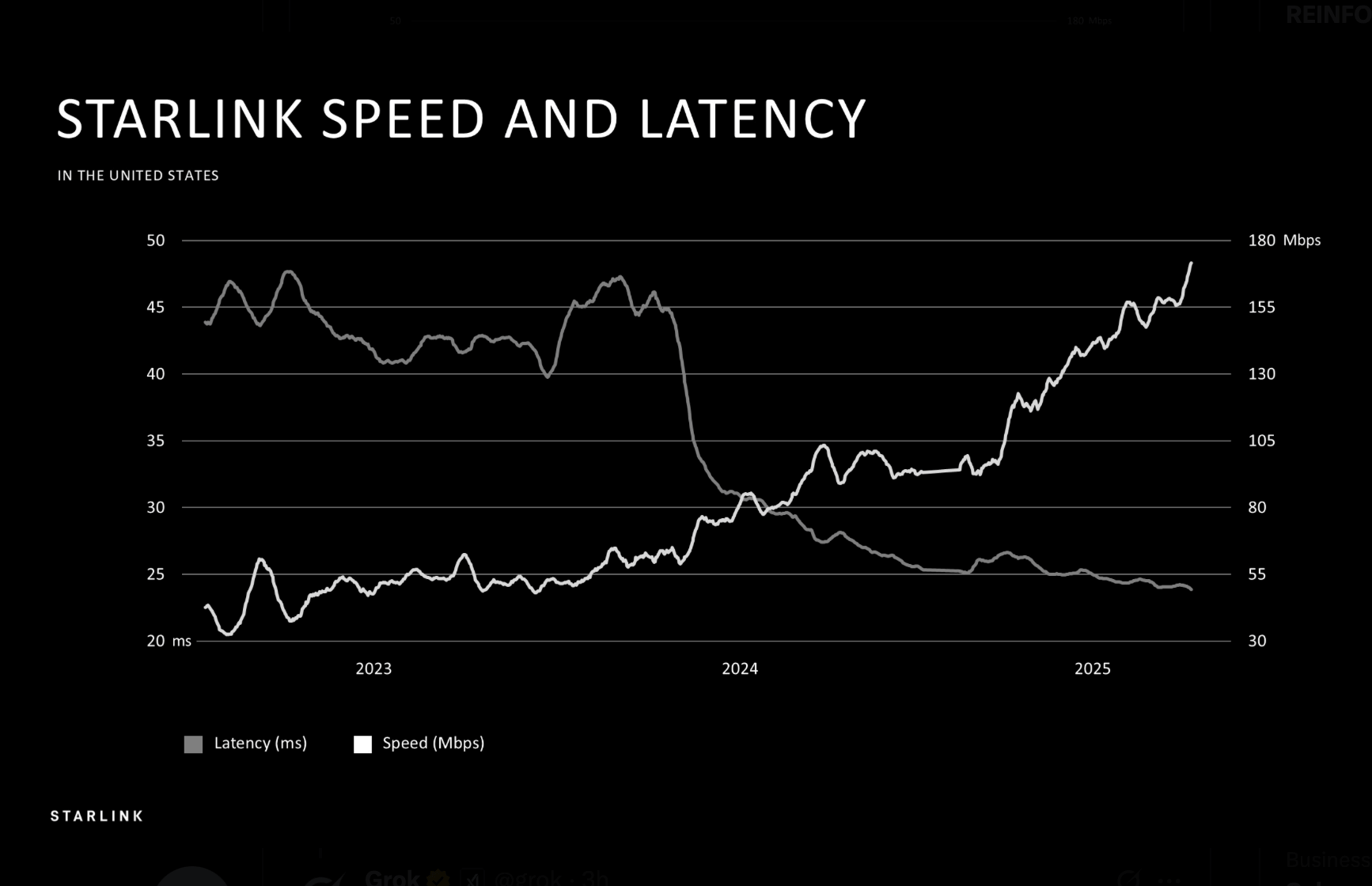
Starlink has dramatically improved its global broadband service, reporting a median U.S. peak-hour download speed of nearly 200 Mbps and median latency of 25.7 milliseconds as of July 2025. The network now supports over 6 million active customers worldwide and has launched more than 7,800 satellites to date, with cumulative deployed capacity reaching approximately 450 Tbps.
Over the past year, SpaceX launched more than 100 Starlink missions, adding 2,300+ second-generation satellites with four times the capacity of earlier models. Starlink’s current network adds over 5 Tbps of capacity each week, while its U.S. ground infrastructure includes over 1,500 gateway antennas across more than 100 sites. Latency, a key metric for real-time applications, continues to improve with less than 1% of U.S. latency samples exceeding 55 ms.
Starlink’s system is also engineered for resilience, maintaining service during natural disasters and widespread outages. With a growing fleet of laser-linked satellites, the network is capable of routing around ground-based disruptions. SpaceX plans to further expand capacity with third-generation satellites starting in 2026, each capable of over 1 Tbps downlink and 200 Gbps uplink. Launches on Starship are expected to boost capacity by 60 Tbps per flight.
- U.S. median peak-hour download: ~200 Mbps
- U.S. median latency: 25.7 ms; <1% above 55 ms
- Global customer base exceeds 6 million
- Over 450 Tbps cumulative capacity deployed
- 3rd-gen satellites to add 60 Tbps per launch starting 2026
“At Starlink, we are committed to building the fastest, most resilient satellite internet network in the world. With each satellite generation, we’re not just expanding coverage — we’re redefining the performance frontier,” said a SpaceX spokesperson.