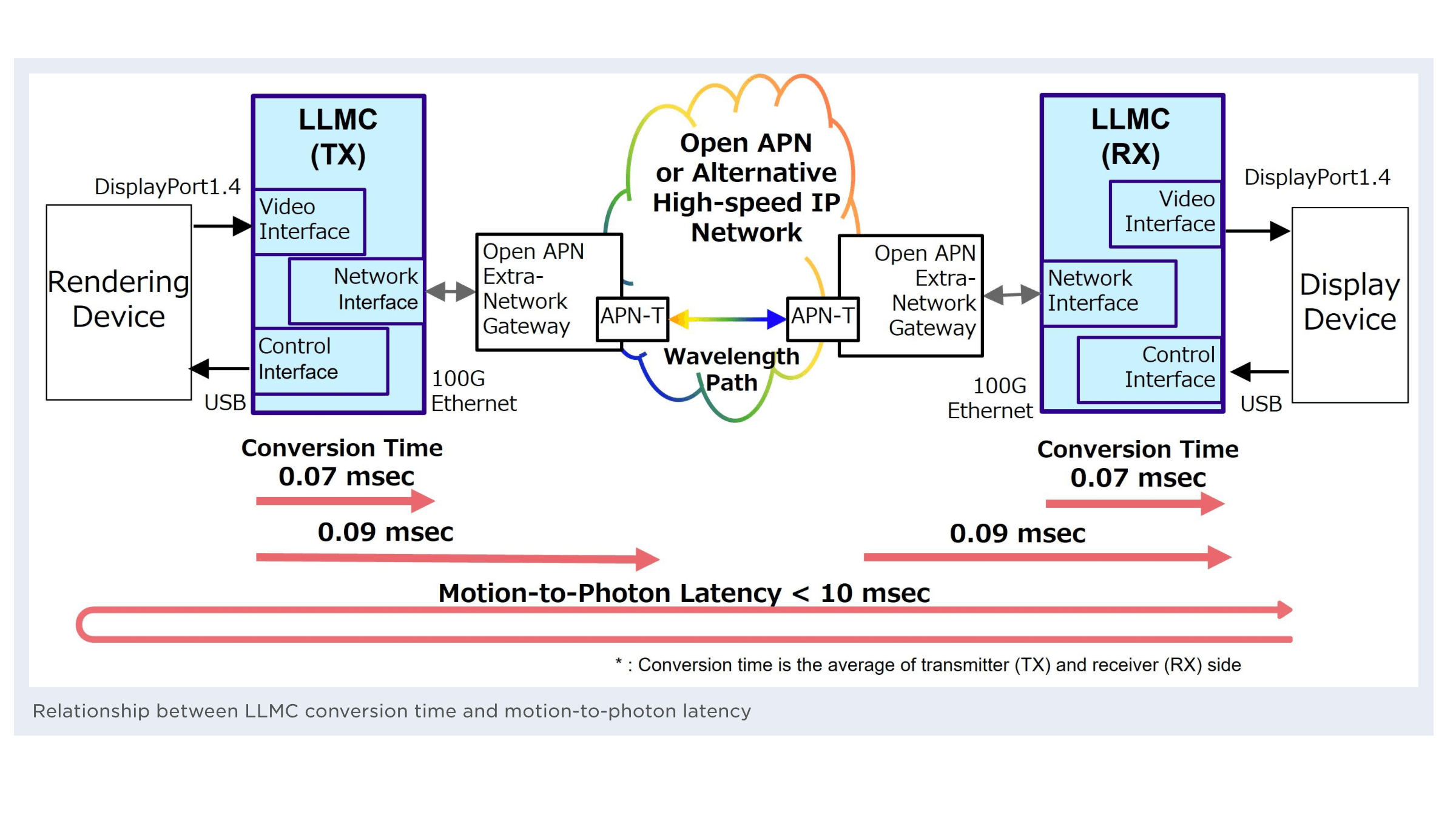
Sumitomo Electric Industries has introduced a low-latency media converter (LLMC) technology that delivers high-resolution video content over networks with an average transmission latency of just 0.07 milliseconds. Jointly developed with Taiwan-based ATEN International, the technology converts DisplayPort signals used in head-mounted displays into Ethernet signals for transmission. The proof of concept (PoC) was showcased at the IOWN Global Forum, targeting immersive XR applications like 3D imaging, virtual reality (VR), and augmented reality (AR).
Sumitomo Electric collaborated with Sony Group Corporation for the PoC, focusing on a bidirectional remote XR video service named Interactive Live Music (ILM). The system incorporated LLMC devices, Sony’s renderer technology, and Infinera’s ICE-X transceivers. Tests achieved the forum’s 10-millisecond motion-to-photon latency target, essential for preventing motion sickness during XR use. LLMC devices reached an average latency of 0.07 msec per unit, enabling seamless transmission over Open APN networks.
The IOWN Global Forum presented these results at its events in New York and Taipei, with a live demo combining the PoC system and commercially available VR devices. Sumitomo Electric plans to further develop products leveraging this technology to enhance next-generation XR services.
Key Points:
• LLMC Transmission Speed: 0.07 msec latency with DisplayPort-to-Ethernet conversion.
• Supported Networks: Designed for high-speed Open APN with up to 100 Gbps Ethernet.
• Verification: Achieved under 10 msec motion-to-photon latency in 3D XR use cases.
• Collaborators: Jointly developed with ATEN International and tested with Sony and Infinera technologies.
• Target Use Cases: Real-time 3D imaging, AR/VR, and remote XR services.