• Home
  • Events Calendar
  • Blueprint Guidelines
  • Privacy Policy
  • Subscribe to Daily Newsletter
  • NextGenInfra.io
No Result
View All Result
Converge Digest
Thursday, April 16, 2026
  • Home
  • Events Calendar
  • Blueprint Guidelines
  • Privacy Policy
  • Subscribe to Daily Newsletter
  • NextGenInfra.io
No Result
View All Result
Converge Digest
No Result
View All Result

Home » Sun Awarded DARPA Contract to Develop Microchip Interconnect System

Sun Awarded DARPA Contract to Develop Microchip Interconnect System

March 23, 2008
in Uncategorized
A A

The Defense Advanced Research Projects Agency (DARPA) has awarded Sun Microsystems a $44.29 million funding for a five and a half-year research project focused on microchip interconnectivity via on-chip optical networks.

The project, which is part of DARPA’s Ultraperformance Nanophotonic Intrachip Communication program, aims to accelerate the development of lower cost, high performance and high productivity systems using arrays of low-cost chips. The goal is to create high bandwidth, low latency, and low power interconnections between the parallel computing chips in such an array.

Sun said its program combines optical signaling with Proximity Communication, its key chip-to-chip I/O technology, to construct arrays of low-cost chips in a single virtual “macrochip.” Such an aggregation of inexpensive chips looks and performs like a single chip of enormous size, thus extending Moore’s Law; it also avoids soldered chip connections to enable lower total system cost. Long connections across the macrochip leverage the low latency, high bandwidth, and low power of silicon optics, and through this program Sun and DARPA will research technologies to dramatically further reduce the cost of these optical connections. The result is a virtual supercomputer.

“Optical communications could be a truly game-changing technology — an elegant way to continue impressive performance gains while completely changing the economics of large-scale silicon production,” said Greg Papadopoulos, chief technology officer and executive vice president of research and development for Sun. “Congratulations to Sun Labs and Microelectronics teams for their constructive creativity and for driving innovation into the semiconductor marketplace.”http://www.research.sun.com

  • Earlier this month, researchers at IBM announced a nanophotonic switch for routing optical data between cores in future computer chips. Like a long-haul fiber-optic network, such an extremely miniature on-chip network will transmit, receive, and route messages between individual cores that are encoded as a pulses of light. IBM estimates that by using light instead of wires, as much as 100 times more information can be sent between cores, while using 10 times less power and consequently generating less heat.

    The report on this work, entitled “High-throughput silicon nanophotonic wavelength-insensitive switch for on-chip optical networks�? by Yurii Vlasov, William M. J. Green, and Fengnian Xia of IBM’s T.J. Watson Research Center in Yorktown Heights, N.Y. is published in the April 2008 issue of the journal Nature Photonics. This work was partially supported by the Defense Advanced Research Projects Agency (DARPA) through the Defense Sciences Office program “Slowing, Storing and Processing Light�?.

Tags: AllOptical
ShareTweetShare
Previous Post

Incumbents AT&T and Verizon Wireless Among Winners in 700 MHz Auction

Next Post

Nortel Lands 5-Year CDMA Contract with US Cellular

Staff

Staff

Related Posts

Microsoft Inks 5-Year, Multi-Billion Deal with KT to Drive AI in Korea
Optical

Open RAN xHaul and IPoDWDM Solutions Take Center Stage

February 27, 2025
Ribbon Communications Secures $385 million credit facility
Optical

Ribbon Completes DWDM Deployment for Bharti Airtel

October 27, 2024
Tech Update video: Ayar Labs’ Optical I/O Chiplets
Optical

ECOC24 video: What’s Next for Optical DSPs? 1.6T and Beyond

September 24, 2024
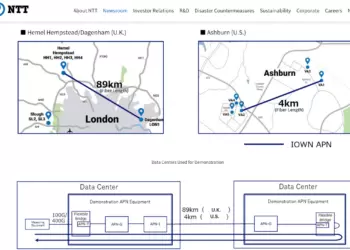
NTT Achieves Less Than 1ms Latency, Below 1μs Jitter at 400Gbps
Optical

NTT Achieves Less Than 1ms Latency, Below 1μs Jitter at 400Gbps

April 12, 2024
#OFC24: A New Class of Silicon Photonics for AI Data Centers
Video

Big Power Savings with 800G Linear Receive Optics

April 4, 2024
AFL acquires Optical Telecom for DAS expertise
Optical

Fujikura’s AFL to build fiber manufacturing factory in Poland

October 18, 2023
Next Post

India's BSNL Awards $100 Million GSM Expansion Contract to Nortel

Please login to join discussion

Categories

  • 5G / 6G / Wi-Fi
  • AI Infrastructure
  • All
  • Automotive Networking
  • Blueprints
  • Clouds and Carriers
  • Data Centers
  • Enterprise
  • Explainer
  • Feature
  • Financials
  • Last Mile / Middle Mile
  • Legal / Regulatory
  • Optical
  • Quantum
  • Research
  • Security
  • Semiconductors
  • Space
  • Start-ups
  • Subsea
  • Sustainability
  • Video
  • Webinars

Archives

Tags

5G All AT&T Australia AWS Blueprint columns BroadbandWireless Broadcom China Ciena Cisco Data Centers Dell'Oro Ericsson FCC Financial Financials Huawei Infinera Intel Japan Juniper Last Mile Last Mille LTE Mergers and Acquisitions Mobile NFV Nokia Optical Packet Systems PacketVoice People Regulatory Satellite SDN Service Providers Silicon Silicon Valley StandardsWatch Storage TTP UK Verizon Wi-Fi
Converge Digest

A private dossier for networking and telecoms

Follow Us

  • Home
  • Events Calendar
  • Blueprint Guidelines
  • Privacy Policy
  • Subscribe to Daily Newsletter
  • NextGenInfra.io

© 2025 Converge Digest - A private dossier for networking and telecoms.

No Result
View All Result
  • Home
  • Events Calendar
  • Blueprint Guidelines
  • Privacy Policy
  • Subscribe to Daily Newsletter
  • NextGenInfra.io

© 2025 Converge Digest - A private dossier for networking and telecoms.

This website uses cookies. By continuing to use this website you are giving consent to cookies being used. Visit our Privacy and Cookie Policy.
Go to mobile version