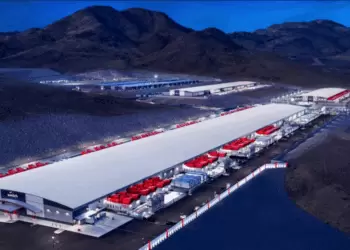
Switch is the operation behind the massive SuperNAP in Las Vegas, also known by superlatives such as ‘world’s densest data centre’ or the first ‘elite’ data centre capable of exceeding Tier IV classification by the Uptime Institute. Switch currently has about 1.8 million sq feet of colocation data centre space powered up in Las Vegas, with plans to add a further 854,000 sq feet of space in this same market. Switch has also kicked off construction of a multi-billion dollar data centre campus in Reno, Nevada, as well as another marquee data centre in Grand Rapids, Michigan. An international expansion is also underway with its first data centre in Europe (Siziano, Italy) and Asia (Chonburi, Thailand). Last week, Switch unveiled its latest ambition – a data centre campus spanning more than one million sq feet in Atlanta.
Switch is privately-held company founded in 2000 by Rob Roy, a young entrepreneur who seized upon the idea that the world’s leading corporations and telecom operators would benefit from highly-secure, scalable and energy-efficient colocation space where their systems could be in close physical proximity to many other like-minded carriers and corporations. Many others had this same idea at the turn of the millennium and thus we had the birth of top data centre operators whose names are still recognised today (Equinix CoreSite, Telecity), along with others that have since disappeared.
The company really got started by acquiring an Enron Broadband Services building located on Las Vegas’ east Sahara Boulevard that provided access to long-haul fibre routes from the national network operators. This facility was originally intended to be the operational centre of Enron’s bandwidth arbitrage business. Following Enron’s spectacular collapse, the property was acquired in a bankruptcy auction by Rob Roy, reportedly only for $930,000.
Rob Roy, who remains CEO and chairman of the business, had the counter-intuitive insight to build the world’s largest data centre in the desert city of Las Vegas. There are several reasons why Las Vegas could have been a bad choice. First, the geographic location is far away from the financial centres of North America – there are relatively few Fortune 500 headquarters in Las Vegas. Second, Las Vegas is unmistakably situated in a desert. During July, the average daytime high temperature is 40.1C (104F). It is commonly understood that air conditioning is one of the greatest costs in running a data centre, and for this reason hyperscale data centres have been built near the Arctic Circle. Why build one in the desert? Third, Las Vegas is known for gambling and entertainment, but not particularly for high-tech. If you are looking for hotspots for tech talent, you might think of Silicon Valley, Seattle, Boston, Austin, Ann Arbor or many other locations before picking Las Vegas.
 However, each of these objections turned out to be an advantage for Switch thanks to the persistence or innovation of its founder. Regarding its location, the Nevada desert is geographically isolated from other potential geographic disasters. It is spared from the earthquakes of California, Oregon or Washington. It is not in tornado alley nor is it in the path of any potential hurricane. The location has no possibility of suffering through a debilitating blizzard, flood or tsunami. The biggest enterprises with the tightest requirements will want to have at least one major data facility out of any potential danger zone. By scaling its data centre campus to an enormous size, the Switch SuperNAP becomes its own gravity centre for attracting clients to the campus. According to the company’s website, there are over 1,000 clients now, including big names such as Boeing, eBay, Dell EMC, Intel, JP Morgan Chase and many others.
As for the desert heat, Switch innovations enabling it to nail the energy efficiency challenge. The company’s proprietary Thermal Separate Compartment in Facility (T-SCIF) design, which enables an unusually high-density of power load per rack, does not use water cooling. Nor does it use conventional computer room air conditioning units. Key ingredients include a slab concrete floor, hot air containment chambers, high ceilings and a heat exchange system mounted above. HVAC cooling units are outside the building. The company cites a PUE of 1.18 for its data centres in Las Vegas and an estimated 1.20 for its new facility in Reno, Nevada.
Regarding technology innovation, Rob Roy now has 256 patents and patent-pending claims with many focused on his Wattage Density Modular Design (WDMW) data centre design. Talent attracts talent. Whereas some data centre operators describe themselves primarily as real estate investments trusts, Switch positions itself as a technology leader. One example is its proprietary building management system, which uses more than 10,000 sensors to gather millions of daily data points for dynamically optimising operations.
The Nevada desert enjoys abundant sunshine and since January 2016 all its data centres have operated on 100% renewal energy thanks to two nearby solar power stations operated by the company. These solar farms use PV panels to generate 180 MW of capacity. The focus on renewable power has earned the company an “A” listing on Greenpeace’s Clean Company Scorecard, ahead of Apple, Facebook, Google, Salesforce, Microsoft, Equinix and all the others with large-scale data centre operations.
Below is an overview of major facilities and developments (data from the company website and other public sources):

In March 2017, Switch officially opened the first phase of the 1.8 million-square-foot data centre campus in Grand Rapids, Michigan. The iconic building, which is an adaptive reuse of the Steelcase Pyramid, is the centre piece of what is intended to become the largest, most advanced data centre campus in the eastern U.S. The entire campus is powered by green energy.
In February 2017, Switch inaugurated its Citadel Campus in Reno, Nevada (near Tesla’s Gigafactory). The Citadel Campus, located on 2,000 acres of land, aims to be the largest colocation facility in the world when it is fully built. The first building has 1.3 million sq feet of space. It is connected to the Switch SUPERLOOP, a 500-mile fibre backbone built by the company to provide low-latency connectivity to its campus in Las Vegas as well as to the San Francisco Bay Area and Los Angeles.
In December 2016, SUPERNAP International officially opened the ‘largest, most advanced’ data centre in southern Europe. The new facility is built to the specifications of the company’s flagship, Tier IV Gold-rated Switch Las Vegas multi-tenant/colocation data centre. The new facility is located near Milan and includes 42,000 sq meters of data centre space with four data halls.
In January 2016, construction began on a new $300 million SUPERNAP data centre in Thailand’s eastern province of Chonburi. The new SUPERNAP Thailand data centre, which is in the Hemmaraj Industrial Estate, will cover an area of nearly 12 hectares and will be strategically built outside the flood zone, 110-metres above sea level and only 27 km away from an international submarine cable landing station.