T-Mobile US (NASDAQ: TMUS) reported strong third-quarter 2025 results, marking another record in customer growth and network leadership. The company delivered service revenues of $18.24 billion, up 9% year-over-year, and postpaid service revenues of $14.88 billion, up 12%. Core adjusted EBITDA rose 6% to $8.68 billion, driven by record postpaid additions and continued broadband expansion.
T-Mobile added 2.3 million postpaid net customers, including more than 1 million postpaid phone adds, its best Q3 in over a decade. The company led the industry in postpaid churn and broadband additions, gaining 560,000 broadband customers—506,000 through 5G fixed wireless access (FWA) and 54,000 through fiber. Management raised full-year guidance across all major metrics, citing strong demand, network efficiency, and early synergy realization from recent acquisitions including UScellular and Metronet.
Network Leadership and Technology Strategy
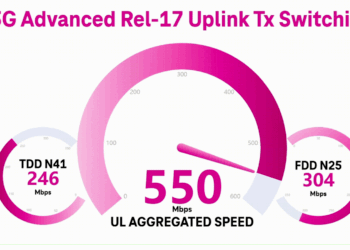
- T-Mobile said it remains two years ahead of its competitors in 5G coverage and performance, extending its lead with 5G Advanced features such as L4S (Low-Latency, Low-Loss, Scalable throughput) and carrier aggregation on 70% of its sites.
- The operator was recognized by Opensignal as the Global Winner for 5G Coverage Experience and Global Leader in 5G Reliability, and ranked the #1 U.S. fixed-wireless carrier for consistent quality.
- Median download speeds on new iPhone 17 devices were nearly 90% faster than one benchmark competitor and over 40% faster than another, according to Ookla data.
- 5G Home Internet customers now average ≈580 GB per month, up 30% year-over-year, even as average speeds improved nearly 50%.
- The company said it is adding and upgrading thousands of sites—many in smaller markets and rural areas—to reinforce its “Ultra Capacity” 5G footprint.
Broadband and Fiber Expansion
- T-Mobile ended Q3 with 8.9 million broadband customers, including 8 million on 5G FWA.
- Fixed wireless ARPU and customer lifetime value are now comparable to postpaid phone users, underscoring FWA’s profitability.
- Fiber initiatives through Metronet and Lumos joint ventures are contributing new subscribers; the company raised full-year fiber net-add guidance to 130,000.
- T-Mobile reaffirmed its plan to reach 12–15 million homes passed on fiber using capital-light partnerships that combine its brand and distribution with JV partners’ build expertise.
AI, Digital Transformation, and Experience Innovation
- About 75% of iPhone upgrades during the preorder window were completed digitally via the T-Life app, which now has over 85 million installs.
- The company’s IntentCX initiative—co-developed with OpenAI—is simplifying upgrade and trade-in processes using generative AI to reduce friction in the customer journey.
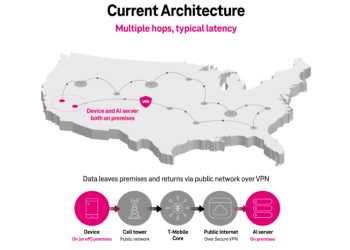
- T-Mobile continues to integrate AI-driven network planning and customer-driven coverage optimization to guide infrastructure investments and improve perception at the local level.
Spectrum and Future-Proofing the Network
- T-Mobile reiterated that it holds the largest and most balanced spectrum portfolio in the U.S., combining low-band and mid-band layers for nationwide coverage and capacity.
- Rather than overpay in secondary-market spectrum deals, the company is focusing on densification and preparing for upcoming FCC auctions following restoration of auction authority.
- The operator is collaborating closely with SpaceX to develop direct-to-cell satellite connectivity, with field tests underway and plans to extend coverage to remote and underserved areas.
- The company is also advancing 6G research and AI-RAN concepts in partnership with NVIDIA, Nokia, and Ericsson, positioning to be “two to three years ahead” as 6G matures.
Financial Highlights
- Core adjusted EBITDA: $8.68 billion, up 6% YoY
- Adjusted Free Cash Flow: $4.8 billion
- Operating Cash Flow: $7.5 billion, up 21% YoY
- Cash CapEx: $2.6 billion, up 35% YoY due to new greenfield builds and integration costs
- Raised 2025 guidance:
- Postpaid net adds: 7.2–7.4 million (up ≈1 million midpoint)
- Postpaid phone adds: ≈3.3 million
- Core EBITDA: $33.7–$33.9 billion
- Adjusted Free Cash Flow: $17.8–$18.0 billion
- Cash CapEx: ≈$10 billion
“T-Mobile has more spectrum than anyone else, better spectrum than anyone else, and we are committed to not only being the network leader of today but also investing tirelessly to defend and widen the margin of our network leadership for tomorrow,” said Srini Gopalan, COO and incoming CEO of T-Mobile.
🌐 Analysis: T-Mobile’s Q3 results reinforce its position as the U.S. market’s growth leader, driven by network quality, spectrum advantage, and disciplined execution. The company’s increasing reliance on AI for both customer interaction and network optimization marks a strategic shift toward intelligent automation across the stack. Its FWA and fiber expansion—balanced by capital-light economics—signal that broadband will remain a major growth driver even as 5G Advanced and satellite integration reshape the coverage landscape for the late 2020s.