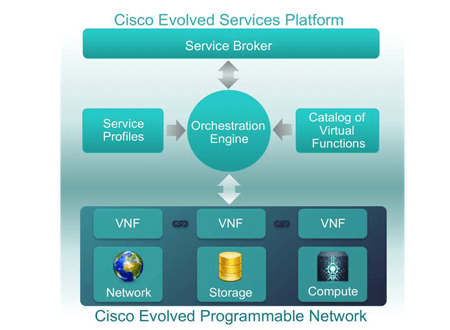
 Cisco and Telefónica announced a collaboration focused on converged IP and optical networks. Specifically, Telefónica will be testing the Cisco Open Network Architecture, comprised of the Evolved Services Platform (ESP) and Evolved Programmable Network (EPN), which combine both hardware and software. These capabilities include virtual network functions, software-defined networking (SDN) and advanced orchestration.
Some key points of the agreement:
- Over the next two years, Cisco and Telefónica will be jointly using the Cisco WAN Automation Engine software, which automates and optimizes the engineering of the WAN network, provisioning flexible SLAs (Service Level Agreements) and ultimately, creating a better user experience.
- Telefónica and Cisco will collaborate on different use cases extracted from the Telefónica network topology, including multilayer restoration, the creation of a multidomain route and a multilevel by-pass, all of this with a multi-vendor approach in order to guarantee compatibility between products from different manufacturers.
- The tests will be based on various hardware solutions from Cisco and other vendors that are widely used in the market. Cisco gears included such as Cisco CRS Series routers and transport platform Cisco Network Convergence System 2000.
- The testing platform with also be using Cisco nLight, which is multilayer control technology (GMPLS, Generalized Multiprotocol Label Switching) facilitating the exchange of information between the IP and optical layers to optimize operations and maximize the benefits of a convergent transport network.
- Telefónica will be validating models which help minimize investment cost (by means of redundant and underutilized resources) and to achieve a unified network architecture that is more efficient, less complex and easier to upscale, downscale and operate, enabling it to obtain significant savings in operating and capital costs.
“Architectural approaches based on network layers that are constructed and run independently generate inefficiencies of scale, provision and operation that must be resolved as soon as possible. What we need is an innovative focus capable of creating an optimally convergent transport infrastructure, and that’s what we, along with Telefónica, are trying to provide leveraging SDN technology benefits,” stated Bill Gartner, Vice President of Optical Networking Group at Cisco.
http://pressoffice.telefonica.com/
In February 2014, Cisco introduced an Evolved Services Platform (ESP) for Service Providers that leverages its software-defined networking (SDN) and network function virtualization (NFV) offerings.

The Cisco ESP is a unified virtualization and orchestration software platform that creates, automates and provisions services in real time, across compute, storage and network functions, to deliver desired business outcomes for applications running across multiple domains.
Cisco said the primary characteristics of this virtualization and orchestration software platform are:
- Open: Cisco ESP is multi-vendor and based on open standards and incorporating Openstack and Open Daylight (SDN) protocol suite, it is fully compliant with ETSI NFV MANO, 3GPP and more. With interoperation of third-party software, Cisco ESP works with Cisco’s virtual functions and with other vendors’ functions and applications such as Metaswitch Networks and Openwave Mobility.
- Extensible: Cisco ESP offers the most comprehensive broad set of capabilities with more on the way and spanning across the entire service provider architecture – cloud, video, mobile and fixed – to provide service providers greater means to optimize their networks or create, automate the creation of new services as the business needs dictate.
- Elastic: Cisco ESP allows service providers to seamlessly and dynamically scale their existing services while also dramatically accelerating deployment of new services and network functions. Resources are harnessed in an automated way when and where they are needed to enable providers deliver “On Demand” offerings at web speed.