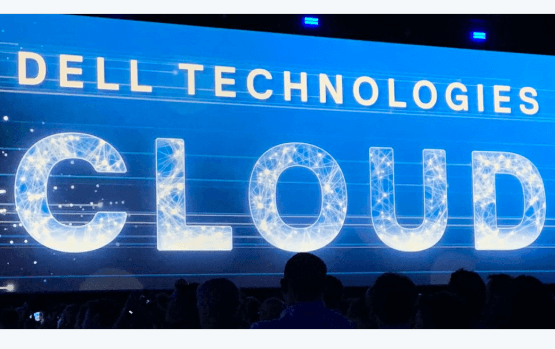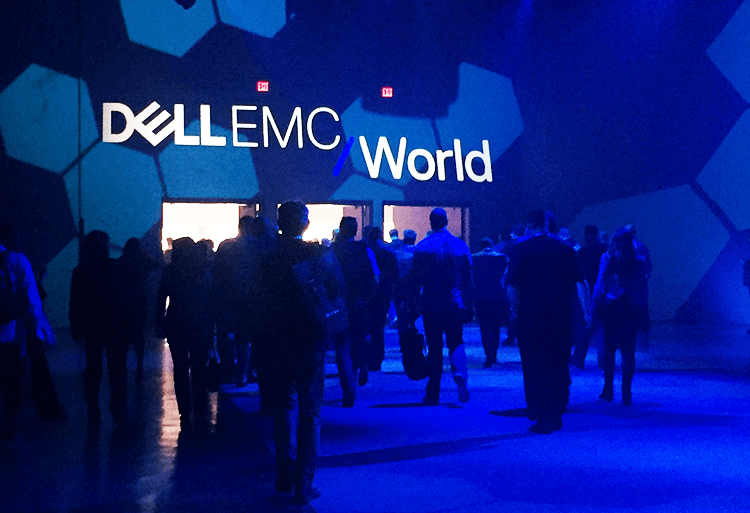
The 13,500 people gathered at the Dell EMC World conference in Las Vegas this week came from 122 countries, basically reflecting the global reach of the tech industry. About 50% of Dell Technologies’ annual revenue of $62 billion came from outside the U.S. Whereas Hewlett-Packard famously split its PC and printing operations (now HP Inc.) from its enterprise solutions business (now HPE) in November 2015, Dell has kept the family together while massively adding new market segments to its portfolio.
The company has a stated mission of becoming its customers’ essential infrastructure provider and insists that the ‘death of the PC’ has been greatly exaggerated. While consumers now rely mostly on smartphones, tablets and laptops, enterprise customers are still buying PCs in significant numbers because they know that PCs are the primary tool for accomplishing most office tasks. Dell sees the PC as an essential link in its overall value chain. Dell supplies nearly all the Fortune 500 companies in the U.S. to some extent, and its brand is especially strong with retail companies, the hospitality industry, transportation and others. As described in Part 1, Dell Technologies is emerging as an IT superpower. Its nearest competitors are HPE, Huawei, IBM and Lenovo, but the comparisons are rough. Unlike the American rivals, Dell remains in the low margin consumer PC business, and unlike the Chinese vendors it has stayed out of the massive mobile handset business.

The integration of two major corporations – Dell Inc. and EMC – is admittedly an enormous project that will take years to fully accomplish and not everything has found a place under the big umbrella. There have been three divestitures amounting to $7 billion. The most notable of these was the decision in March 2016 to sell Dell IT Services (the old Perot Systems) to Japan’s NTT Data for $3.05 billion. In June 2016, Dell agreed to sell its software division to Francisco Partners and Elliott Management for a reported $2 billion. The deal involved Dell’s Quest Software and SonicWALL division. Dell paid $2.4 billion for Quest in 2012. Despite the paper loss, these divestures enabled Dell to pay down its significant debt before completing the acquisition of EMC.
Quick update on Dell’s financial picture
For its most recently completed fiscal 2017, Dell Technologies posted consolidated revenue $61.6 billion and non-GAAP revenue from continuing operations of $62.8 billion. The company generated an operating loss of $3.3 billion, with a non-GAAP operating income of $5.1 billion. The company ended the year with a cash and investments balance of $15.3 billion, an increase of $287 million from the third quarter.
Dell Technologies’ overall sales mix is approximately:
• 60% from Dell Client Solutions Group (desktop PCs, virtual desktops, notebooks, tablets, and peripherals, such as monitors, printers, and projectors under the Dell brand name).
• 35% from Dell EMC (storage solutions, servers, converged infrastructure, switching, security, cloud services).
• 5% from VMware.
Highlight from Q4 2017 results:
• Gross margin for the quarter of 32.0%.
• Since closing the EMC transaction, Dell Technologies paid down approximately $7 billion in debt and repurchased $824 million of Class V common stock.
• The Client Solutions Group generated revenue of $9.8 billion, up 11% versus the fourth quarter of last year; revenue for the full year was $36.8 billion, up 2% year over fiscal year 2016.
• PC shipments reached 11 million, representing the largest volume of products shipped since the fourth quarter of 2011.
• 16 consecutive quarters of gaining yr/yr PC share and grew fastest of the top 5 in yr/yr unit shipment growth in Q4 and for full year.
• Dell attained the No.1 share position worldwide for displays, gaining unit share yr/yr for the 16th consecutive quarter.
• The Infrastructure Solutions Group generated $8.4 billion of revenue, including $3.6 billion in servers and networking and $4.8 billion in storage, and an operating income of $1 billion.
• Dell regained the No.1 worldwide server unit share position driven by strength in the mainstream PowerEdge business.
• Attained the No.1 market share position in all-flash arrays4, which exited 2016 at a more than $4 billion demand run rate.
• No.1 in Converged Infrastructure, accelerating in Hyper-converged.
• No.1 in x86 server unit share.
• VMware revenue for the quarter of $1.9 billion, with operating income of $565 million, or 29.2% of revenue.
The essential argument
Applications increasingly run on clouds. Private clouds are more secure, have better performance characteristics, and are less expensive that public clouds. Clouds run on data centre infrastructure (servers, storage and switches). Dell is the leading supplier of IT infrastructure, therefore Dell benefits from cloud migration. For the past decade, CIOs have sought to optimise IT for their businesses. With the digital transformation underway, CIOs now know that IT is their business. The corporate vision sees: (1) cloud-native apps driving the public clouds; (2) traditional apps moving to hybrid clouds; and (3) hybrid clouds being built on converged infrastructure. If Dell can capture these app migrations with software frameworks, then sales at the hardware layer could follow.
For mission-critical apps, Dell now has Virtustream, a hot start-up based in Bethesda, Maryland, that EMC acquired in 2015. Virtustream’s cloud management software provides the ability to run SAP, Oracle and other complex enterprise software in a cloud environment using micro VMs. The system measures and allocates the precise amount of compute, networking and storage resources needed for a given task. Virtustream also provides cloud archiving and restoration services.
For traditional apps, VMware is the king of virtualisation. Its vSphere is widely used in enterprise data centres. The NSX software defined networking (SDN) delivers virtualisation and programmability for network resources. The hottest application for NSX to date has been micro-segmentation of the network for security purposes. VMware is run as an independent business unit. While it is early to say if the VMware franchise will provide a long term competitive to Dell EMC over other networking and storage vendors, it is a prized asset that is good to have in house.
For cloud-native applications, Dell Technologies has Pivotal Software, a San Francisco-based cloud foundry company that was formed in 2012 after spinning out of EMC and VMware (investors in Pivotal include Dell EMC, Ford, GE, Microsoft and VMware). The Pivotal framework for software gives developers the ability to build micro-services-based dynamic data pipelines. By deep understanding the app development process, the infrastructure can be optimised and ready to respond to cloud native requirements.
Dell’s strategy acknowledges that we live in multi-cloud world. The company is also a big advocate of open software and disaggregated networking hardware. It further sees software developers building cloud native apps. Yet it knows that its revenues depend heavily on the sale of x86 laptops, desktops, servers and flash storage. It now has a vision as well as business teams in place to differentiate from commodity hardware suppliers. The race is on to see if management can execute on this vision by integrating these component companies.
(Parts 3 and 4 will look at Dell’s networking business and Dell Financial Services.)